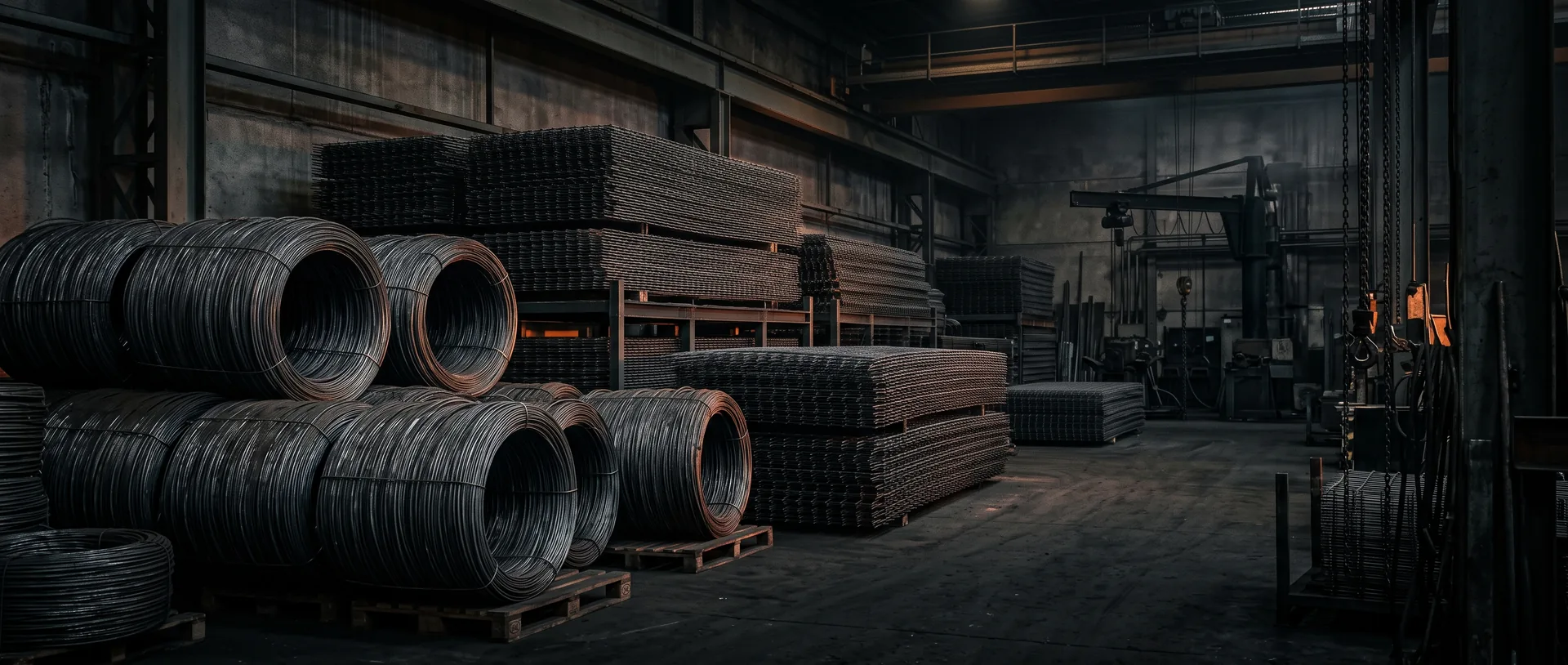
Mesh & rebar designation decoder
What does SL72, A142, 6×6-W2.9 or #4actually mean — and what's the nearest code in another region? Pick a common one, or ask about any designation.
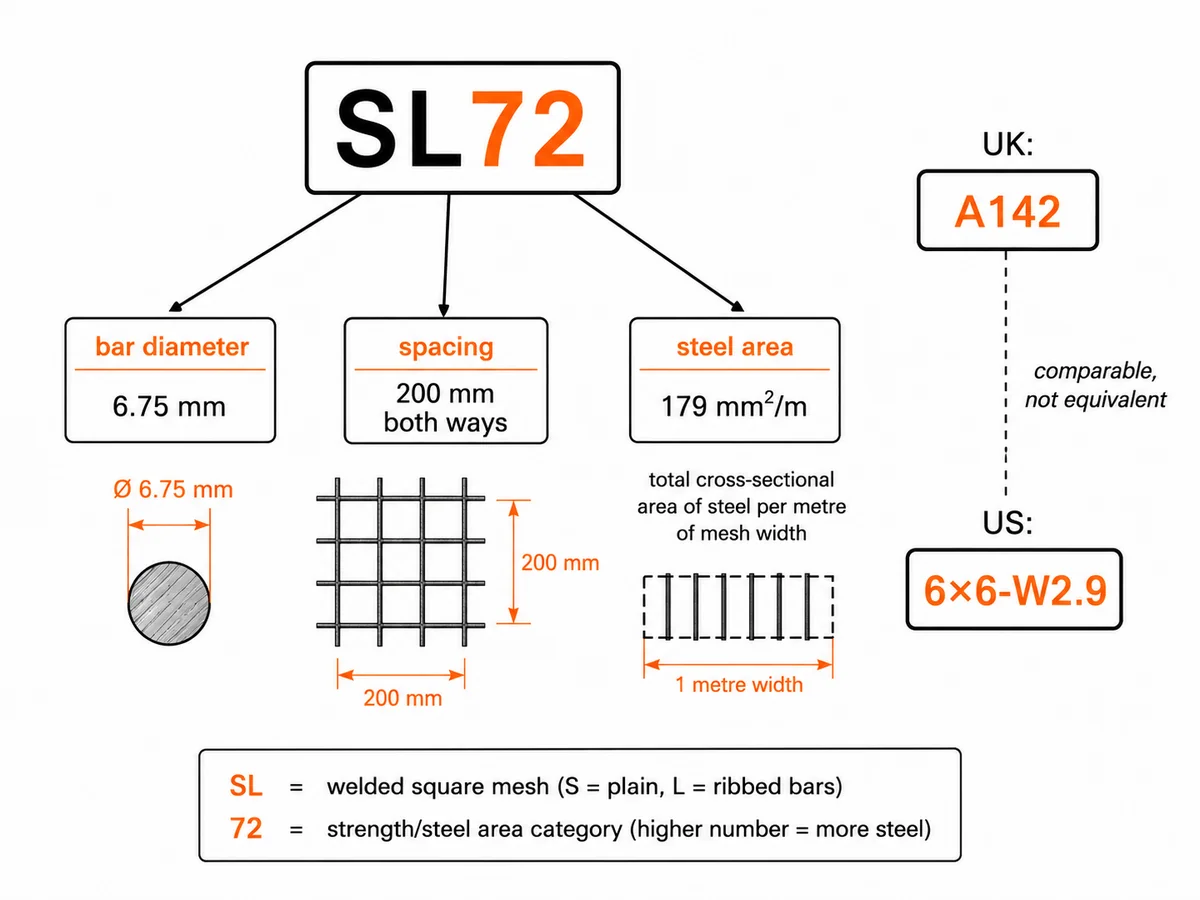
Ask Leeter AI ↓Square mesh — 6.75 mm bars at 200 mm both ways · 179 mm²/m · 2.81 kg/m² · sheet 6.0×2.4 m
Cross-region: ≈ UK A193 (comparable steel area — not officially equivalent)
How this is calculated
- 1Three national systems, three encodings
AS/NZS 4671 (AU/NZ) SL/RL: S = square pitch, R = rectangular, and the trailing L = Grade 500L ductility; the number is a catalogue code that loosely tracks wire size (SL72 is 6.75 mm, not 7.2). BS 4483 (UK/EU) A/B/C: the most self-describing — the number IS the main steel area in mm²/m (A142 = 142 mm²/m). ASTM A1064 (US) spacing×spacing–W/D: W = smooth, D = deformed, and the number = wire area in hundredths of a square inch (6×6-W2.9 = 0.029 in² wire).
- 2Derivation
Every value is reproducible: area per metre A = (π/4)·d²×(1000/pitch) mm²/m, and areal mass = A×7.85×(directions)/1000 kg/m². Check: SL72 → (π/4)·6.75² = 35.8 mm², ×5/m = 179 mm²/m, ×7.85×2 = 2.81 kg/m².
- 3US bar sizes
#n = n/8 inch nominal diameter — but only for #3–#8 (#4 = ½ in = 12.7 mm). #9–#18 break the rule and are defined by area, a common professional gotcha the tool now flags.
- 4Comparable, not equivalent
A cross-region match aligns steel area per metre only; it does not transfer the grade, ductility class, weldability or code acceptance — the three standards use different grades (AS/NZS 500L, BS 500A/B/C, ASTM 65–80 ksi) and test methods. SL62 (141 mm²/m) vs A142 (142 mm²/m) match within 1% yet are not interchangeable on a stamped drawing. Confirm the governing standard from your drawings.
Leeter provides the tool, not a warranty of the result. Every figure above is a planning estimate for reference only — confirm structural, code and customs decisions with your engineer, inspector or broker.


From estimate to firm quote
These tools size the job. Send us the spec and we'll price the material, packing and lead time.