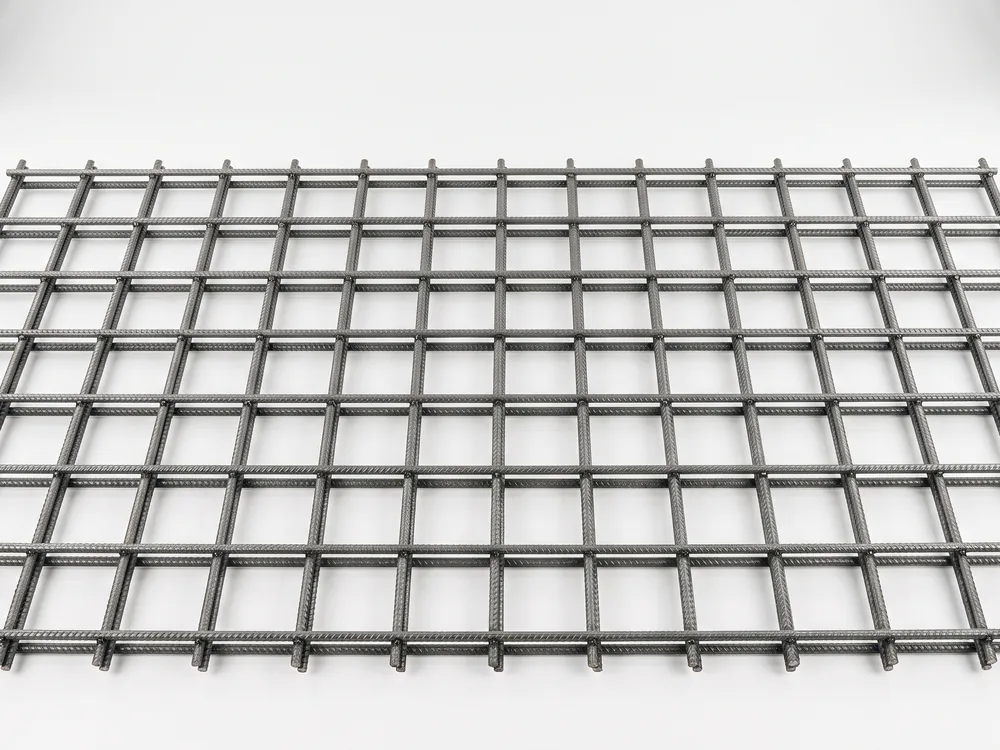
We are Hebei Leeter Import and Export Co., Ltd ("Leeter"), a concrete reinforcing mesh manufacturer in Dingzhou, Hebei, exporting since 2006 to all three of these markets — so we build to whichever designation your drawings use. For the choice between mesh and loose bar, see reinforcing mesh vs rebar; this page is the designation reference.
Australia & New Zealand — AS/NZS 4671
Standard sheet is 6.0 m × 2.4 m (14.4 m²). Square "SL" mesh has equal bars both ways; rectangular "RL" mesh has heavy main bars at 100 mm with a constant light cross wire.
SL square mesh
| Code | Bar dia | Pitch (both ways) | Steel area (mm²/m) | Mass (kg/m²) | Mass / sheet |
|---|---|---|---|---|---|
| SL52 | 4.75 mm | 200 mm | 89 | 1.40 | ~22 kg |
| SL62 | 6.0 mm | 200 mm | 141 | 2.22 | ~33 kg |
| SL72 | 6.75 mm | 200 mm | 179 | 2.81 | ~41 kg |
| SL81 | 7.6 mm | 100 mm | 454 | 7.13 | ~105 kg |
| SL82 | 7.6 mm | 200 mm | 227 | 3.56 | ~52 kg |
| SL92 | 8.6 mm | 200 mm | 290 | 4.55 | ~66 kg |
| SL102 | 9.5 mm | 200 mm | 354 | 5.56 | ~80 kg |
The code digit is a rounded label, not the exact wire: SL72 is 6.75 mm, not 7 mm, and SL92/SL102 are 8.6/9.5 mm. Note SL81 is the only 100 mm-pitch member — don't assume 200 mm across the board.
RL rectangular mesh
The main bars sit at 100 mm; the cross wire is a constant 7.6 mm at 200 mm on every RL size — it is there for crack control and handling, not primary strength.
| Code | Main bar dia @100 | Main area (mm²/m) | Mass (kg/m²) | Mass / sheet |
|---|---|---|---|---|
| RL718 | 6.75 mm | 358 | 4.59 | ~68 kg |
| RL818 | 7.6 mm | 454 | 5.35 | ~79 kg |
| RL918 | 8.55 mm | 574 | 6.29 | ~93 kg |
| RL1018 | 9.5 mm | 709 | 7.35 | ~109 kg |
| RL1118 | 10.65 mm | 890 | 8.77 | ~131 kg |
| RL1218 | 11.9 mm | 1112 | 10.51 | ~157 kg |
Narrow trench mesh (L8TM, L11TM, L12TM — 7.6/10.65/11.9 mm main bars) is sold as 200–400 mm strips for footings and beams, so its mass is per strip, not per sheet.
UK & Europe — BS 4483
Standard sheet is 4.8 m × 2.4 m (11.52 m²). The key fact: the designation number is the main steel area in mm²/m — A142 is 142 mm²/m, B785 is 785 mm²/m.
A series (square)
| Code | Wire dia | Pitch | Area each way (mm²/m) | Mass (kg/m²) | Mass / sheet |
|---|---|---|---|---|---|
| A98 | 5 mm | 200 mm | 98 | 1.54 | ~17.7 kg |
| A142 | 6 mm | 200 mm | 142 | 2.22 | ~25.6 kg |
| A193 | 7 mm | 200 mm | 193 | 3.02 | ~34.8 kg |
| A252 | 8 mm | 200 mm | 252 | 3.95 | ~45.5 kg |
| A393 | 10 mm | 200 mm | 393 | 6.16 | ~71.0 kg |
B series (structural, rectangular)
| Code | Main dia @100 | Main area (mm²/m) | Cross dia @200 | Mass (kg/m²) |
|---|---|---|---|---|
| B196 | 5 mm | 196 | 7 mm | 3.05 |
| B283 | 6 mm | 283 | 7 mm | 3.73 |
| B385 | 7 mm | 385 | 7 mm | 4.53 |
| B503 | 8 mm | 503 | 8 mm | 5.93 |
| B785 | 10 mm | 785 | 8 mm | 8.14 |
| B1131 | 12 mm | 1131 | 8 mm | 10.90 |
The C series (long mesh, C283–C785) carries heavy main bars at 100 mm with a light cross wire at 400 mm, for one-way spanning.
United States — ASTM A1064 (WWR)
US welded wire reinforcement uses the style spacing × spacing – W/D × W/D, e.g. 6×6 – W2.9×W2.9:
- W = smooth wire, D = deformed wire.
- The number is the wire's cross-sectional area in hundredths of a square inch — W2.9 = 0.029 in², D4 = 0.040 in² deformed.
| Style (ASTM A1064) | Spacing | Steel area each way (in²/ft) | Approx. weight (lb / 100 ft²) |
|---|---|---|---|
| 6×6 – W1.4×W1.4 | 6″ | 0.028 | ~21 |
| 6×6 – W2.1×W2.1 | 6″ | 0.042 | ~30 |
| 6×6 – W2.9×W2.9 | 6″ | 0.058 | ~42 |
| 6×6 – W4.0×W4.0 | 6″ | 0.080 | ~58 |
| 4×4 – W2.9×W2.9 | 4″ | 0.087 | ~62 |
| 4×4 – W4.0×W4.0 | 4″ | 0.120 | ~85 |
Lighter styles ship in rolls (typically 5 ft × 150 ft); heavier styles come as flat sheets (5′×10′, 7′×20′, 8′×20′).
Old gauge callout → new W-number
You will still see the obsolete style spacing × spacing – gauge × gauge (e.g. 6×6 – 10×10). The last two numbers are steel-wire gauge, where a higher number is thinner wire — the inverse of the W-number. The mapping:
| Old style | New (ASTM A1064) |
|---|---|
| 6×6 – 10×10 | 6×6 – W1.4×W1.4 |
| 6×6 – 8×8 | 6×6 – W2.0/W2.1 |
| 6×6 – 6×6 | 6×6 – W2.9×W2.9 |
| 6×6 – 4×4 | 6×6 – W4.0×W4.0 |
| 4×4 – 10×10 | 4×4 – W1.4×W1.4 |
| 4×4 – 6×6 | 4×4 – W2.9×W2.9 |
The "6×6-10/10" callout on its own is ambiguous and technically obsolete — always pair it with the W-number on a submittal.
Common mistakes to avoid
- Confusing AU "SL" with UK "A". SL72 (179 mm²/m) is not A142 or A193 — different standards, and the number means different things (AU ≈ diameter + pitch; UK = steel area).
- Reading the designation as mass. A393 is 393 mm²/m of area but 6.16 kg/m² of mass; SL72 is 179 mm²/m but 2.81 kg/m². The number is area, never weight.
- Assuming the digit is the exact diameter. SL72 is 6.75 mm, not 7 mm.
- Swapping sheet sizes. AU is 6.0 × 2.4 m; UK is 4.8 × 2.4 m; the US uses rolls or flat sheets with no single standard.
- Quoting the old gauge callout without the W-number, or reading the gauge pair as spacing.
Ordering reinforcing mesh for export
- Give the designation and the standard (e.g. "SL72 to AS/NZS 4671" or "A142 to BS 4483" or "6×6-W2.9 to ASTM A1064"), plus sheet size and quantity — the code alone is ambiguous across regions.
- State bar diameter and pitch in millimetres as a cross-check, since the code digit is rounded.
- Confirm the finish (bare, galvanized or epoxy) and whether you need sheets or rolls; to convert a designation to shipment weight, our mesh weight calculation guide shows the method.
As the manufacturer we produce reinforcing mesh to AS/NZS 4671 (SL/RL), BS 4483 (A/B/C) and ASTM A1064 (W/D), in standard and cut sheet sizes, bare or coated — send the designation, standard and sheet size and we confirm the wire diameter and mass before production.
Frequently asked questions
What does SL72 mesh mean?
SL72 is an Australian/New Zealand square reinforcing mesh (AS/NZS 4671) with 6.75 mm bars at 200 mm spacing both ways — a steel area of 179 mm²/m and a mass of 2.81 kg/m², or about 41 kg for a standard 6.0 × 2.4 m sheet. The "72" is a rounded label for the bar and pitch, not an exact 7 mm wire; the actual diameter is 6.75 mm.
What is A142 mesh and how much does it weigh?
A142 is a UK/European square mesh (BS 4483) made of 6 mm wire at 200 mm spacing, giving a steel area of 142 mm²/m — which is exactly what the "142" means. It weighs 2.22 kg/m², or about 25.6 kg for a standard 4.8 × 2.4 m sheet. In BS 4483 the designation number always equals the main steel area in mm²/m.
How much does 6×6 welded wire mesh weigh?
It depends on the wire size, which the W-number gives. A 6×6 mesh weighs about 21 lb per 100 ft² in W1.4 (old 10-gauge), about 42 lb in W2.9 (old 6-gauge), and about 58 lb in W4.0. "6×6" alone only sets the spacing — you must also state the W-number or old gauge to fix the weight.
What does W mean in welded wire reinforcement?
In ASTM A1064, W means a smooth (plain) wire and D means a deformed wire, and the number is the wire's cross-sectional area in hundredths of a square inch — so W2.9 is 0.029 in² and D4 is 0.040 in² deformed. It replaced the old steel-wire-gauge callout, where a higher gauge number meant thinner wire.
Are SL, A and W/D mesh interchangeable?
No. They are three separate standards — AS/NZS 4671 (SL/RL), BS 4483 (A/B/C) and ASTM A1064 (W/D) — with different sheet sizes and different meanings for the code. SL72 is not the same as A193 or a US W-style, even where the steel areas look similar. Always specify the designation together with its standard so the mesh is built correctly.
Sources
- Mesh & Bar (AU, ACRS-certified) — SL/RL reinforcing mesh table
- Bestbar (AU) — reinforcing mesh sizes and sheet dimensions
- Rainham Reinforcement (UK) — BS 4483 A/B/C fabric table
- Wire Reinforcement Institute — W/D system and style weights
- Mid Continent Steel & Wire — reading welded wire mesh sizes (old-to-new mapping)
