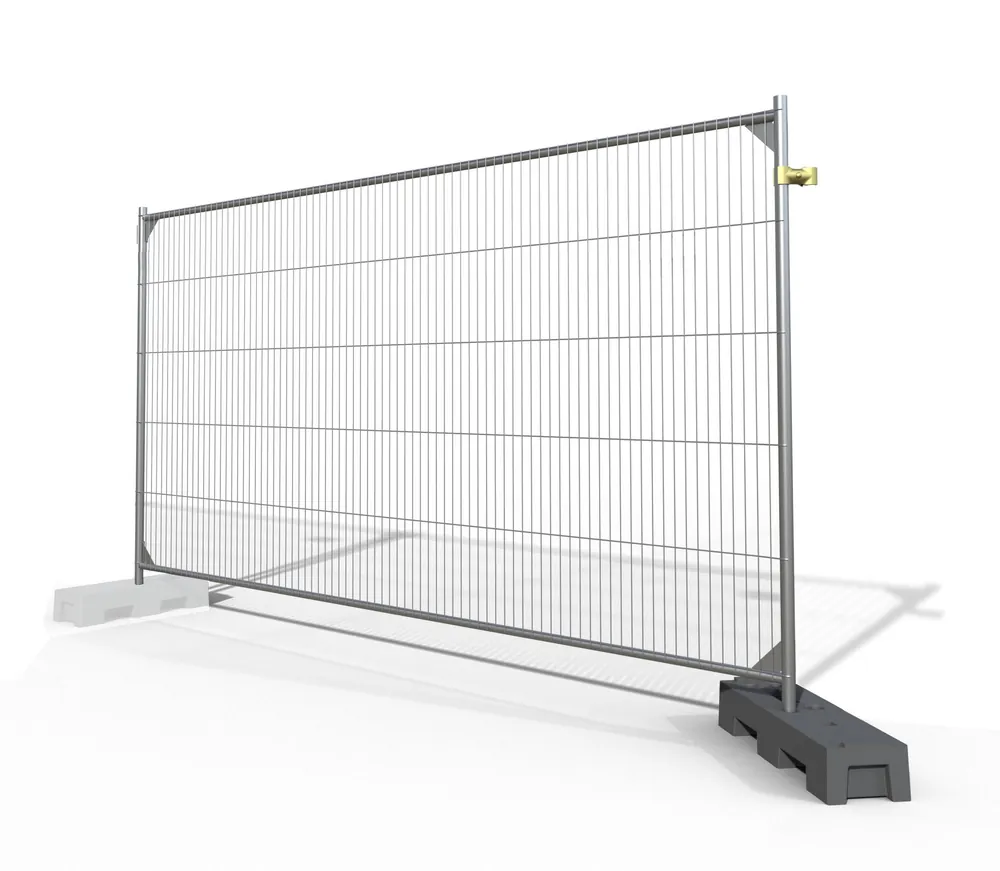
We are Hebei Leeter Import and Export Co., Ltd ("Leeter"), a construction wire, mesh and fencing manufacturer in Dingzhou, Hebei, China, exporting since 2006 to buyers across North America and Europe. Because we build to order, panel height, length, wire gauge and mesh opening are all specified on your PO rather than fixed to one regional standard.
Standard panel heights and lengths
Most temporary fence panels ship in a small set of stock dimensions. The table below shows the metric sizes we run most often as a manufacturer and supplier, with imperial equivalents for US and Canadian buyers.
| Height (m) | Height (ft) | Length (m) | Length (ft) | Typical use |
|---|---|---|---|---|
| 1.0 | 3.3 | 2.5 | 8.2 | Low crowd/pedestrian barrier |
| 1.2 | 3.9 | 2.5 | 8.2 | Event and pathway control |
| 1.5 | 4.9 | 3.0 | 9.8 | General site perimeter |
| 1.8 | 5.9 | 2.9 | 9.5 | US "6×9.5" construction panel |
| 2.0 | 6.6 | 3.5 | 11.5 | UK/Europe Heras-style panel |
| 2.1 | 6.9 | 2.4 | 7.9 | Australia temp fencing standard |
For bulk and container orders, most importers pick one or two heights and standardize the rest of the hardware around them. That keeps clamps, couplers and feet interchangeable across the whole fleet.
Mesh openings and wire gauge options
Two frame styles cover almost all demand: welded mesh and chain-link (woven) mesh. Both mount into the same tube frames, so the choice is about security, visibility and cost rather than panel size.
| Panel type | Wire diameter | Common mesh openings |
|---|---|---|
| Welded mesh temporary fence | 2.5–6.0 mm (0.10–0.24 in) | 50×100 mm, 75×150 mm, 80×160 mm |
| Chain-link temporary fence | 1.5–4.0 mm (0.06–0.16 in) | 50×50 mm, 60×60 mm, 70×70 mm |
Heavier 4.0–6.0 mm welded wire gives a rigid, anti-climb panel favored on long-term construction sites, while 2.5–3.0 mm keeps weight and cost down for events. For a permanent perimeter rather than a movable one, the same welded-wire approach scales up into 3D welded mesh fence panels with pressed V-bends and peach or square posts. Surface finish options include electro-galvanized, hot-dip galvanized, powder-sprayed and PVC/PE dip-coated, in green, blue or white. Our welded mesh temporary fence and chain-link temporary fence share the same frame tooling, so you can mix panel types in one container.
Regional size differences: US vs Australia vs UK
The biggest source of confusion for buyers is that every region names and sizes these panels differently:
- US and Canada call them "temporary fence panels" or "construction fence panels." The two dominant sizes are 6 ft × 9.5 ft (1.83 × 2.90 m) and 6 ft × 12 ft (1.83 × 3.66 m), usually chain-link on a round tube frame.
- Australia uses "temp fencing," standardized at 2.1 m × 2.4 m (6.9 × 7.9 ft), often welded or chain-link, with a clamp joining every pair of panels.
- UK and Europe use "Heras fencing" (a genericized brand name) at roughly 2.0 m × 3.5 m (6.6 × 11.5 ft), typically welded mesh with a round-tube frame and rubber or concrete feet.
Because these are conventions rather than legal standards, an OEM manufacturer can build any of them. When you order wholesale from China, specify the exact height × length in millimetres to avoid a mismatch with your existing bases and couplers.
How to choose the right size
There is no single "temp fence size" — the right temporary fence size depends on the job, the ground and how your crew handles the panels. Match panel size to those first. Taller 2.0–2.1 m panels with heavy welded wire suit secure construction perimeters; lighter 1.2–1.8 m panels suit crowd control and events where staff reposition them by hand. Longer 3.5 m panels cover ground faster and cut the number of feet and clamps per run, but weigh more and pack fewer units per pallet. On a mixed container, keep to one or two heights so bases, clamps and couplers stay universal.
Frequently asked questions
What are the standard sizes of temporary fence panels?
The common standards are US/Canada 6 ft × 9.5 ft (1.83 × 2.90 m) and 6 ft × 12 ft (1.83 × 3.66 m), Australia 2.1 m × 2.4 m (6.9 × 7.9 ft), and UK/Europe Heras-style 2.0 m × 3.5 m (6.6 × 11.5 ft). In metric production, heights run 1.0–2.0 m and lengths 2.0–3.0 m, and a manufacturer can build to any of these on request.
How tall is a temporary fence panel?
Most temporary fence panels stand about 2.0–2.1 m (6.5–6.9 ft) tall, which is the typical anti-climb height for construction and event perimeters. Shorter options at 1.0–1.5 m (3.3–4.9 ft) are used for pedestrian and crowd control where a full-height barrier is not needed.
What size are Heras fence panels?
"Heras" panels — the UK/European term for temporary welded mesh fencing — are approximately 2.0 m tall by 3.5 m wide (6.6 × 11.5 ft), mounted on a round-tube frame with rubber or concrete feet. The name is a genericized brand, so any OEM supplier can manufacture panels to those dimensions; confirm the exact height and length in millimetres on your order.
What is the standard temp fence size?
There is no single global standard temp fence size — it is set by region. The US standard temporary fence size is 6 ft × 9.5 ft or 6 ft × 12 ft, Australia's is 2.1 m × 2.4 m, and the UK/Europe "Heras" standard is about 2.0 m × 3.5 m. In metric production, heights run 1.0–2.0 m and lengths 2.0–3.5 m, and a manufacturer can build to any of these.
What is a standard temporary fencing panel?
A standard temporary fencing panel is a free-standing welded (or chain-link) mesh panel that drops into a portable concrete or plastic foot and clamps to the next panel, with no digging or footings. The most common builds are the US 6 ft × 9.5 ft / 6 ft × 12 ft panel, the Australian 2.1 m × 2.4 m panel and the UK "Heras" 2.0 m × 3.5 m panel, in 2.5–4.0 mm galvanized wire with a 50 × 100 mm or 75 × 150 mm mesh. Our welded mesh temporary fence range supplies the panel, feet and clamps as a matched set.
Can I order custom temporary fence panel sizes for bulk import?
Yes. As a manufacturer we build panel height, length, wire diameter, mesh opening and coating to your specification. For wholesale container orders, standardizing on one or two sizes keeps hardware interchangeable and simplifies freight planning.
For the full picture beyond size — standards (AS 4687, ASTM F3342), galvanizing, wind and ballast, and how to vet a supplier — see our temporary fencing panel specifications guide.
