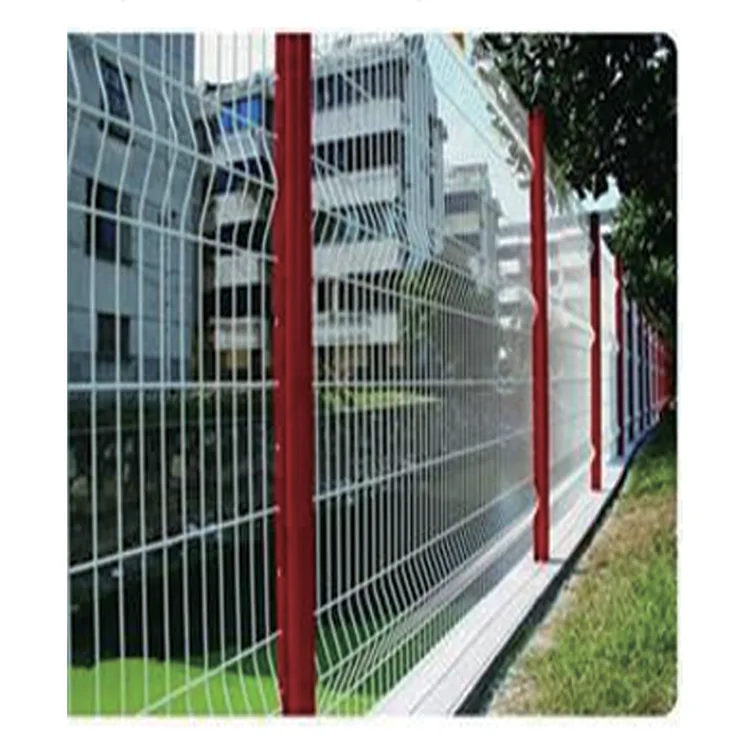
We are Hebei Leeter Import and Export Co., Ltd ("Leeter"), a wire, mesh and fencing manufacturer in Dingzhou, Hebei, China, exporting since 2006 to buyers across North America and Europe. 3D panels — also sold as "curvy welded fence," "V mesh" or "wire wall panels" — are one of our core permanent fencing lines alongside field fence and chain link fence.
What makes a fence panel "3D"
A 3D panel starts as a flat sheet of welded wire mesh, then passes through a press that folds two to four horizontal V-shaped ribs (also called curves or bends) across the full panel width. Those folds do two jobs. First, they act like corrugation in sheet steel: a folded panel resists bending and climbing loads far better than a flat panel of the same wire diameter, which is why a 4.0mm 3D panel can replace a heavier flat panel in many perimeter jobs. Second, the folds give the fence its recognizable architectural look, which is why 3D panels dominate European residential, school, park and light-industrial perimeters and are gaining share in North America.
Taller panels get more folds: a 1.2m panel typically carries two V-folds, a 1.7m or 2.0m panel three, and a 2.5m panel four. If your market has a preference, specify the fold count when you request a quote.
Wire diameter and mesh size options
Wire diameter is the main price and strength lever. We weld 3D panels from 3.0mm up to 7.0mm wire, and roughly nine out of ten container orders land on 4.0mm or 5.0mm — 4.0mm (0.16 in) for residential and landscape resale, 5.0mm (0.20 in) for commercial and light-security perimeters. Heavier 6.0–7.0mm wire is quoted for utility yards and sites that expect impact or cutting attempts.
| Spec | Options | Most popular |
|---|---|---|
| Wire diameter | 3.0–7.0mm (0.12–0.28 in) | 4.0mm and 5.0mm |
| Mesh apertures | 50x100, 50x150, 50x200, 60x100, 60x200, 75x150, 75x200mm | 50x200 and 75x150mm |
| Panel heights | 1.0 / 1.2 / 1.5 / 1.7 / 1.8 / 2.0 / 2.5m | 1.2m, 1.8m, 2.0m |
| Panel widths | 2.0m or 2.5m | 2.5m |
| V-folds per panel | 2–4 depending on height | — |
Mesh choice follows the market. The 50 x 200mm aperture (2 x 8 in) is the classic European 3D fence look with tight 50mm vertical spacing that resists footholds. The 75 x 150mm mesh uses less wire per square meter, so it prices lower — a common choice for landscape and agricultural resale. The 50 x 100mm and 60 x 100mm meshes are denser, stiffer options where a customer wants a more secure or more premium panel.
Heights, widths and what they mean for containers
Standard heights are 1.0, 1.2, 1.5, 1.7, 1.8, 2.0 and 2.5m — in imperial terms roughly 3.3, 4, 5, 5.6, 6, 6.6 and 8.2 ft. Panels ship flat-stacked on pallets, so height directly drives how many panels fit a 20 ft or 40 ft container. As a rule, shorter residential panels (1.0–1.5m) in 4.0mm wire cube out before they weigh out, while 2.0m-plus panels in 5.0mm wire can approach container weight limits once you add posts. Ask us for a stuffing plan per spec; we quote panel count, post count and gross weight together so your landed cost per linear foot is predictable.
The 2.5m width is the volume standard because it covers more run per panel and per clip set. The 2.0m width suits markets with tighter post spacing conventions or where crews handle panels solo.
Finishes and colors
Every 3D panel gets a zinc base layer plus an organic top layer:
- Electro-galvanized + powder-sprayed: the standard export finish. The zinc layer protects the steel, the polyester powder layer adds UV-stable color.
- Hot-dip galvanized + powder-sprayed: a thicker zinc layer for coastal or long-warranty markets, under the same powder top coat.
- PVC or PE dipped: a thick plastic skin over galvanized wire, giving the softest feel and heaviest coating build for wet or roadside environments.
RAL 6005 moss green is the default color and covers most stock programs. Blue and white are regular alternatives, and we match custom RAL colors for branded or municipal projects at reasonable minimums. The same finish system applies to the matching posts so the whole fence line weathers evenly.
Posts and clips
We supply three post profiles, all pre-punched or supplied with clip sets so panels bolt on without site welding:
| Post type | Typical profile | Notes |
|---|---|---|
| Square post | 60x60mm class | The universal choice; simple, strong, easy to pack |
| Rectangular post | 60x40mm class | Flat face toward the panel; economical on steel |
| Peach post | Peach/oval section | Clip-friendly curved face; popular premium look in Europe |
Panels attach with metal or polymer security clips at three to four points per post. Post length runs longer than panel height to allow concrete embedment — typically around 500mm (20 in) in-ground for a 1.8–2.0m fence. If your project uses driven posts instead of concreted ones, our studded T-posts pair with welded mesh for agricultural and temporary lines, though rigid 3D panels are best matched to their own bolted post systems.
Euro fence: the rolled alternative
Where a buyer wants the welded-mesh look at a lower freight and price point, Euro fence — welded wire fence supplied in rolls, usually PVC-coated green — is the workhorse. Because it rolls, it ships denser than rigid panels and installs on simple posts with tie wire.
| Euro fence spec | Options |
|---|---|
| Wire diameter (core/with coating) | 1.7/2.2mm, 2.0/2.5mm, 2.5/3.0mm |
| Mesh sizes | 75x50, 100x50, 100x75, 100x100, 50x60mm |
| Heights | 0.6–2.0m (2–6.6 ft) |
| Roll lengths | 10–25m (33–82 ft) |
Euro fence suits garden centers, hardware retail and rural resale; 3D panels suit contractors and perimeter projects that need rigidity and a flat, architectural face. Many of our distributors stock both from the same container, plus welded wire mesh sheets for construction customers. You can see the full rigid-panel range on our welded fence panels product page.
How to specify a 3D panel order
A complete inquiry has seven lines: wire diameter, mesh aperture, panel height, panel width, finish (zinc type + powder or PVC/PE), color, and post type with clip count. Add your port and target quantity and we return a quote with per-panel weight and container loading. If you are building a stock program rather than supplying one project, start with 4.0mm / 50x200mm / 1.2m and 1.8m heights in RAL 6005 — that combination turns over fastest in both Europe and North America — then add 5.0mm commercial SKUs as demand proves out.
Frequently asked questions
What wire diameter should I choose for 3D fence panels?
Choose 4.0mm for residential, garden and landscape fencing, and 5.0mm for commercial or light-security perimeters — these two diameters cover most import programs. We manufacture from 3.0mm up to 7.0mm, so budget lines can drop to 3.0mm and high-security or impact-exposed sites can step up to 6.0–7.0mm.
What are the standard 3D panel sizes?
Standard panels are 2.0m or 2.5m wide and 1.0, 1.2, 1.5, 1.7, 1.8, 2.0 or 2.5m tall (about 3.3 to 8.2 ft). The most common mesh apertures are 50 x 200mm and 75 x 150mm, with 50x100, 50x150, 60x100, 60x200 and 75x200mm also in regular production.
What is the difference between 3D panels and Euro fence?
Both are welded wire fencing, but 3D panels are rigid pressed panels in heavier 3.0–7.0mm wire that bolt to posts with clips, while Euro fence is lighter welded mesh (1.7–3.0mm coated wire) supplied in 10–25m rolls and tied to posts. Panels give a stiffer, more architectural fence; rolls give lower cost per meter and denser container loading.
What color and coating do 3D fence panels come in?
The standard build is galvanized wire (electro or hot-dip) with a powder-sprayed or PVC/PE-dipped top layer. RAL 6005 green is the default export color, with blue, white and custom RAL colors available. The zinc layer handles corrosion; the organic layer handles UV and appearance.
Which posts fit 3D welded fence panels?
Square, rectangular or peach-profile steel posts, each supplied with clips that clamp the panel edge at several points per post. Peach posts are the premium European look, square posts the universal standard. Posts are finished in the same coating and color as the panels and sized longer than the panel height to allow for embedment.
Are 3D fence panels a good choice for a construction site?
Yes. A 3D panel fence for a construction site perimeter gives rigidity and an anti-climb face that flat mesh or chain link cannot match at the same wire weight. For construction and light-security perimeters, use 5.0mm wire in 2.0m or 2.5m heights with 50 x 200mm mesh — the pressed V-ribs let a 5.0mm 3D panel replace a heavier flat panel. For temporary or rental site perimeters, pair them with our welded mesh temporary fence panels on portable feet.
What is a heavy duty 3D fence panel?
A heavy duty 3D fence panel steps the wire up to 6.0–7.0mm (versus the standard 4.0–5.0mm), with three or four V-bends and closer mesh such as 50 x 100mm or 50 x 150mm, for high-security, industrial and impact-exposed perimeters. Heavier wire and tighter mesh resist cutting and climbing; specify hot-dip galvanizing plus a powder-coat top layer for the longest outdoor service life.
Can I get custom steel mesh fence panel specifications?
Yes. As a manufacturer we build custom steel mesh fence panel specifications to order — wire diameter (3.0–7.0mm), mesh aperture, panel height and width, number of V-bends, finish and RAL color are all set on your PO rather than fixed to one catalog SKU. Send your perimeter length, site type and target port and we return per-panel weight and container loading with the quote.
