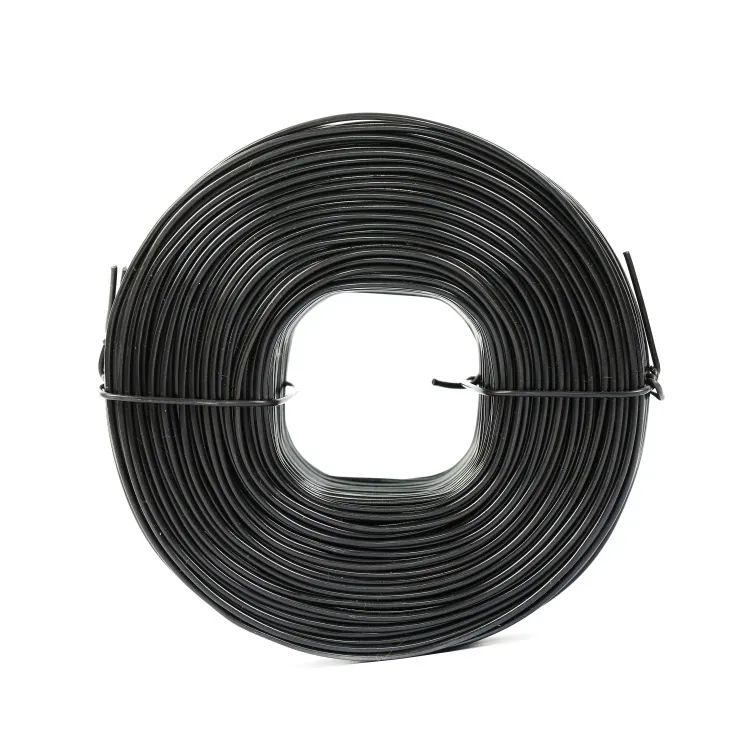
We are Hebei Leeter Import and Export Co., Ltd ("Leeter"), a rebar tie wire manufacturer in Dingzhou, Hebei, exporting since 2006 — our core line is 16 and 16.5 gauge black annealed and galvanized wire. This guide gives the length-per-weight figures crews use to know how long a coil lasts; for coil and spool formats see our tie wire coil weights guide.
The formula
Length per unit weight = 1 ÷ (steel density × cross-sectional area), with steel at 7,850 kg/m³ (0.284 lb/in³) and area = (π/4) × diameter². That reduces to two handy forms:
- Feet per pound = 1 ÷ (2.6766 × d²) with d in inches
- Metres per kg = 162.20 ÷ d² with d in millimetres
For 16 gauge (0.0625" / 1.588 mm): 1 ÷ (2.6766 × 0.0625²) = 95.7 ft/lb, and 162.20 ÷ 1.588² = 64.3 m/kg. Published coils confirm it — a 5 lb coil listed at 479.9 ft is 96.0 ft/lb, and 3.5 lb coils at 330–340 ft work out to 94–97 ft/lb.
Length by gauge
These use the US Steel Wire Gauge (Washburn & Moen) diameters, computed from the formula and corroborated against product coils.
| Gauge (US SWG) | Diameter | Feet per lb | Metres per kg |
|---|---|---|---|
| 14 ga | 0.080" / 2.03 mm | ~58 | ~39 |
| 16 ga | 0.0625" / 1.59 mm | ~96 | ~64 |
| 16.5 ga | 0.058" / 1.47 mm | ~110 | ~74 |
| 17 ga | 0.054" / 1.37 mm | ~128 | ~86 |
| 18 ga | 0.0475" / 1.21 mm | ~166 | ~111 |
The same 3.5 lb hand coil therefore holds very different lengths by gauge: about 204 ft at 14 ga, 335 ft at 16 ga, 390 ft at 16.5 ga, and 580 ft at 18 ga.
The 16.5-gauge trap
"16.5 gauge" is sold two ways and they differ by about 13%. A true half-step between W&M 16 and 17 is about 0.058" / 1.47 mm (≈110 ft/lb — the common US spec, e.g. a 3.5 lb coil at ~390 ft). But an imported metric wire labelled 1.57 mm is really closer to full 16 gauge (≈98 ft/lb). Confirm the actual diameter in millimetres rather than trusting the "16.5" label.
Mind the gauge system
The diameters above are US Steel Wire Gauge. A Birmingham Wire Gauge (BWG/Stubs) chart lists 16 ga as 0.065", 17 as 0.058", 18 as 0.049" — different numbers for the "same" gauge, and AWG differs again (16 = 0.0508"). Using the wrong table throws the feet-per-pound off. Our tie wire gauge comparison sets the systems side by side.
How many ties per pound and per coil
A single rebar tie uses roughly 6–9 inches (0.5–0.75 ft) of wire — the low end for a snap tie on small bar, the high end for a saddle or wrap tie on #5 and larger. Dividing the feet-per-pound by the per-tie length:
| Gauge | Feet per lb | Ties per lb (0.5 → 0.75 ft) |
|---|---|---|
| 16 ga | ~96 | ~128 – 191 |
| 17 ga | ~128 | ~171 – 256 |
Per standard hand coil at 16 gauge:
- 1.5 lb coil (~143 ft) → about 190–290 ties
- 3.5 lb coil (~335 ft) → about 450–670 ties
- A 3.5 lb coil of thinner 16.5 ga (~385 ft) → about 510–770 ties
The range is wide because it is driven by the per-tie length, so always state your assumption. As a field rule, one 3.5 lb / 16 ga coil ties out in roughly a half-day per tier for one worker. To size the whole job rather than one coil, use our tie wire per ton of rebar guide.
Coating changes the count
The figures above are for bare black annealed wire, the baseline. Galvanizing adds only a thin zinc layer, so the length change is negligible. PVC coating is different: the plastic jacket adds both diameter and weight, so a coated coil holds noticeably fewer feet per pound than the bare-steel calculation, and part of the coil weight is plastic, not steel. Always quote feet-per-pound against the steel core gauge and note whether the wire is coated.
Buying tie wire by length
- Specify the gauge and the actual wire diameter in millimetres, not just a coil weight — a 3.5 lb coil can be 204 ft or 580 ft depending on gauge.
- State the coating (black annealed, galvanized, PVC) so the feet-per-pound is quoted against the steel core, not the finished OD.
- Match coil weight to the crew — 1.5 lb and 3.5 lb hand coils for reach and belt use, bulk spools for volume — and use the ties-per-coil figures above to plan restocking.
As the manufacturer we supply 16 and 16.5 gauge (and 14–18 on request) black annealed, galvanized and PVC-coated tie wire in 1.5 lb, 3.5 lb and bulk coils — tell us the gauge, coating and coil weight and we will confirm the exact feet-per-coil before production.
Frequently asked questions
How many feet of tie wire are in a pound?
About 96 feet per pound for 16 gauge wire (roughly 64 metres per kilogram). Thinner wire holds much more — about 110 ft/lb at 16.5 ga, 128 at 17 ga and 166 at 18 ga — while heavier 14 ga holds only about 58 ft/lb. Because length scales with one over the diameter squared, always state the gauge when quoting feet per pound.
How much tie wire is in a 3.5 lb coil?
About 330–340 feet (roughly 100–104 m) for a 16 gauge coil, and about 390 ft for a thinner 16.5 gauge coil. A 1.5 lb coil of 16 gauge holds about 143 ft. The exact length depends on the gauge — a 3.5 lb coil ranges from around 204 ft in heavy 14 gauge to about 580 ft in thin 18 gauge.
How many ties can I get from a coil of tie wire?
Roughly 450–670 ties from a 3.5 lb coil of 16 gauge, and about 190–290 ties from a 1.5 lb coil, assuming each tie uses 6–9 inches of wire. Snap ties on small bar use the least wire; saddle and wrap ties on larger bar use the most, so state the per-tie length when you estimate.
How do I convert tie wire feet per pound to metres per kg?
Use metres per kg = 162.20 ÷ (diameter in mm)², or simply multiply feet-per-pound by about 0.672. For 16 gauge that is 96 ft/lb ≈ 64 m/kg. Both come from the same physics — steel density times the wire's cross-sectional area — so the diameter, not the gauge label, drives the answer.
Does the gauge number mean the same thing on every chart?
No. Tie wire length depends on the actual diameter, and gauge systems disagree: US Steel Wire Gauge 16 is 0.0625", but Birmingham Wire Gauge 16 is 0.065" and AWG 16 is 0.0508". A "16 gauge" wire can differ by system, and "16.5 gauge" is sold as both 1.47 mm and 1.57 mm. Confirm the diameter in millimetres to get the feet-per-pound right.
