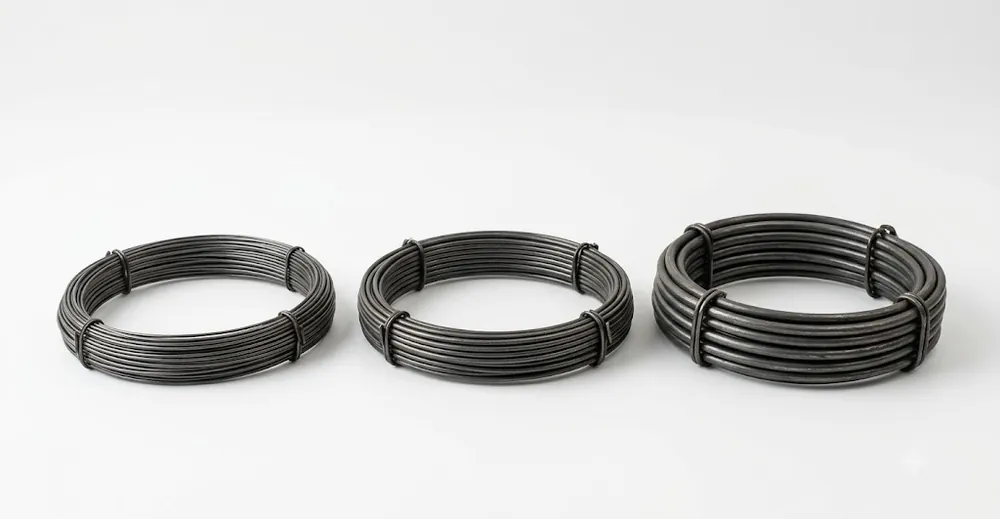
We are Hebei Leeter Import and Export Co., Ltd, a manufacturer in Dingzhou, Hebei that has produced construction wire since 2006. We ship rebar tie wire to jobsites across North America and Europe, and the gauge question lands in our inbox almost every week. This guide gives you the working logic our own estimators use.
What does tie wire gauge actually measure?
Gauge is a diameter reference, and lower numbers mean thicker wire. That inversion trips up first-time buyers, so it is worth stating plainly. A 16-gauge wire is thicker and stronger than an 18-gauge wire, even though 18 is the bigger number. The three gauges we ship most for rebar work sit close together in millimeters but behave very differently in the hand.
Here is the quick reference we keep taped to the sample bench:
| Gauge | Diameter (mm) | Diameter (inch) | Typical use |
|---|---|---|---|
| 16GA | 1.6 mm | 0.063 in | Hand-tying #4 and larger bar, structural intersections, walls and columns |
| 16.5GA | 1.47 mm | 0.058 in | General hand tying, the common all-round choice |
| 18GA | 1.22 mm | 0.048 in | Hand-tying light mesh, slab-on-grade, high tie counts |
Those diameters are the annealed wire body, before any PVC or poly coating. If you buy coated wire, the coating adds roughly 0.1 to 0.2 mm to the outside dimension, which changes the feel in the hand but not the holding strength. Holding strength lives in the steel core.
Which gauge for which bar size?
Bar size is the first filter, because a heavier bar wants a tie that resists springback while you twist. As a rule of thumb from our shipping data and customer feedback: tie #3 and #4 bar with 16.5GA or 18GA, tie #5 and #6 bar with 16GA or 16.5GA, and reach for 16GA on #7 and larger where the joint carries real load and the crew is tying by hand.
The logic is mechanical, not marketing. A thicker wire fights back harder during the twist, which is exactly what you want against a stiff #8 bar that resists being pulled snug. On light #3 mesh, that same stiffness becomes a fight the crew loses hundreds of times a day, and hands cramp by lunch. So the correct answer flips depending on where you stand on the slab.
Two honest caveats. First, coating and cut length change the feel as much as gauge does; a 6-inch pre-cut in 18GA ties very differently from an 8-inch loop in the same gauge. Second, local inspection practice sometimes specifies a minimum gauge for structural ties regardless of bar size. Always read the spec before you read this table.
Should you tie by hand or by tool?
Tie method may decide the gauge more than bar size does. Hand-tying crews generally prefer 16GA or 16.5GA because the extra body gives a firm, twist-and-hold feel that stays tight under a boot, with 18GA reserved for light mesh. Battery-powered rebar tiers such as the MAX RB series and Makita are built around much thinner wire on dedicated level-wound reels, typically 19 to 21 gauge (0.8 to 1.0 mm); none of the hand-tie gauges on this page, 16GA, 16.5GA or 18GA, are compatible with those tools. Feed a tool the wrong wire and you get jams, half-twists and wasted wire.
If your crew runs auto-tie tools, buy the wire the tool is engineered for. We have watched buyers save a few cents per pound on a heavier coil, then lose an afternoon to feed jams and burned motors. That is a bad trade. The tool's throughput is worth far more than the wire spread.
For mixed crews, the practical move is to stock two products: tool-spec 19 to 21GA (0.8 to 1.0 mm) reels for the tier operators and a hand-tie gauge for the finishers and patch work. For the hand-tie side, 16.5GA is the compromise most general contractors settle on, and it is the gauge we ship in the largest volume.
How much does gauge change holding strength?
Holding strength scales with the cross-sectional area of the steel, and area grows with the square of the diameter. That is the number most buyers underestimate. Step from 1.22 mm (18GA) up to 1.6 mm (16GA) and the wire's cross-section increases by roughly 70 percent, so a single 16GA tie resists pull-apart far more firmly than a single 18GA tie, not just a little more.
Annealing state matters alongside diameter. Soft annealed black wire twists easily and locks tight, which is why it dominates hand-tie work. Fully hardened wire holds more load per strand but resists the twist, so it shows up mostly in specialty and pre-formed loop ties. When we quote a gauge, we also quote the temper, because the two together decide how the tie behaves on the bar.
One field reality worth stating: on most flatwork the tie is not a structural connection, it just holds bars in position for the pour. In that case 18GA is plenty and the speed gain is the real prize. Save the 16GA for the joints where movement during the pour would actually pull the cage out of tolerance.
How does gauge affect cost and ties per pound?
Thinner wire gives you dramatically more ties per pound, which is the lever that controls your consumables budget. Because weight per foot scales with the square of diameter, a pound of 18GA wire contains far more length, and therefore far more ties, than a pound of 16GA at the same tie length. On a high-volume slab, that difference compounds fast across a full crew and a full week.
Run the math on your own tie length before you order. Take your standard cut length, divide the coil or reel length by it, and you have ties per unit. We publish coil weights and lengths on each product page so buyers can model this without guessing. If you are comparing two quotes, compare cost per thousand ties, not cost per pound, or you will pick the wrong winner.
The other cost hidden in gauge choice is labor. Faster tying with lighter wire and a tool can cut tie time per intersection substantially, and labor usually dwarfs wire cost on a job. So the cheapest wire per pound is rarely the cheapest wire per finished cage. Weigh both.
What about coating, coil format and reels?
Format decides whether the gauge you chose actually performs. Hand-tie gauges like 16GA, 16.5GA and 18GA come as bulk coils and as pre-cut single loops for hand work, while auto-tie tools take their own purpose-wound 19 to 21GA (0.8 to 1.0 mm) reels. Buy the format that matches your method, or the gauge advantage disappears in handling waste and rework.
For tool crews, the wire has to match both the tool's gauge spec and its spool geometry. Our tie wire reels and coil options are wound to standard tool dimensions so operators are not fighting the feed. For hand crews, pre-cut lengths in the right gauge remove the cutting step entirely and keep tie length consistent across the team, which also keeps your ties-per-pound math honest.
Coating is a durability and corrosion choice layered on top of gauge. Black annealed is the default for interior and short-exposure work. PVC or galvanized coatings add corrosion resistance for exposed or coastal jobs, at a higher price and a slightly larger feed diameter. Pick the gauge first for strength and speed, then pick the coating for the environment.
A quick decision path
Start with the tie method, then the bar, then the environment. If you run battery tiers, buy the tool's spec reel, usually 19 to 21GA (0.8 to 1.0 mm), and stop there. If you hand-tie structural bar #5 and up, default to 16GA. For everything in between, 16.5GA is the safe standard, and it is why we keep the deepest inventory in that gauge.
When a buyer is genuinely unsure, we ask three questions: what bar sizes dominate the job, is the crew on tools or tying by hand, and is corrosion a factor. Those answers point to a gauge and a coating almost every time. If your job mixes all three conditions, stock two gauges rather than forcing one to cover work it was never meant to do.
Frequently asked questions
Is 16 gauge or 18 gauge tie wire stronger?
16 gauge is stronger because it is thicker: 1.6 mm versus 1.22 mm. The extra diameter gives roughly 70 percent more steel cross-section, so a single 16GA tie resists pull-apart much more firmly. Choose 18GA only when speed and tie count matter more than raw holding strength.
What gauge tie wire do battery rebar tiers use?
Most battery-powered rebar tiers, including the MAX RB series and Makita models, run dedicated 19 to 21 gauge (0.8 to 1.0 mm) wire on purpose-wound reels. Hand-tie coils in 16GA, 16.5GA or 18GA are not compatible and cause feed jams, half-twists and wasted wire. Check your tool manual, then order the reel format wound for that tool.
What is 16.5 gauge tie wire used for?
16.5GA (1.47 mm) is the all-round middle option that many general contractors standardize on. It hand-ties comfortably and suits #4 through #6 bar. If you want to stock a single hand-tie gauge for mixed work, 16.5GA is the most common choice and the one we ship in the highest volume.
How many ties are in a pound of tie wire?
It depends on gauge and cut length, not just weight. Thinner 18GA wire yields far more length and ties per pound than 16GA at the same tie length, because weight scales with the square of diameter. Divide your coil length by your standard cut length to get an exact count for your job.
Does coated tie wire hold rebar as well as black wire?
Yes. Holding strength comes from the steel core, so PVC or galvanized coating does not reduce it; the coating only adds corrosion resistance and a slightly larger outside diameter. Match the core gauge for strength, then choose the coating for the exposure your job faces.
Need help matching gauge, temper and coating to your bar schedule and tie method? Tell us your bar sizes, whether your crew tools or hand-ties, and your corrosion exposure, and we will spec the right wire and format. Request a quote and we will get you sample-accurate numbers on ties per pound and delivered cost.
