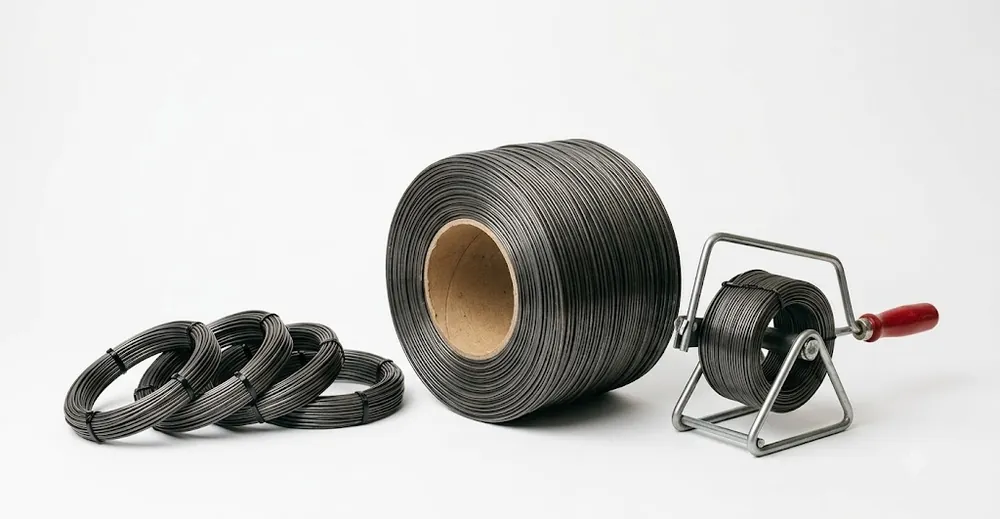
We have manufactured and exported rebar tie wire from Dingzhou, Hebei since 2006, mostly to buyers in North America and Europe. Over those years we have learned that the wire itself is only half the conversation. The other half is the coil: its weight, its inner diameter, and how it lands on a pallet. This guide walks a distributor or contractor through the trade-offs so the format on your next purchase order actually fits the people using it.
Why coil format matters more than most buyers expect
Ask a foreman what slows down a tying crew and few will blame the coil. Yet the format sets the rhythm of the work. A worker hand-tying rebar carries the wire on a hip or in an apron. If the coil is too heavy, it drags; if it is too light, it runs out every few minutes and someone walks back to the gang box. The sweet spot is a coil a person can carry all shift without thinking about it.
Storage tells a parallel story. A pallet of small coils holds far more individual units than a pallet of half-loose 50 kg spools, which matters when you sell to dozens of small contractors who each want a case, not a pallet. Bulk spools win on price per pound and on restocking speed for a single large pour. The right choice depends on who stands at the end of the supply chain.
There is also the tool question. Automatic tying tools do not accept loose wire. They need a wound reel with a fixed inner diameter and a controlled weight, or the tool jams. So the moment a crew switches from pliers to a battery tier, the coil conversation restarts from scratch.
What are the common tie wire formats and weights?
Three families cover almost every job: small hand coils, bulk spools, and tool reels. Below is how we typically build them, though we adjust gauge, length, and finish to order.
| Format | Typical weight | Inner diameter | Best use |
|---|---|---|---|
| Small hand coil | 1.5 lb / 3.5 lb (roughly 0.7-1.6 kg) | 4-6 in | Manual tying, retail packs, small crews |
| Medium coil | 5-10 kg | 6-8 in | Steady hand-tying on mid-size sites |
| Bulk spool | 25 kg / 50 kg | 200-300 mm | High-volume pours, rewinding, resale by weight |
| Tool reel | ~0.4-1.1 lb per reel | Tool-specific bobbin | Battery-powered automatic rebar tiers |
A few notes on the numbers. Hand coils are usually sold by the piece or by the case, so the per-coil weight is a selling unit as much as a working unit. Bulk spools are priced and shipped by net weight, which is why buyers care about the ratio of wire to packaging. Tool reels are the strictest: the weight and winding must match the tool brand's cavity, and even a small deviation causes misfeeds.
Gauge sits underneath all of this. Common annealed diameters run from about 0.8 mm to 1.6 mm (roughly 16 to 21 gauge in trade terms). A heavier gauge on the same coil weight means fewer meters of wire, so a 3.5 lb coil of thick wire holds less length than a 3.5 lb coil of thin wire. Buyers who compare only coil weight without checking gauge sometimes get a surprise at how fast the wire runs out.
Small coils versus spools: which should you stock?
For most distributors serving mixed customers, small coils move faster off the shelf while bulk spools deliver the lowest cost per pound. The decision comes down to your customer mix, not to any single "best" format. Here is how we frame it with our own buyers.
When small coils win
Small coils shine anywhere a person carries the wire. Residential foundations, road furniture, mesh tying, and light commercial work all favor a 1.5 lb or 3.5 lb coil that clips to a belt. They also suit retail and counter sales, because a contractor can grab two or three and go without splitting a pallet. Packaging protects each coil, so returns and shelf damage stay low. The trade-off is cost: more labor and material go into winding and wrapping many small units, so the price per pound is higher than bulk.
When bulk spools win
Bulk 25 kg and 50 kg spools are built for volume and for rewinding operations. A precast yard tying the same cage all day loses less time reloading from a big spool on a stand. Rewinders buy large spools to spin their own smaller coils. And because packaging is a smaller share of the shipment, the delivered cost per pound drops. The catch is handling: a 50 kg spool is a two-hand lift, not a belt clip, and it needs a dispenser or a spindle to pay off cleanly. Stored loose on a shelf, big spools tangle and waste wire.
Most of our distributor customers carry both. They keep small coils as the everyday retail line and offer bulk spools to their high-volume accounts. That split lets one supplier cover a job site with three tools and a warehouse pouring a bridge deck.
How do tool reels differ from hand coils?
Tool reels are the most engineered format we make, because a battery tier will only run on wire wound to its exact bobbin. A hand coil tolerates a loose wind and a rough inner diameter. A tool reel does not. The wire must be clean, consistently annealed, and wound without crossovers, or the tool's feed motor stalls mid-tie.
Weight per reel is deliberately small, often under a pound, so the tool stays balanced in one hand. That means reels run out quickly and get swapped often, which is why buyers order them by the case and keep spares on the belt. Our tie wire reels are matched to the common tool cavities used across North American and European sites, and we test the wind so the wire pays off straight.
The economics differ too. Per pound, tool reels cost more than either hand coils or bulk spools because of the tighter winding tolerance and the smaller unit. Crews accept that premium because an automatic tier ties several times faster than pliers, so labor savings dwarf the wire cost. If your customer has invested in the tools, the reel format is not optional; it is the only wire that works.
Packaging: cartons, pallets, and what travels well
Good tie wire packaging protects the wind, resists moisture, and stacks predictably in a container. Annealed wire rusts if it sits in a damp warehouse, so we wrap coils in film or paper and pack them in cartons that keep the coils from crushing each other. Small coils go into cartons by the dozen; cartons go onto pallets; pallets fill a container by weight and by cube.
Two details save buyers money. First, the wire-to-tare ratio. A carton that is mostly cardboard ships air, so we size cartons to the coil and avoid dead space. Second, pallet stability for the long ocean leg to North America or Europe. We band and, on request, shrink-wrap pallets so nothing shifts in transit. A shifted pallet means dented coils and rejected units at the dock.
Inner diameter also belongs in the packaging conversation. A coil with too small an inner diameter kinks the wire and fights the dispenser. Too large, and the coil goes soft and collapses in the box. We hold the inner diameter to the format, 4-6 inches on hand coils and 200-300 mm on bulk spools, so the wire pays off smoothly and the coil keeps its shape from our floor to your customer's hand.
How to choose the right format for your crews
Start with the tool, then the crew size, then the shelf. If the site runs battery tiers, the format is decided: buy matched reels and stop there. If the crew ties by hand, weigh the coil against how long a worker carries it. For belt work, 1.5 lb to 3.5 lb coils keep people moving. For a fixed tying station, a bigger coil or a bulk spool on a stand cuts reloads.
Then think about your own warehouse. A distributor selling to many small contractors should lean on small coils, which sell by the piece and turn quickly. A supplier feeding a few large pours should carry bulk spools for the price and the reload speed. Gauge and finish round out the order: match the diameter to the rebar size and the tie style, and pick black annealed or galvanized based on exposure and how long the steel sits before the pour.
When you are unsure, tell us the tool, the rebar size, and the crew, and we will recommend a format and weight. We would rather ship the right coil once than have a customer fight the wrong one all season. If you want options priced out, request a quote and we will lay out the trade-offs in plain numbers.
Frequently asked questions
What is the most common tie wire coil weight for hand tying?
The most common hand-tying coils weigh about 1.5 lb or 3.5 lb, which is roughly 0.7 kg to 1.6 kg. These sizes clip to a belt or drop in an apron and last a reasonable stretch without dragging on the worker. Heavier medium coils of 5-10 kg suit fixed tying stations where the wire stays on a stand.
How much wire is on a 3.5 lb coil?
It depends entirely on gauge. A 3.5 lb coil of thin 0.8 mm wire holds far more length than the same weight in 1.6 mm wire, because heavier gauge packs fewer meters per pound. Always confirm the gauge, not just the coil weight, when you compare suppliers or estimate how long a coil lasts on the job.
Can I use bulk spool wire in an automatic tying tool?
No. Battery-powered tiers only accept reels wound to the tool's exact bobbin and inner diameter. Loose wire from a 25 kg or 50 kg spool will jam the feed. If your crew runs automatic tools, order matched tool reels; if they tie by hand, bulk spools and hand coils both work fine.
What inner diameter should a tie wire coil have?
Hand coils typically run a 4-6 inch inner diameter, while bulk spools sit around 200-300 mm. The goal is a coil that pays off straight without kinking and holds its shape in the carton. Too small kinks the wire; too large lets the coil collapse. We match inner diameter to each format we ship.
Should a distributor stock small coils or bulk spools?
Stock both if your customers are mixed. Small coils sell by the piece and turn fast for retail and small contractors, while bulk spools give large accounts the lowest cost per pound and quicker reloads on big pours. Splitting your inventory this way lets one supplier serve both a two-person crew and a bridge-deck job.
Talk to us before your next order
The right coil format saves labor on the site and space in the warehouse, and it costs nothing extra to get right at the point of order. Tell us your tools, your rebar sizes, and your crew setup, and we will match the weight, gauge, and packaging to how the wire actually gets used. Contact Leeter to price your formats and plan a shipment that lands ready to work.
