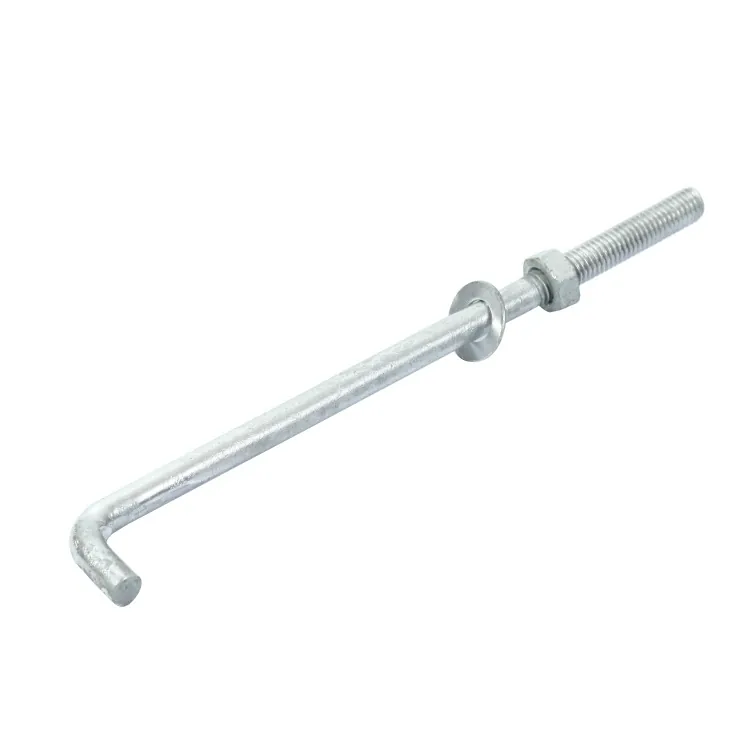
At Hebei Leeter Import and Export Co., Ltd ("Leeter"), we have shipped anchor bolts to North America and Europe since 2006 from our base in Dingzhou, Hebei. The mistakes we see most often are not about steel grade. They are about a builder receiving M20 bolts when the drawing called for 3/4", or nuts that spin but never seat. This guide walks through sizing systems, thread pitch, matching hardware, and the market conventions that decide which system you should quote.
Why the measurement system matters before anything else
Anchor bolts anchor structural steel, equipment bases, light poles, and machinery to concrete. The bolt only does its job when the projecting thread accepts the correct nut and the correct washer, and when the embedded end develops the pull-out strength the engineer assumed. Get the system wrong and none of that holds.
The problem is that imperial and metric hardware are close enough to feel interchangeable and far enough apart to fail. A 3/4" bolt measures 19.05 mm across the major diameter. An M20 bolt measures 20 mm. Slide an M20 nut onto a 3/4" thread and it will start, wobble, and cross-thread. On a job site under schedule pressure, someone forces it, the thread galls, and the connection is compromised. So before you discuss grade, coating, or length, lock down the system.
Metric vs imperial anchor bolt sizing: how the two systems compare
Metric anchor bolts are named by their nominal shank diameter in millimetres, written with an M prefix, so M16 means a 16 mm diameter. Imperial anchor bolts are named by diameter in inches, such as 3/4" or 1". The two scales never line up cleanly, which is why substitution by "closest size" is risky rather than convenient.
Below is a practical cross-reference for the diameters that cover the vast majority of structural work. Treat it as an ordering aid, not a permission slip to swap one for the other on a fixed drawing.
| Imperial diameter | Major diameter (mm) | Nearest metric size | Metric major diameter (mm) | Interchangeable? |
|---|---|---|---|---|
| 1/2" | 12.70 | M12 | 12.00 | No |
| 5/8" | 15.88 | M16 | 16.00 | No |
| 3/4" | 19.05 | M20 | 20.00 | No |
| 7/8" | 22.23 | M22 | 22.00 | Close, still no |
| 1" | 25.40 | M24 | 24.00 | No |
| 1-1/4" | 31.75 | M30 | 30.00 | No |
| 1-1/2" | 38.10 | M36 | 36.00 | No |
| 2" | 50.80 | M48 | 48.00 | No |
Notice that even the closest pairs differ by a millimetre or more. That gap is enough to prevent nuts from threading and enough to change how the bolt clears an anchor plate hole. When a drawing specifies a diameter, supply that exact diameter in that exact system.
What is the difference in anchor bolt thread pitch?
Thread pitch is where the two systems diverge most sharply. Imperial anchor bolts almost always use UNC, the Unified National Coarse series, measured in threads per inch. Metric anchor bolts use ISO metric coarse threads, measured as the distance in millimetres between adjacent thread crests. Different units, different geometry, zero compatibility.
A 3/4" UNC bolt carries 10 threads per inch. Its nearest metric neighbour, M20, uses a 2.5 mm coarse pitch. Convert and you find the imperial thread advances about 2.54 mm per turn against the metric 2.5 mm, close but not equal, and the thread flank angles and depths still differ enough to bind. This is why a nut from one system feels like it "almost" fits the other, then jams. The near-miss is the trap.
Here is the thread reference we hand to buyers who are converting a drawing between systems.
| Diameter | Imperial UNC (TPI) | Metric coarse pitch (mm) |
|---|---|---|
| 1/2" / M12 | 13 | 1.75 |
| 5/8" / M16 | 11 | 2.00 |
| 3/4" / M20 | 10 | 2.50 |
| 7/8" / M22 | 9 | 2.50 |
| 1" / M24 | 8 | 3.00 |
| 1-1/4" / M30 | 7 | 3.50 |
| 1-1/2" / M36 | 6 | 4.00 |
For most anchor bolt work you will stay with coarse threads, because coarse threads tolerate galvanizing buildup, dirt, and field handling far better than fine threads. Fine pitches exist in both systems for special connections, but for embedded structural anchors, coarse is the sensible default in either measurement world.
Matching nuts, washers, and thread condition
The nut is not a separate accessory decision. It is part of the anchor bolt specification, and it must match the bolt's system, diameter, and thread. An imperial bolt takes an imperial heavy hex nut sized to the same UNC thread. A metric bolt takes a metric hex nut cut to the same ISO pitch. Mixing them is the single most common field failure we field questions about.
Washers follow the same logic. Imperial plate and structural washers are dimensioned in inches with hole sizes matched to imperial bolt diameters. Metric washers use millimetre bores. A washer with the wrong bore either will not pass over the thread or leaves so much slop that it cannot distribute load properly under the nut.
One more detail that matters for hot-dip galvanized anchors: the nut thread should be tapped oversize, or the bolt thread cut undersize, to leave room for the zinc coating. On imperial hot-dip work this follows the ASTM overtapping allowance; on metric work it follows the ISO tolerance for hot-dip fasteners. When you order galvanized anchor bolts from us, we supply nuts already tapped to run freely over the coated thread, so crews are not chasing threads with a die on site. If you want to align the bolt grade with this decision, our ASTM F1554 grades explainer covers the strength classes that pair with these thread systems.
Which system should you quote for each export market?
Match the system to the destination's building culture, not to your own shop habits. North American projects run on imperial diameters, UNC threads, and specifications like ASTM F1554 for anchor rods. European and international projects run on metric sizes, ISO threads, and specifications drawn from EN and ISO standards. Quoting the wrong system forces a redraw or a scrap order.
Here is the quick market map we work from when a customer is unsure.
| Market | Default system | Common diameters | Typical spec family |
|---|---|---|---|
| United States, Canada | Imperial | 1/2"-2" | ASTM F1554, A307 |
| United Kingdom, EU | Metric | M12-M48 | EN / ISO grades 4.6, 8.8 |
| Australia, NZ | Metric | M12-M36 | AS/NZS |
| Middle East (int'l firms) | Metric | M16-M48 | EN / ISO |
| Latin America | Mixed | varies | project-specific |
The genuinely tricky markets are the mixed ones. A refinery in Latin America built by a US EPC contractor may run imperial anchors on an otherwise metric site. A European wind project shipping components to North America may carry metric bolts into imperial territory. In those cases, do not assume. Read the anchor bolt drawing and confirm the callout in writing before cutting steel. Our guide to reading an anchor bolt drawing shows exactly where the diameter and thread are annotated so nothing gets guessed.
How to spec a cross-border anchor bolt order cleanly
Write the order so a receiving crew in another country cannot misread it. Every anchor bolt line should state five things: the system, the diameter, the thread designation, the length and projection, and the matching nut and washer count. A line that reads "3/4" x 18" ASTM F1554 Gr. 36, UNC thread, hot-dip galvanized, c/w 2 heavy hex nuts and 1 plate washer" leaves no room for a metric substitution.
Watch these anchor bolt sizing and thread pitfalls in particular:
- Do not convert diameters by rounding to the nearest neighbour. 3/4" is not M20.
- Do not carry a bolt from one system with a nut from the other. They will bind.
- Confirm coarse versus fine thread; coarse is standard for embedded anchors.
- For galvanized parts, confirm nuts are overtapped so they run over the zinc.
- State projection length, not just total length, so enough thread clears the plate.
- On mixed-market jobs, verify the drawing callout in writing before production.
We keep both imperial and metric anchor bolts in production so a single project with both systems can ship complete from one supplier, with the correct nuts and washers matched to each line. If you are unsure which system a job needs, send us the drawing and request a quote; we will read the callout and confirm before anything is cut.
Frequently asked questions
Can I use a metric nut on an imperial anchor bolt?
No. A metric nut and an imperial bolt use different thread pitches and flank geometry, so the nut may start a turn or two, then cross-thread and jam. Even the closest pair, M20 and 3/4", differs enough to bind and gall the thread. Always match the nut to the bolt's own system and thread designation.
How do I convert an imperial anchor bolt size to metric?
You do not convert by picking the nearest number, because the diameters and threads never line up exactly. Instead, redesign the connection to a genuine metric size and confirm the engineer accepts it. If the drawing specifies imperial, supply imperial. Substituting M20 for 3/4" changes the diameter, the thread, and the matching hardware, which the design may not allow.
Which anchor bolt system does North America use?
North America uses the imperial system: diameters in inches from about 1/2" to 2", cut with UNC coarse threads, and paired with imperial heavy hex nuts and washers. Structural anchor rods usually follow ASTM F1554, with grades 36, 55, and 105 covering common strength needs. Metric anchors are unusual on standard US and Canadian projects unless an international contractor specifies them.
What thread type do metric anchor bolts use?
Metric anchor bolts almost always use ISO metric coarse threads, where pitch is the millimetre distance between thread crests, such as 2.5 mm on an M20. Coarse threads resist damage from handling, dirt, and galvanizing buildup, which makes them the practical default for embedded anchors. Fine metric threads exist for special connections but are rarely used for structural anchoring.
Do galvanized anchor bolts need special nuts?
Yes. Hot-dip galvanizing adds zinc thickness to the bolt thread, so the nut must be tapped oversize to run freely over the coating. Imperial galvanized work follows the ASTM overtapping allowance, and metric work follows the ISO hot-dip tolerance. We supply galvanized anchor bolts with nuts already overtapped, so crews are not forced to re-chase threads on site.
Get the system right before you order
Metric or imperial, the anchor bolt only performs when the diameter, thread, nut, and washer all belong to the same system and match the drawing. Decide the system by destination market, verify the callout on the drawing, and specify the matching hardware on every order line. That discipline prevents the field mismatches that cost days on a schedule.
If you are exporting to North America, Europe, or a mixed-system project, send us the drawing and let us confirm the sizing and thread before production. Request a quote and we will match the correct anchor bolts, nuts, and washers to your market.
