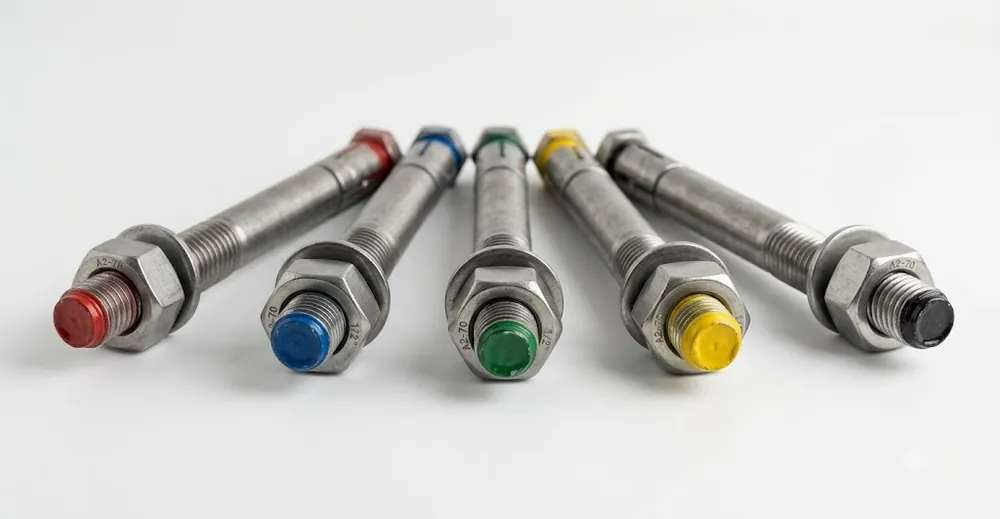
As a manufacturer that has produced anchor bolts in Dingzhou, Hebei since 2006, we ship all three grades to fabricators and contractors across North America and Europe. This guide explains what each grade means, how yield and tensile strength differ, why weldability matters, and how the color coding on the bolt end keeps the right steel in the right hole. Our goal is simple: help you specify the correct grade the first time.
What is ASTM F1554 and why does grade matter?
ASTM F1554 is the American standard that governs straight and bent anchor bolts, rods and other anchoring hardware for the range 1/4 inch through 4 inch diameter. It replaced older specifications that were scattered across several documents, and it brought anchor bolts under one consistent umbrella. The grade you choose controls the mechanical properties of the steel, the allowable working load, and often the price of the finished bolt.
Grade matters because an anchor bolt is a safety-critical link. It transfers wind, seismic and gravity loads from a steel column or base plate down into the concrete. Under-specify the grade and the bolt can yield or fail under load. Over-specify it and you pay for strength you do not need, sometimes while sacrificing ductility and weldability. Getting the grade right is a balance between capacity, cost and constructability.
The standard also allows the buyer to specify supplementary requirements. These include weldability, Charpy impact testing for low-temperature service, and specific finishes such as hot-dip galvanizing. When you order anchor bolts from us, we confirm the grade, the thread class, the finish and any supplements on the order acknowledgement so nothing is left to assumption.
What does F1554 grade 36 offer?
F1554 grade 36 is the workhorse of the standard. It is a low-carbon steel with a minimum yield strength of 36 ksi and a tensile range that typically runs from about 58 to 80 ksi. This is essentially the anchor-bolt version of common A36 structural steel, which is why so many general foundation details default to it. If a drawing simply calls for "anchor bolts" without a grade, grade 36 is usually what the engineer had in mind.
The main advantage of grade 36 is ductility and weldability. Because the carbon content is low, the steel bends cleanly into L-shapes and J-shapes without cracking, and it welds readily without special preheat or filler considerations in most cases. That makes it ideal for cast-in-place hooked anchors, embedded plates and light structural connections where extreme capacity is not the driving requirement.
Grade 36 is the most economical choice, and it covers the majority of everyday jobs: pre-engineered metal buildings, light poles, canopies, guardrails and equipment pads. Where loads climb, you move up the ladder. But for standard commercial and light industrial anchoring, grade 36 remains the sensible default.
When should you choose grade 55?
Grade 55 sits in the middle. It offers a minimum yield strength of 55 ksi and a tensile range of roughly 75 to 95 ksi, giving you noticeably more capacity than grade 36 while keeping good ductility. Engineers reach for it when the loads exceed what grade 36 can comfortably handle but the design does not yet demand the highest strength class.
A key feature of grade 55 is the weldable variant, known as grade 55S1. Standard grade 55 may use alloying that limits field welding, so if you need to weld the anchor, a nut or a plate to the bolt, you specify the S1 supplement. This controls the chemistry so the carbon equivalent stays low enough for reliable welds. We flag this on every grade 55 quotation because the difference is easy to overlook and expensive to discover on site.
Typical grade 55 applications include moderately loaded columns, heavier light-pole bases, sign structures exposed to significant wind, and machinery that generates dynamic loads. It is a practical compromise: stronger than grade 36, more forgiving and often cheaper than grade 105, and available in a weldable form when the connection detail requires it.
What makes grade 105 different?
F1554 grade 105 is the high-strength class, with a minimum yield strength of 105 ksi and a tensile range of about 125 to 150 ksi. This is a quenched and tempered alloy steel, closer in behavior to a high-strength bolt than to mild structural rod. It is reserved for demanding structural anchoring where base plates carry very high tension or where a compact bolt group must resist large overturning moments.
The trade-offs are important. Grade 105 is harder and less ductile than the lower grades, and it is generally not welded because the heat can compromise the tempered structure and invite cracking. It also costs more, both because of the alloy content and the heat treatment. For that reason we advise customers to use grade 105 only where the engineering genuinely calls for it, not as a blanket upgrade.
Where does grade 105 earn its keep? Heavy industrial structures, tall braced frames, large signage and transmission structures, and seismic details that concentrate demand into a small anchor group. In those cases the extra strength lets you use fewer or smaller bolts, which can simplify the base plate and the reinforcing around it.
How do the grades compare at a glance?
The table below summarizes the three grades. Yield and tensile figures are general values drawn from the standard's grade definitions and are meant for orientation; always work from the current published standard and your engineer's calculations for final design values.
| Grade | Min yield (ksi) | Tensile range (ksi) | Typical use |
|---|---|---|---|
| 36 | 36 | ~58-80 | General anchoring: metal buildings, light poles, equipment pads |
| 55 | 55 | ~75-95 | Moderate loads: heavier columns, sign structures, dynamic loads |
| 105 | 105 | ~125-150 | High strength: heavy industrial, seismic, large overturning moments |
Two points are worth stressing. First, higher yield does not mean "better" in every case, because ductility and weldability drop as strength rises. Second, the tensile ranges overlap less than the yield numbers suggest, so the jump from grade 36 to grade 105 nearly triples the yield capacity. That gap is exactly why matching grade to load pays off.
How does weldability and color coding work?
Weldability follows carbon content and alloying. Grade 36 welds easily, grade 55 welds only in its S1 weldable form, and grade 105 is normally not welded at all. If your detail requires welding a nut, a coupler or a stiffener to the anchor, tell your supplier before production so the right grade and supplement are used. Welding a non-weldable grade in the field is a common and avoidable mistake.
To prevent grade mix-ups on the jobsite, ASTM F1554 uses a color code applied to the exposed end of each bolt. The convention is blue for grade 36, yellow for grade 55, and red for grade 105. A quick glance at the bolt end confirms the grade before the crew sets it in the template. We apply this color coding as standard on our F1554 production, and we can also add heat or lot marking when your quality plan requires traceability.
Color coding is a small detail that prevents big errors. On a busy foundation pour with several grades on site, the painted ends are often the last line of defense against installing the wrong steel.
How do you choose the right F1554 grade by load?
Start with the engineer's demand. The structural drawings or calculations give the required tension and shear per bolt, and from there you select the lowest grade that satisfies the demand with the specified safety factors. Do not guess. If the drawing names a grade, order that grade; if it names only a strength, ask the engineer to confirm the grade before you buy.
A practical decision path looks like this. For everyday light and commercial work, specify grade 36. When loads rise and the detail may need welding, specify grade 55 or 55S1. When a compact, heavily loaded anchor group governs the design, specify grade 105 and accept its reduced weldability. Always match the nut and washer grades and the finish, such as hot-dip galvanizing, to the bolt so the whole assembly performs as intended.
When you are unsure, request a quote and send us the drawing. We will confirm the grade, diameter, embedment length, thread class, finish and quantity, and flag anything that looks inconsistent. It costs nothing to check, and it prevents a rejected pour or a change order later.
Frequently asked questions
What do the numbers 36, 55 and 105 mean in ASTM F1554? Each number is the minimum yield strength of the steel in ksi, or thousands of pounds per square inch. Grade 36 yields at 36 ksi, grade 55 at 55 ksi, and grade 105 at 105 ksi. Higher numbers mean more load capacity but lower ductility and weldability.
Which F1554 grade is the most common? Grade 36 is by far the most common. It is a low-carbon, A36-equivalent steel that bends and welds easily, costs the least, and suits most general anchoring such as metal buildings, light poles and equipment pads. Many drawings default to grade 36 when no grade is stated.
Can F1554 anchor bolts be welded? Grade 36 welds readily. Grade 55 welds only in its weldable S1 variant, so specify grade 55S1 if welding is required. Grade 105 is normally not welded because heat can damage its quenched and tempered structure. Always confirm the grade before welding on site.
What are the metric equivalents of F1554 grades? As a rough guide, grade 36 aligns with Q235 mild steel or property class 4.6, grade 55 sits near the middle range, and grade 105 aligns with the higher-strength class 8.8 family. These are approximate cross-references, not exact substitutes, so confirm mechanical properties for your project.
How does the color coding identify each grade? ASTM F1554 marks the exposed bolt end with a color: blue for grade 36, yellow for grade 55, and red for grade 105. This lets crews verify the correct grade at a glance before setting the bolt, which prevents costly mix-ups during a foundation pour.
Talk to us about your anchor bolts
Specifying the right F1554 grade protects your structure and your budget. If you have a drawing, a load table or a bolt schedule, send it over and we will confirm the grade, finish and lead time. Request a quote and our team will help you get the correct anchor bolts on the first order.
