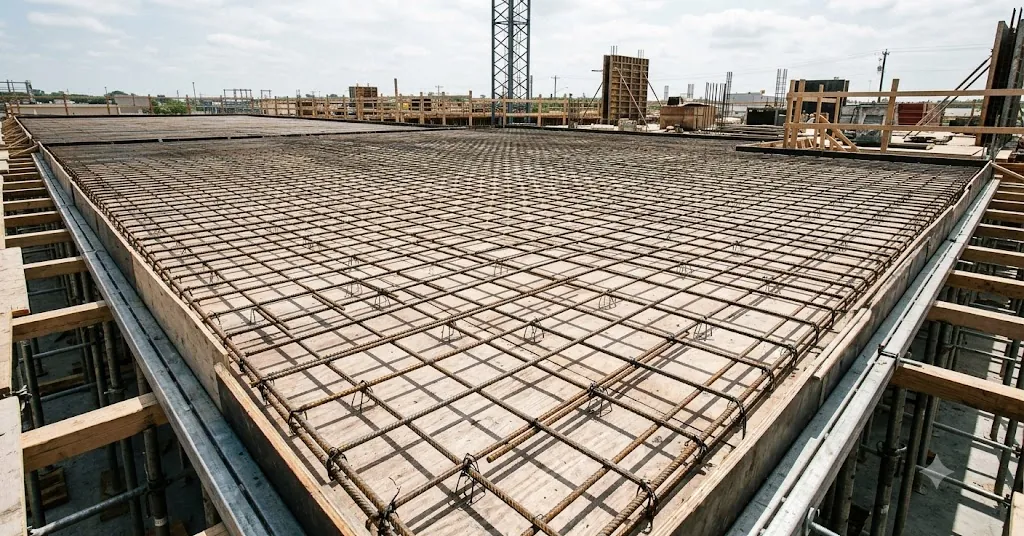
At Hebei Leeter Import and Export Co., Ltd, we have exported rebar supports since 2006 from Dingzhou, Hebei, mostly to contractors and distributors across North America and Europe. The notes below reflect what we see shipped and asked about, not a substitute for your project engineer. Cover depth, spacing, and load values on any job come from the drawings and the specification. When those conflict with a rule of thumb here, follow the drawings.
Why does the structure type decide the support?
The support has one job: hold the steel at the height the designer specified until the concrete sets. Where that steel sits, and what it rests on, changes with the structure. A slab-on-grade has a stable subgrade underneath, so a short chair with a firm foot is usually enough. An elevated deck has forming below and a second mat above, so you need taller supports and something that keeps the top bars from sagging between them. A bridge deck adds an aggressive service environment, water, salt, and freeze-thaw, so the support material itself matters as much as its height.
Think of it as three variables that move together: how the steel is held up from below, how many mats you carry, and how hostile the environment is. Ground slabs are the mildest case on all three. Bridge decks are the harshest. Elevated building decks sit in between. Once you place a structure on that scale, the shortlist of suitable supports gets short fast.
What rebar supports work for a slab-on-grade?
A slab-on-grade almost always carries a single mat of steel or mesh set toward the bottom third of the slab, so the supports are short and stable. The two workhorses are slab bolsters, which run as continuous runners under a line of bars, and rod chairs, which are individual bar chairs placed on a grid. Both come in standard heights that match common slab thicknesses, and both can be ordered with plastic feet.
The plastic foot detail matters more than people expect. Many ground slabs are poured over a vapor barrier or a poly sheet laid on stone or sand. A bare wire leg can punch through that membrane or press into soft fill and let the bar drop. A plastic base spreads the load and protects the barrier, which is why it is a common request for residential and light commercial slabs. On a stiff, well-compacted subgrade without a membrane, plain wire bolsters are often accepted. Check the spec before you decide.
Spacing is the other half of the job. Bars sag between supports, so runners and chairs go closer together for heavier steel and wider apart for light mesh. The drawings or the reinforcement detailer set the spacing; a support that is correct in height but too far apart still lets the mat wander out of position.
Slab bolsters or rod chairs?
Both work, and crews often mix them. Continuous slab bolsters shine when you have long parallel runs of bar and want a fast, repeatable line to lay steel on. Rod chairs suit patchy layouts, tie-ins, and spots where a runner would get in the way. For mesh-reinforced slabs, individual chairs or bolster strips both hold the sheet up; the choice usually comes down to what the crew is fastest with and what is already on the truck.
What supports does an elevated deck need?
An elevated deck carries two mats, a bottom mat near the soffit and a top mat near the surface, so it needs both low supports and tall ones. The bottom mat sits on bolsters or chairs much like a ground slab, though the feet rest on plywood or metal forming rather than soil. The top mat is where elevated decks diverge: it has to be held up across open space, and the answer is the continuous high chair.
Continuous high chairs are welded upper and lower wires with legs bent to a set height. They run in parallel lines under the top mat and give the steel a stiff, repeatable platform that resists foot traffic during the pour. Where a runner cannot reach, individual high chairs fill in. Heights are ordered to hit the specified top cover for the deck thickness, so a 10 inch deck and a 7 inch deck take different chairs even if everything else looks the same.
Foot bearing changes on an elevated deck too. On steel deck forming, plastic-tipped or plastic-based legs help avoid marking the pan and give a cleaner bearing. On plywood, plain wire is usually fine. The load during placing matters here in a way it does not on grade, because there is no soil to catch a chair that yields; the support carries the mat and the workers walking the steel.
Keeping the top mat where it belongs
The most common elevated-deck problem we hear about is top cover loss, the top bars ending up too low because chairs were spaced too far apart or knocked over. Tighter chair spacing, running the continuous chairs in the direction of the traffic, and tying the mat down to the chairs all help. Adequate top cover is what protects that steel from corrosion later, so it is worth the extra chairs.
What makes bridge deck supports different?
Bridge decks combine the two-mat layout of an elevated deck with a punishing environment, so the material of the support becomes a specification item, not an afterthought. Deicing salts, standing water, and freeze-thaw cycles drive chloride into the concrete, and any exposed metal support leg becomes a potential corrosion path to the reinforcement. That is why bridge specifications frequently call for epoxy-coated wire chairs, all-plastic chairs, or supports with plastic tips that keep bare steel away from the concrete surface and the traffic side.
Cover requirements on bridge decks are also higher than on building slabs, which pushes chair heights up and makes stable, wide-footed supports important. Continuous high chairs and individual high chairs are still the tools for the top mat, but they arrive coated or molded rather than plain. Agencies and departments of transportation often publish approved-product lists, and the accepted support type is tied to that list. Read it before ordering, because a plain galvanized chair that passes on a parking deck may be rejected on a highway bridge.
Support selection by structure
The table below summarizes the shortlist for each structure. Treat it as a starting point for a conversation with your engineer, not a substitute for the drawings.
| Structure | Mats carried | Typical supports | Base / material notes |
|---|---|---|---|
| Slab-on-grade | Single bottom mat | Slab bolsters, rod chairs | Plastic feet over vapor barrier; plain wire on firm subgrade |
| Elevated building deck | Bottom + top mat | Bolsters/chairs below; continuous high chairs on top | Plastic tips on steel deck forming; height set to top cover |
| Bridge deck | Bottom + top mat | Continuous and individual high chairs | Epoxy-coated or all-plastic; higher cover; check approved list |
| Mesh-reinforced ground slab | Single mesh sheet | Bolster strips or individual chairs | Wide feet to stop punch-through on poly |
A few habits keep selection honest across all four rows. Match the height to the specified cover, not to what is on hand. Set spacing tight enough that the heaviest bar in the mat does not sag. And choose the foot and material for what the support actually rests on and lives in, whether that is soil, plywood, a steel pan, or a salted deck.
How do you order the right height and spacing?
Start from the drawings, then confirm three numbers: cover, bar size, and support spacing. Cover fixes the chair or bolster height, since the support holds the steel at cover from the form or subgrade. Bar size and the load during the pour influence how close together supports go, because heavier steel sags more. Support spacing is often noted on the reinforcement details or left to the placing contractor within the specification limits.
If the drawings are silent on a detail, ask rather than assume. We can supply the standard heights and foot options for each structure, but the values that make a pour pass inspection, cover depth and spacing, belong to your engineer. When you are ready to price a specific list, request a quote with the heights, quantities, and foot type, and we will confirm what ships fastest.
Frequently asked questions
Do I need plastic feet on rebar supports slab on grade?
Plastic feet are commonly used on slabs poured over a vapor barrier or poly sheet, because a bare wire leg can puncture the membrane or sink into soft fill and let the bar drop. On a firm, well-compacted subgrade with no membrane, plain wire bolsters are often accepted. Follow the project specification.
When do I switch from bolsters to continuous high chairs?
You add continuous high chairs once a structure carries a top mat that has to be held across open space, which is the case on elevated building decks and bridge decks. A slab-on-grade with a single bottom mat generally does not need them. Bolsters and rod chairs handle the bottom mat in both cases.
Why do bridge decks require coated or plastic supports?
Bridge decks face deicing salt, standing water, and freeze-thaw, which drive chloride toward the steel. An exposed metal support leg can become a corrosion path to the reinforcement. Epoxy-coated or all-plastic chairs keep bare steel away from that exposure. Many transportation agencies list the accepted support types, so check the approved-product list.
What height chair should I order?
Chair and bolster height equals the specified cover from the form or subgrade to the steel, so it changes with each structure and slab thickness. Read the cover value off the drawings, not off a standard slab assumption. When the drawings and a rule of thumb disagree, the drawings win.
Can the same chair work on both an elevated deck and a bridge deck?
The chair shape can be the same, but the material usually is not. An elevated building deck may accept plain or plastic-tipped high chairs, while a bridge deck often requires epoxy-coated or all-plastic versions and higher cover. Confirm the specification and any approved-product list before ordering the bridge version.
Ready to spec your supports?
Tell us the structure, the cover, and the quantities, and we will match slab bolsters, rod chairs, or high chairs to the job and confirm lead time. To price a list or ask about foot and coating options, request a quote and our team will follow up.
