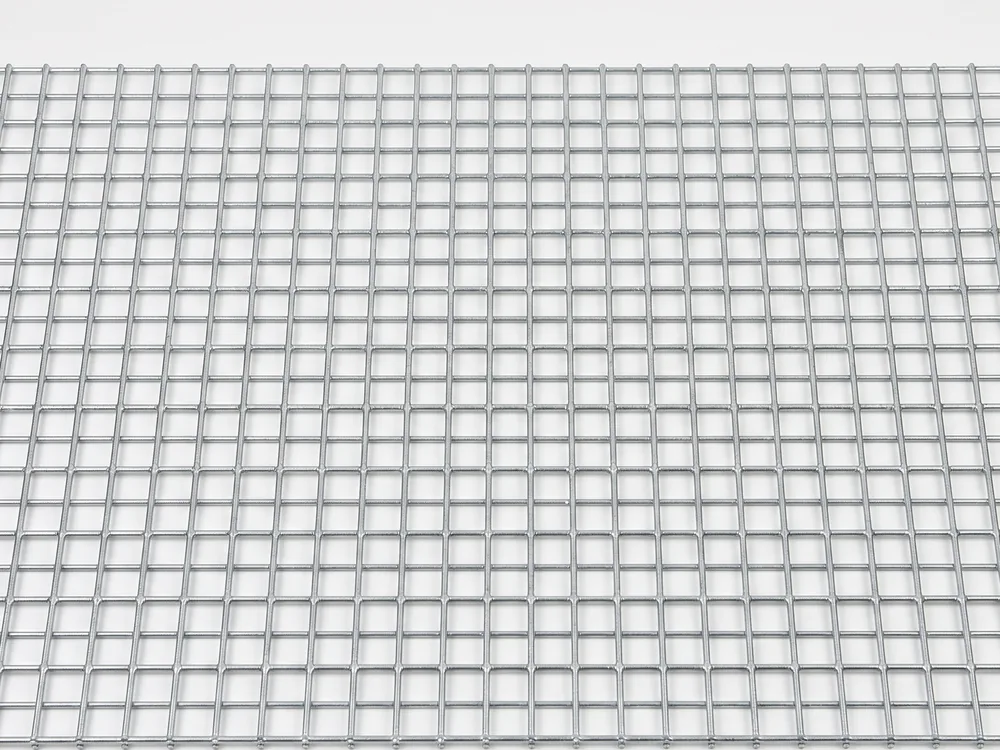
At Hebei Leeter Import and Export Co., Ltd ("Leeter"), a wire and mesh exporter based in Dingzhou, Hebei since 2006, we quote weight on almost every order that ships to North America and Europe. Below is exactly how we run the math, with a full worked example and the tables our own team uses.
Where the 0.00617 formula comes from
The formula is not magic. It comes straight from the density of steel and the area of a round wire. A wire is a cylinder, so its cross-sectional area is π/4 x d². For a wire 1 millimetre in diameter, that area is 0.7854 square millimetres, which over one metre of length gives a volume of 785.4 cubic millimetres, or 0.7854 cubic centimetres.
Multiply that volume by the steel density of 7.85 g/cm³ and you get 6.165 grams per metre for a 1 mm wire. Convert to kilograms and round, and the constant becomes 0.00617. Because area scales with the square of diameter, you simply plug in d²:
Mass per metre (kg) = 0.00617 x d²
So a 3 mm wire weighs 0.00617 x 9 = 0.0555 kg per metre. A 4 mm wire weighs 0.00617 x 16 = 0.0987 kg per metre. Double the diameter and the weight quadruples, which is why wire gauge matters far more than aperture when you are chasing a target weight.
How do you calculate the weight of a full mesh panel?
To calculate the weight of a full mesh panel you add up the length of every wire, then multiply by the mass per metre. Welded and woven mesh both use two sets of wires: line wires that run along the length, and cross wires that run across the width. Count each set separately, because they often use different diameters and spacings.
Here is the step-by-step method our estimators follow:
- Note the panel length L and width W in metres.
- Note the wire diameter d in millimetres and the aperture or pitch p in millimetres for each direction.
- Count line wires: (W in mm / pitch) + 1, each one L metres long.
- Count cross wires: (L in mm / pitch) + 1, each one W metres long.
- Add both total lengths together to get total wire length in metres.
- Multiply total length by 0.00617 x d².
The "+1" matters because a panel has a wire on both edges. On large sheets it barely moves the number, but on small samples it can add several percent, so we keep it in.
A worked example you can copy
Take a common welded wire mesh panel: 2 metres long, 1 metre wide, 50 mm x 50 mm aperture, 3 mm wire throughout. This is a typical fence infill or mesh partition sheet.
Line wires run the 2 m length. Across the 1 m (1000 mm) width at 50 mm pitch you get 1000 / 50 + 1 = 21 wires, each 2 m long, so 42 metres of line wire. Cross wires run the 1 m width. Along the 2 m (2000 mm) length at 50 mm pitch you get 2000 / 50 + 1 = 41 wires, each 1 m long, so 41 metres of cross wire. Total wire length is 42 + 41 = 83 metres.
Mass per metre for 3 mm wire is 0.00617 x 3² = 0.0555 kg. Panel weight is 83 x 0.0555 = 4.61 kg. The panel covers 2 square metres, so the weight per square metre is 4.61 / 2 = 2.30 kg/m². That single figure, kilograms per square metre, is the language your freight forwarder and your finance team both understand.
What is welded mesh weight per m2 for common specs?
Welded mesh weight per m2 depends almost entirely on wire diameter and pitch, and you can read it straight off a table once the formula is baked in. For a square mesh with pitch p in millimetres, the theoretical weight per square metre is (2000 / p) x 0.00617 x d². The 2000/p term counts the total metres of wire packed into one square metre from both directions.
The table below shows typical welded wire mesh weights. These are theoretical values for bright steel wire before galvanizing; hot-dip galvanizing adds roughly 3 to 8 percent depending on coating mass.
| Aperture (pitch) | Wire diameter | Wire per m² | Weight per m² |
|---|---|---|---|
| 50 mm | 2.0 mm | 40 m | 0.99 kg |
| 50 mm | 3.0 mm | 40 m | 2.22 kg |
| 50 mm | 4.0 mm | 40 m | 3.95 kg |
| 75 mm | 3.0 mm | 26.7 m | 1.48 kg |
| 75 mm | 4.0 mm | 26.7 m | 2.63 kg |
| 100 mm | 4.0 mm | 20 m | 1.97 kg |
| 100 mm | 5.0 mm | 20 m | 3.09 kg |
| 100 mm | 6.0 mm | 20 m | 4.44 kg |
Notice how the 50 mm, 4 mm mesh at 3.95 kg/m² weighs four times the 50 mm, 2 mm mesh at 0.99 kg/m². Same aperture, double the wire, quadruple the weight. If your application allows a smaller wire, the freight savings compound across a full container.
Why does mesh weight drive your freight cost?
Mesh weight drives freight because sea and road carriers charge on whichever is greater, actual weight or volumetric weight, and dense steel mesh almost always bills on actual weight. A standard 20-foot container has a payload limit near 25 to 28 tonnes depending on the line and route, so weight, not floor space, usually caps how much mesh you can load.
Work the earlier example forward. Suppose you order 5,000 of those 2 x 2 metre welded panels. Each panel is 2 m² x 2.30 kg/m² x 2 = wait, each panel here is 2 m² and weighs 4.61 kg, so 5,000 panels weigh 23,050 kg. That fills a 20-foot container to its payload before it fills the space. If you had specified 4 mm wire at the same aperture, each panel would jump to about 7.9 kg, and 5,000 panels would weigh 39,500 kg, forcing you into two containers.
This is the core reason we ask for your exact wire diameter and aperture before quoting freight on welded wire mesh. A 1 mm change in wire gauge can move a shipment from one container to two, and the freight difference often dwarfs the material saving. When you are ready to price a load, request a quote with your panel size, wire diameter, and aperture, and we return both material and shipping weight.
Woven and crimped mesh: the same rule with a twist
Woven wire mesh follows the identical mass-per-metre formula, but the wire path is longer than the flat panel dimension because the wires crimp over and under each other. That crimp adds length, and therefore weight, that a flat calculation misses.
For a plain weave, the extra length depends on how tightly the wire bends around its neighbour. As a practical rule, we add a crimp allowance of roughly 2 to 6 percent to the straight-line wire length for medium and coarse woven meshes, and more for very fine or heavily crimped patterns. If precision matters, weigh a physical sample: cut a known area, put it on a scale, and back-calculate. A measured sample beats any formula because it captures crimp, weld burn-off, and real wire tolerance in one number.
| Mesh type | Formula basis | Typical adjustment |
|---|---|---|
| Welded, straight wire | Flat wire length | None (weld loss under 1%) |
| Crimped / woven | Flat length + crimp | Add 2-6% |
| Galvanized (hot-dip) | Base steel weight | Add 3-8% coating |
| PVC coated | Base steel weight | Add per coating spec |
Quick checks before you commit a number
Before you send a weight to a customer or a carrier, run three sanity checks. First, confirm which wire is which: line and cross wires sometimes carry different diameters, and mixing them up skews the total. Second, confirm the aperture definition, because some suppliers quote the clear opening and others quote centre-to-centre pitch; the difference is one wire diameter, and on fine mesh that changes the wire count. Third, decide whether the number is bare steel or coated, and state it plainly on your paperwork.
We always label our quotes as theoretical bare-steel weight plus a stated coating allowance, so nobody is surprised on the packing list. Honest weight up front prevents the worst outcome in export: a container that clears the factory but sits overweight at the port.
Frequently asked questions
What is the formula for wire mesh weight?
The core formula is mass per metre of wire equals 0.00617 x d² kilograms, where d is the wire diameter in millimetres. Multiply that by the total length of all line and cross wires in the panel. The constant comes from steel's density of 7.85 g/cm³ combined with the circular cross-section of the wire.
How do I convert panel weight to weight per m2?
Divide the total panel weight by the panel area in square metres. In our worked example, a 2 m² panel weighing 4.61 kg gives 2.30 kg/m². For a square mesh you can also compute it directly as (2000 / pitch in mm) x 0.00617 x d², which skips the wire-counting step entirely.
Does galvanizing change the calculated weight?
Yes. The base formula gives bare steel weight only. Hot-dip galvanizing typically adds 3 to 8 percent depending on coating mass, and PVC coating adds more according to its thickness spec. Always state whether your quoted weight is bare or coated, because the coating can be the difference between a legal and an overweight container.
Why do line and cross wires need separate math?
Line and cross wires often use different diameters, different spacings, and different lengths, so lumping them together produces the wrong total. Count each set on its own: line-wire count times panel length, plus cross-wire count times panel width. Only then apply the mass-per-metre figure for each wire's specific diameter.
How does wire diameter affect shipping cost more than aperture?
Because weight scales with the square of diameter, a small gauge increase moves weight fast. Going from 3 mm to 4 mm wire raises weight by about 78 percent at the same aperture, while widening the aperture only trims a linear amount. Since containers usually bill on actual weight, wire diameter is the biggest lever on your freight bill.
Getting wire mesh weight right is the difference between a smooth shipment and a costly surprise at the dock. Run the 0.00617 x d² formula, count both wire directions, add your coating allowance, and check the result against a physical sample whenever you can. When you want a second set of eyes on the numbers, send us your panel size, wire diameter, and aperture, and we will confirm the weight and freight before you commit. Request a quote and we will get you an accurate figure the same working day.
