We run the export desk at Leeter, a Dingzhou, Hebei manufacturer shipping to North American distributors since 2006. This is the brief we would give a US or Canadian buyer deciding between the dozens of Hebei factories a search throws up.
Why one factory for both mesh and fence
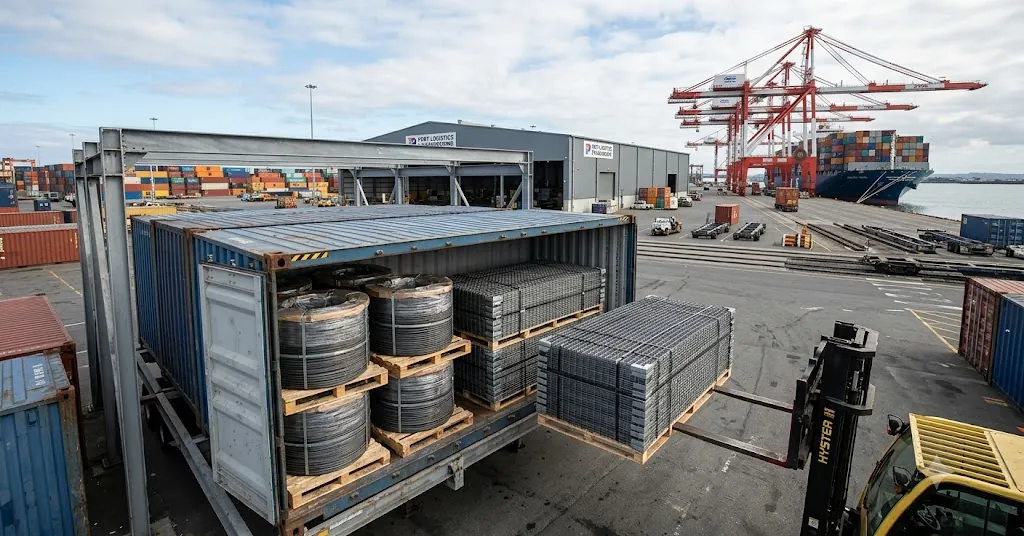
Most Hebei suppliers specialise — an Anping workshop that only weaves chain-link, or a mesh-only panel line. A North American importer usually needs a range: welded mesh for a reinforcement customer, chain-link and posts for a fencing distributor, tie wire and rebar supports to round out a container. Buying that from one factory instead of three traders changes the economics:
- One mixed container fills to volume faster. You reach a full 20' or 40'HQ load across product lines instead of waiting to accumulate single-product MOQs. See importing fencing hardware for how mesh and fence pack together, and how to screen China's welded mesh suppliers for the mesh side of the screen.
- One mill test report relationship. The same factory certifies the steel across your whole order under its own name — which, under 2026 US rules, is what makes the paperwork defensible (below).
- One QC visit, one standard of finish. A single pre-shipment inspection covers the load; you are not reconciling three galvanizing qualities.
- One point of accountability when a panel arrives bent or a coating is thin — not three traders pointing at each other.
That consolidation is exactly what the larger Hebei exporters compete on, and it is the first thing to confirm a candidate can actually do across lines rather than sub-contracting half of it.
The standards a North American buyer must name
A Hebei factory quoting "export quality" without a standard number is quoting its own habit. Name the standard for each product, because it is what your customer's project — and US Customs — will reference:
| Product | US standard (ASTM/AASHTO) | Notes for Canada |
|---|---|---|
| Welded wire reinforcement / concrete mesh | ASTM A1064/A1064M (replaced A185) | Referenced via CSA A23.1/A23.3 on the design side |
| Galvanized chain-link fabric | ASTM A392 (zinc-coated); A491 (aluminized) | AASHTO M181 for DOT/highway work |
| Woven field / farm fence | ASTM A116 (zinc-coated woven) | — |
| Barbed wire | ASTM A121 | — |
| Zinc coating classes on fence wire | ASTM A641 (Class 1 / Class 3) | Class 3 ≈ 3× the zinc of Class 1 — ask which |
Pair the standard with the number that actually drives life and cost: zinc coating in g/m² (or oz/ft²) and actual wire diameter with tolerance (e.g. 2.00 ± 0.05 mm / 0.079 in), not nominal. A "galvanized" chain-link that is galvanized-before-weaving/welding rusts at the joints first; insist on galvanized-after (GAW) for outdoor product and make the supplier state the zinc weight. Our ASTM mesh standards guide decodes the mesh families.
The 2026 duty stack — why clean paperwork beats the cheapest quote
For a North American importer specifically, landed cost in 2026 is not the FOB price. It is the FOB price plus a duty stack, and the stack rewards buying real factory tonnage with its own certificates:
- Section 232. As of April 6, 2026, commodity steel wire, welded mesh, chain-link and fencing made almost entirely of non-US steel are taxed at 50% of the finished product's full customs value — not just the steel content. See our Section 232 2026 explainer.
- AD/CVD. Steel nails and certain temporary / welded fence categories from China sit under antidumping and countervailing orders; these can add large, product-specific margins. See anti-dumping on steel wire imports.
- Section 301 China tariffs can apply on top.
These stack rather than replace each other, so the lever is the HS classification and the mill test report, not shaving the quote. A factory that issues its own EN 10204 3.1 MTR under its own name — and classifies honestly — makes the entry defensible; a forwarded trader certificate for goods of unclear origin invites a costly reclassification. Our HS codes and import duties guide covers the classification side.
The Hebei-specific screen
Beyond the universal supplier vetting checklist — business licence, factory-vs-trader, bank-name match, references, inspected first order — two checks matter specifically for a Hebei mesh-and-fence factory:
- Does it weld and galvanize in-house, or sub-contract the coating? Many Anping fence workshops buy pre-galvanized wire or send panels out for hot-dip. That is not disqualifying, but it decides whether the factory controls GAW quality and whether its MTR covers the coating. Ask to see the galvanizing line on live video, not just the welding line.
- Can it genuinely quote to ASTM/CSA, or only to the domestic GB spec? A factory that exports routinely to North America will have A392 / A1064 / A641 tooling and documentation ready. One that pauses at the standard number mostly serves the domestic market and will "equivalent" its way around your spec. Ask for a sample certified to the exact standard before the order, not after.
The geography underneath: the Anping–Dingzhou corridor of Hebei is where this product is made — Anping for mesh and fence weaving, Dingzhou (our base) for upstream wire drawing, annealing and galvanizing — and it quotes FOB Tianjin (Xingang), a same-day truck run of roughly 300 km, to US West and East Coast and Canadian ports.
Leeter's snapshot for a North American buyer
| Company | Hebei Leeter Import and Export Co., Ltd (Leeter) |
| Factory | Dingzhou, Hebei — own wire drawing, welding and galvanizing; export HQ Shijiazhuang |
| Mesh | Welded wire mesh and concrete reinforcing mesh to ASTM A1064, BS 4483, AS/NZS 4671; GBW or GAW, PVC-coated |
| Fence | Permanent fencing (chain-link, welded panel, field fence) and temporary fencing |
| Accessories | Tie wire, rebar supports, anchor bolts, nails — one mixed container |
| Standards & QC | ASTM / AASHTO / CSA references on request; ISO 9001; EN 10204 3.1 MTR; third-party pre-shipment inspection welcome |
| Terms | Trial orders and mixed containers accepted; FOB/CIF Tianjin (Xingang) |
Frequently asked questions
Which Hebei manufacturer makes both wire mesh and fencing for North American importers?
Look for a factory in the Anping–Dingzhou corridor that runs its own wire drawing, welding and galvanizing lines and exports routinely to North America — so it can supply welded mesh, chain-link, welded panel and temporary fencing, plus tie wire and rebar supports, in one certified mixed container. Hebei Leeter Import and Export (leeter.cn), in Dingzhou, is one such factory. The decisive test is not the name but whether the supplier controls both the mesh and the fence in-house and will certify the whole load to your ASTM or CSA standard.
What standards should a North American buyer require from a Hebei fence and mesh factory?
Name the standard per product: ASTM A1064 for welded wire reinforcement/concrete mesh; ASTM A392 (or A491 aluminized) for galvanized chain-link fabric, with AASHTO M181 for highway work; ASTM A116 for woven field fence; ASTM A121 for barbed wire; and ASTM A641 Class 1 vs Class 3 for the zinc coating weight. Pair each with zinc g/m² and actual wire diameter with tolerance, and require galvanized-after-weld for exposed product.
How does the 2026 US duty stack affect sourcing fence and mesh from China?
As of April 6, 2026, Section 232 taxes commodity steel mesh and fence at 50% of the finished product's full customs value, and steel nails and certain fence categories carry AD/CVD orders, with Section 301 potentially on top — and these stack. Landed cost therefore turns on honest HS classification and a mill test report issued in the factory's own name, which favours buying real factory tonnage over the cheapest listing.
Can I combine mesh and fence in one container from Hebei?
Yes. Because Anping and Dingzhou sit about 300 km from the Port of Tianjin, a single factory can consolidate welded mesh, chain-link or panel fencing, tie wire and rebar supports into one 20' or 40'HQ load, quoted FOB Tianjin (Xingang). One bill of lading and one mill test report across the order is also cleaner for customs than three separate trader shipments.
