We are Hebei Leeter Import and Export Co., Ltd ("Leeter"), a wire, mesh and fencing manufacturer in Dingzhou, Hebei, China, exporting since 2006 to buyers across North America and Europe. Our gabion box line covers both unit types in heavy galvanized, Galfan and PVC-coated wire, and this guide reflects the specs civil contractors and erosion-control distributors order from us most.
Same mesh technology, different structures
Both products are woven — not welded — from double-twist hexagonal mesh: pairs of wires twisted around each other three half-turns at every joint. The double twist matters in the field. If one wire is cut or corroded through, the twist keeps the mesh from unraveling, so the basket keeps working with local damage. And because the mesh is woven, the whole unit is flexible: it can settle with the foundation, deform around scour holes and keep confining its stone, where a rigid structure would crack. That tolerance of movement is the core reason engineers choose gabion systems for riverbanks and soft ground in the first place.
The units arrive on site folded flat and bundled, with lacing wire supplied for assembly. Crews unfold each unit, stitch the edges into a box with the lacing wire, wire units to their neighbors, fill with stone, and close the lids. Internal diaphragms — mesh partitions at 1m intervals along the length — keep the stone from migrating and hold the unit's shape during filling and after settlement.
Gabion box specifications
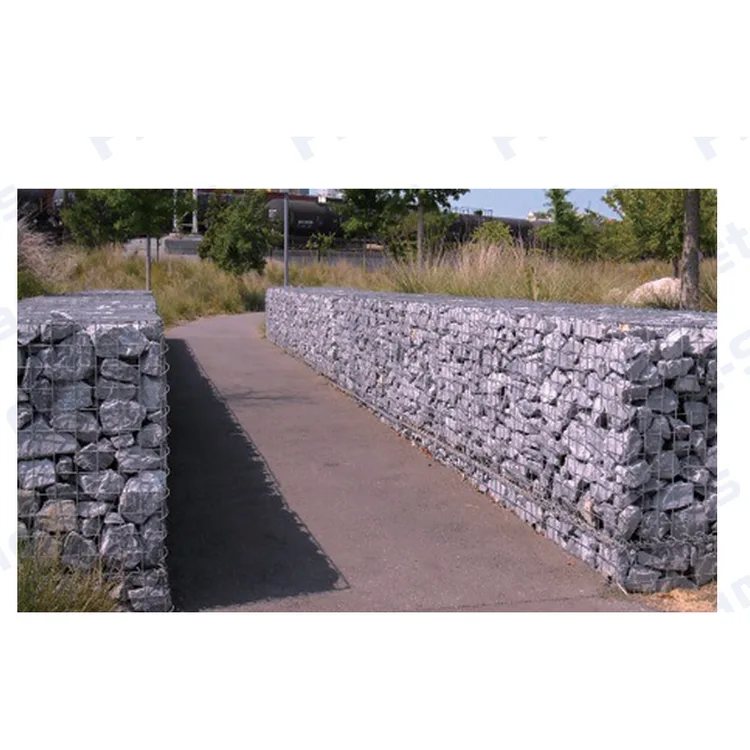
Gabion boxes stack like giant masonry to build gravity retaining walls, weirs, spur dikes, rockfall barriers and architectural landscape walls. Standard export specs:
| Gabion box spec | Standard |
|---|---|
| Mesh type | Double-twist hexagonal, 80 x 100mm |
| Wire diameter | 2.7mm |
| Lengths | 1.5 / 2 / 2.5 / 3 / 4m |
| Width | 1m |
| Heights | 0.5m or 1m |
| Diaphragms | At 1m spacing along length |
| Supplied | Folded flat, with lacing wire |
The workhorse unit is 2 x 1 x 1m (6.6 x 3.3 x 3.3 ft). The 0.5m-high units serve as wall capping courses, low landscape walls and anywhere a half-height step suits the wall geometry. For a retaining wall, boxes are laid in courses like brickwork with staggered joints, each course typically stepped back against the retained slope; the wall works purely by the weight of confined stone, so no concrete footing is needed on competent ground — one of the big cost arguments for gabions over cast walls.
Reno mattress specifications
Reno mattresses (also written "gabion mattresses") lie flat over a surface and armor it. The classic uses are channel linings, riverbank revetment, culvert outfall aprons, shoreline protection and slope facing under wave or current attack.
| Reno mattress spec | Standard |
|---|---|
| Mesh type | Double-twist hexagonal, 60 x 80mm |
| Wire diameter | 2.2mm |
| Lengths | 3 / 4 / 5 / 6m |
| Width | 2m |
| Thicknesses | 0.17 / 0.23 / 0.3m |
| Diaphragms | At 1m spacing along length |
| Supplied | Folded flat, with lacing wire |
The finer 60 x 80mm mesh and lighter 2.2mm wire suit the shallow profile: a mattress holds a single layer of stone, so the mesh has to grip smaller rock tightly across a wide area rather than contain a deep mass. Thickness is chosen against flow velocity — 0.17m (6.7 in) for mild flows, 0.23m (9 in) for moderate current, 0.3m (12 in) where velocities and turbulence are higher, with the project engineer making the final call. Mattresses are usually laid over a geotextile filter so the soil beneath cannot wash out through the stone.
Box or mattress? Choosing by application
| Application | Recommended unit | Why |
|---|---|---|
| Retaining wall, earth support | Gabion box | Mass and stackable courses resist earth pressure |
| Riverbed / channel lining | Reno mattress | Wide shallow armor follows the bed, resists scour |
| Bank and shoreline revetment | Reno mattress (boxes at toe) | Mattress armors the slope; a box course anchors the toe |
| Culvert / outfall scour apron | Reno mattress | Thin flexible apron deforms into scour holes and keeps protecting |
| Rockfall protection base | Gabion box | Heavy mass units absorb impact |
| Landscape and architectural walls | Gabion box | Clean stacked faces, hand-placed face stone |
Many river projects combine the two: mattresses armor the bank slope and bed, while a run of gabion boxes forms the toe wall or a stepped bank protection. Ordering both from one manufacturer keeps mesh, coating and lacing wire consistent across the structure. Note that decorative architectural gabions are sometimes built from stiff welded wire mesh panels instead, which hold perfectly flat faces for cladding and fences — but for civil and hydraulic works, specify woven double-twist units, whose flexibility is the engineering point.
Fill stone: the 1.5x rule
Fill stone is normally 100–250mm (4–10 in) hard, weather-resistant rock. The sizing rule is that stone should be at least about 1.5 times the smaller mesh dimension, so nothing can work its way out through the hexagons: with an 80 x 100mm box mesh that means roughly 120mm minimum stone, and with a 60 x 80mm mattress mesh roughly 90–100mm minimum. Well-graded stone within the range packs tighter, leaving fewer voids, which means more mass per cubic meter of wall. On exposed faces, crews hand-place the visible stone for a tight, attractive finish and machine-fill the core.
Ordering gabions for export
Specify unit type (box or mattress), dimensions, mesh size, wire diameter, coating (heavy galvanized, Galfan, or PVC over galvanized — see our coating guide), quantity, and whether the project needs extra lacing wire or bracing wire. Units pack folded in compact bundles, so gabions load efficiently: a 40 ft container carries enough baskets for thousands of cubic meters of finished structure, with fill stone sourced locally at destination. That split — steel from the factory, stone from your quarry — is what makes gabions one of the most freight-efficient civil products we export.
Frequently asked questions
What sizes do gabion boxes come in?
Standard gabion boxes are 1.5, 2, 2.5, 3 or 4m long, 1m wide, and 0.5 or 1m high, woven from 80 x 100mm double-twist hexagonal mesh in 2.7mm wire. The 2 x 1 x 1m unit is the most ordered size, with diaphragms every 1m and lacing wire included.
What is a reno mattress used for?
A reno mattress is a wide, shallow gabion — 3–6m long, 2m wide, 0.17–0.3m thick — laid flat to protect surfaces from flowing water: channel linings, riverbank revetments, culvert outfall aprons and shorelines. Its thin flexible body armors the surface and deforms into scour holes while continuing to confine the stone.
What size stone goes in a gabion?
Typically 100–250mm (4–10 in) durable rock, and at least about 1.5 times the smaller mesh opening so stone cannot escape — roughly 120mm minimum for 80 x 100mm box mesh. Hand-place stone on visible faces for a clean finish and machine-fill the rest.
Why is double-twist woven mesh used instead of welded mesh?
The double twist stops the mesh unraveling if a single wire fails, and the woven fabric flexes with settlement and scour instead of cracking, which is essential in hydraulic and soft-ground applications. Welded gabions hold flatter faces and suit decorative walls, but civil and river works are specified in double-twist woven mesh.
Do gabion boxes need a concrete foundation?
Usually not on competent ground — a gabion wall is a gravity structure that works through the weight of its confined stone, typically built off a leveled, compacted base or a mattress foundation course. That is a major cost advantage over cast concrete walls, though final foundation design belongs to the project engineer.
