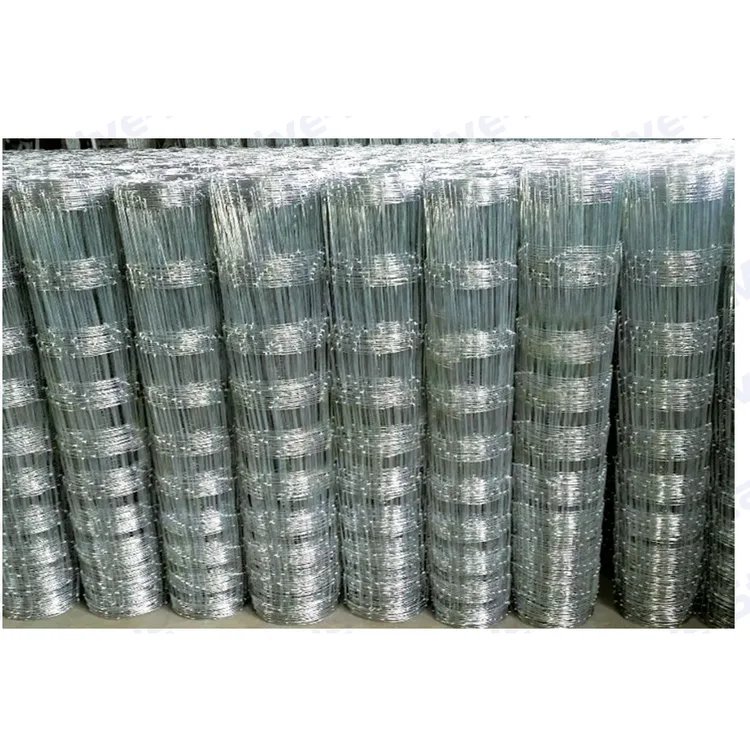
We are Hebei Leeter Import and Export Co., Ltd ("Leeter"), a wire, mesh and fencing manufacturer in Dingzhou, Hebei, China, exporting since 2006 to buyers across North America and Europe. Field fence is one of our highest-volume agricultural lines, and the spec combinations below are the ones our farm-store and ranch-supply customers reorder most.
How hinge joint field fence works
Field fence is a woven fence, not a welded one. Vertical stay wires wrap around the horizontal line wires at each intersection in a hinge joint knot. Under impact — a steer leaning in, a deer strike — the joints flex and the fence springs back instead of popping welds. Combined with the crimps rolled into the line wires, which act as built-in springs across temperature swings, this is why hinge joint remains the default perimeter fence for pasture worldwide: it tolerates abuse, follows rolling terrain, and tensions with basic tools.
The trade-off is that hinge joints can slide under sustained pressure from clever climbers like goats, which is why goat operations favor tighter stay spacing rather than a different knot at this price tier.
Height by animal: the core decision
| Livestock | Recommended height | Imperial | Notes |
|---|---|---|---|
| Sheep | 0.8–1.0m | 32–39 in | Tight bottom spacing keeps lambs in, predators out |
| Goats | 1.0–1.2m | 39–47 in | Choose close vertical stays; goats test fences |
| Cattle | 1.1–1.2m | 43–47 in | The volume standard; often run with a top barbed wire |
| Horses | 1.2–1.5m | 47–59 in | Closer stay spacing reduces hoof entrapment risk |
| Hogs | 0.8–0.9m | 32–35 in | Strong bottom wires resist rooting |
| Deer / elk exclusion | 1.8–2.4m | 71–94 in | 2.0m minimum where deer pressure is high |
Our full height range is 0.8, 0.9, 1.0, 1.1, 1.2, 1.5, 1.6, 1.8, 2.0 and 2.4m, so distributors can stock one product family that covers everything from lamb paddocks to orchard deer exclusion. In North American catalog terms, the 1.2m roll sells as the "47-inch field fence" equivalent and the 2.4m roll competes with 96-inch deer fence.
Graduated spacing: why the gaps change
A field fence roll is described by its horizontal wire count and spacing pattern. Spacing graduates from roughly 6cm (2.4 in) between the bottom wires up to about 15cm (6 in) between the top wires — a typical bottom-to-top progression runs 6-8-10-11 and on up in steps to 14-15cm. The logic is simple: escape and intrusion attempts happen low, where lambs squeeze and coyotes dig, so that is where the wire goes. Up high, wider gaps save steel without losing containment, because a cow challenges a fence with her chest, not her nose through a gap.
Vertical stay spacing is the second lever, and we weave it at 15, 18, 20, 40, 50, 60 or 65cm:
- 15–20cm stays (6–8 in): sheep, goats, hogs and horse fence, where small hooves and heads must not pass through or get caught.
- 40–50cm stays (16–20 in): the general cattle standard — economical and plenty for large stock.
- 60–65cm stays (24–26 in): budget perimeter and boundary lines under light pressure.
Tighter stays raise the steel content per meter, so a 1.0m sheep fence with 15cm stays can weigh as much per roll as a taller cattle spec. Always compare quotes on roll weight, not just height.
Wire diameters, coating and roll lengths
| Spec | Range | Typical cattle spec |
|---|---|---|
| Top/bottom line wires | 2.0–3.5mm | 2.5mm |
| Inner line wires | 1.8–2.5mm | 2.0mm |
| Vertical stay wires | matched to inner wires | 2.0mm |
| Coating | Hot-dip galvanized | Hot-dip galvanized |
| Roll lengths | 50m / 100m | 100m (328 ft) |
| Heights | 0.8–2.4m | 1.2m |
The top and bottom wires are the heaviest because they carry the tension and take the impact: 2.0mm at the economy end, 3.5mm for heavy cattle or long-life ranch spec. Inner wires at 1.8–2.5mm fill the grid. Hot-dip galvanizing is our standard coating on field fence — the fence lives outdoors for decades, and the thick zinc layer is what makes a 20-year fence rather than an 8-year one. If you also stock chain link fence or welded fence panels, the same galvanized-first logic applies across the range.
Rolls ship at 50m for retail-friendly handling and 100m for contractors and ranchers fencing long runs. A 100m roll of 1.2m cattle fence is the single best-selling SKU in the category.
Pairing field fence with studded T-posts
Field fence is a tensioned system: wood or heavy steel at corners and gates, steel T-posts along the line. Our studded T-posts come in 0.95, 1.25 and 1.33 lb/ft weights and 4–8 ft lengths, with studs that lock the line wires and clips in place.
Match the post to the fence: a 1.2m cattle fence pairs with 6 ft posts (driven roughly 18–24 in deep) in 1.25 lb/ft for normal ground, stepping up to 1.33 lb/ft for heavy stock, rocky ground or tight post spacing on corners and curves. Deer fence at 1.8–2.4m needs 8 ft posts. The 0.95 lb/ft post suits temporary strands and light sheep paddocks. Typical line-post spacing for field fence is 8–12 ft depending on terrain and animal pressure — quote posts and fence together and your customer gets a complete bill of materials from one container.
Ordering field fence for import
Specify five things: height, spacing pattern (stay spacing plus graduated horizontal pattern), wire diameters (top/bottom and inner), roll length, and quantity. Mixed containers are normal — for example, cattle rolls, a sheep spec, deer fence and matching T-posts in one 40 ft box. As a manufacturer we weave to order, so if your market expects a specific catalog pattern (a certain wire count at 47 in, for instance), send the pattern and we match it rather than forcing a stock grid.
Frequently asked questions
What height of field fence do I need for cattle?
1.1–1.2m (43–47 in) is the standard cattle height, usually with 40–50cm vertical stays and 2.5mm top and bottom wires. Many ranchers run one strand of barbed wire above the woven fence for bulls or crowded pastures rather than buying a taller roll.
How tall should a deer fence be?
Use 1.8m (71 in) as the minimum and 2.0–2.4m (79–94 in) where deer pressure is high — whitetail and red deer clear lower fences easily. Deer heights pair with 8 ft T-posts so there is still enough post in the ground after supporting the taller fabric.
What does graduated spacing mean on field fence?
The gaps between horizontal wires get smaller toward the bottom of the fence — from about 15cm near the top down to 6cm at the bottom, stepping through 14, 13, 12, 11, 10 and 8cm on the way down. Tight bottom wires stop lambs, piglets and digging predators; wider top gaps keep the price per meter down.
What is the difference between hinge joint and fixed knot fence?
Hinge joint wraps the vertical stay around each line wire, creating a flexible joint that absorbs impact and suits most livestock at the best price. Fixed knot uses a separate knot wire gripping a continuous vertical stay, giving a stiffer fence for high-tensile, wide-post-spacing systems at a higher cost. For standard cattle, sheep and general farm perimeters, hinge joint is the volume seller.
How many T-posts do I need per roll of field fence?
At typical 8–12 ft line-post spacing, a 100m (328 ft) roll needs roughly 28 to 41 line posts, plus wood or braced steel at corners, ends and gates. Order 6 ft posts at 1.25 lb/ft for 1.2m cattle fence and 8 ft posts for 1.8m-plus deer fence, and add about 5% spare posts and clips per container.
