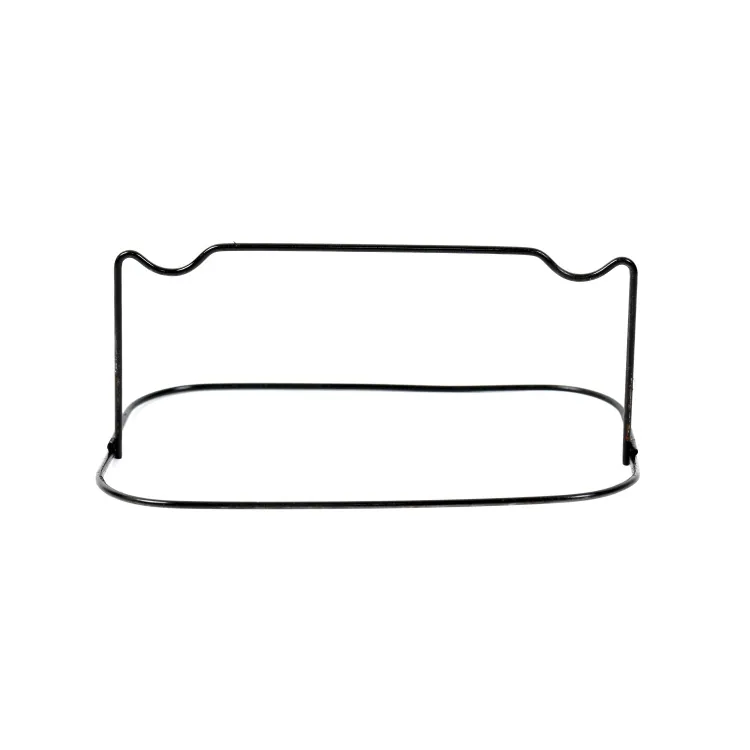
Getting the top mat right matters because that steel resists negative moment over supports and controls cracking at the slab surface. If the top bars sag, cover goes out of spec and the design capacity drops. A continuous high chair keeps the whole line true.
What is a continuous high chair?
A continuous high chair is a fabricated wire support running in one long piece, typically 5 feet (about 1.5 m) per unit, with repeating legs or a base runner and a top wire that cradles the reinforcing bars. It carries the top mat at a fixed height above the form or the bottom mat, delivering consistent concrete cover along the full run.
The design borrows from the individual high chair but stretches it into a continuous member. Where a single high chair supports steel at one point, a CHC supports a whole line. That means fewer pieces to place, faster layout, and a straighter mat because the top wire itself acts as a screed line for the bars resting on it.
Most CHCs use a triangular or trapezoidal leg profile repeated along the length. The apex or top run holds the bars; the feet spread the load onto the deck or lower mat. Contractors often set CHC rows perpendicular to the top bars so each bar crosses several support points at once.
How is a CHC different from an individual high chair?
The core difference is coverage: an individual high chair supports a single point, while a continuous high chair supports a full line of bars in one placement, cutting handling time on large pours. Both hold top steel at the same heights, but the CHC trades piece count for length.
Individual high chairs (with or without a plate base) suit narrow slabs, patch areas, congested zones, and spots where a continuous run cannot fit. They are also easier to nudge into position around penetrations and embeds. A continuous high chair shines on open decks and large mat pours where you want speed and a self-straightening top mat.
Here is a quick comparison to frame the choice.
| Feature | Continuous high chair (CHC) | Individual high chair |
|---|---|---|
| Support pattern | Whole line of bars | Single point |
| Typical unit length | 5 ft (1.5 m) | Point support |
| Placement speed on big pours | Faster | Slower (more pieces) |
| Best for | Open slabs, decks, mat foundations | Patches, congested zones, edges |
| Top-mat straightness | Self-aligning along the wire | Depends on spacing accuracy |
| Base options | Legged, plate, or runner | Legged or plate |
Neither is strictly better. Many jobs use both: continuous high chairs for the main field and individual high chairs to fill edges and awkward corners.
What heights do continuous high chairs come in?
Continuous high chairs are commonly stocked from 2 inches (50 mm) up to 15 inches (380 mm) of support height, measured from the base to the top wire that carries the bars. That range covers everything from thin elevated decks to deep mat foundations and transfer slabs.
Height selection follows a simple rule: the CHC height equals the required clearance from the form (or bottom mat) up to the underside of the top bars. You work back from the specified top cover, the top bar diameter, and where the bar sits relative to the support wire. Always confirm against the placing drawings, not a rule of thumb.
Low-height range (2 to 4 inches)
Shorter continuous high chairs handle elevated slabs and topping pours where the top mat sits only a few inches down from the surface. At these heights the legs are stiff and stability is rarely a concern, so lighter gauges can work.
Mid to tall range (5 to 15 inches)
Taller units serve thick slabs on grade, mat foundations, and heavy decks. As height climbs, the support becomes more slender and prone to racking under foot traffic and bar weight. Taller CHCs therefore need heavier wire, wider bases, or closer row spacing to stay plumb during placement and the pour.
Which base option should you choose?
The base carries every pound of top steel plus the workers walking the mat, so it is the single biggest driver of CHC stability. Continuous high chairs come with three main base styles: legged (bare feet), plate base, and runner base. Each suits a different deck surface.
A legged CHC rests on formed feet and works well on firm plywood or steel forms where the small footprint will not punch through. It is the lightest and most economical option and the easiest to strip after the pour.
A plate base adds a flat bearing plate under each leg, spreading load so the support does not sink into softer surfaces such as vapor barrier over compacted subgrade. Use plate bases on grade slabs and mat pours where point loads would otherwise dimple the membrane or embed into fill.
A runner base uses a continuous bottom wire tying the feet together along the length. This gives the best resistance to tipping and racking, which is why runner-base CHCs are favored at taller heights and on decks with heavy top steel. The tradeoff is more wire and higher cost per foot.
For point supports in the same job, many crews pair CHCs with rod chairs at edges and around openings where a continuous run does not fit.
What wire gauge keeps a CHC stable?
Wire gauge sets the load capacity and, more importantly on tall units, the resistance to bending and racking under construction traffic. Heavier wire holds height under load, while thinner wire can splay or lean, dropping the top mat out of cover. There is no single correct gauge; it depends on height, bar weight, and how much foot traffic the mat will take.
As a working guide, the taller the chair and the heavier the top mat, the heavier the wire should be. A 3-inch CHC under a light mesh top can use a lighter gauge than a 12-inch CHC under two layers of large-diameter bar. Row spacing also matters: placing CHC lines closer together shares the load and lets you use a given gauge at greater height without instability.
We build to the wire diameter the job calls for rather than pushing a one-size product. If you send us the top-mat bar size, spacing, chair height, and expected traffic, we recommend a gauge and base combination that stays true through the pour. Browse the full rebar supports category to see the range we produce.
Coatings matter too. Bare bright wire is standard and lowest cost. For corrosion-sensitive work or exposed surfaces, plastic-tipped feet or epoxy and galvanized options limit rust bleed and staining at the concrete surface. Match the coating to the exposure class in the spec.
Where are continuous high chairs used?
Continuous high chairs appear on almost any pour with a top reinforcing mat and enough open area to run long supports. Typical applications include slabs on grade, elevated structural decks, mat and raft foundations, bridge decks, water-retaining structures, and industrial floors carrying heavy top steel.
On mat foundations the top mat can be large-diameter bar at close spacing, a heavy load that demands runner-base CHCs at taller heights. On elevated decks the priority is speed and a flat mat, so contractors run long CHC lines and screed off the top wire. In water and wastewater structures, cover control is critical for durability, and a continuous support keeps the whole mat within tolerance.
The common thread is repetition. Wherever a long, uniform top mat repeats across a deck, a continuous high chair beats setting hundreds of point supports one at a time. Where the geometry breaks up, around drains, columns, and edges, individual supports fill the gaps.
To spec the right unit for your slab, request a quote with your drawings and we will size the height, gauge, and base for you.
Frequently asked questions
How many continuous high chairs do I need per square meter?
Quantity depends on top-mat weight, bar spacing, and required row spacing, not a fixed figure. As a starting point, crews run CHC lines perpendicular to the top bars at a spacing that keeps the bars from sagging between supports. Send us the mat layout and we will calculate row spacing and unit count for your pour.
Can a continuous high chair replace slab bolsters?
They serve different mats. Slab bolsters typically carry the bottom mat close to the form, while a continuous high chair holds the top mat at greater height. On a two-mat slab you often use bolsters below and CHCs above. They complement each other rather than substitute.
What is the tallest continuous high chair available?
Standard continuous high chairs run up to about 15 inches (380 mm) of support height. Taller supports are possible but usually shift to runner bases and heavier gauges for stability, or to alternative support systems. For heights near or above that range, share your details so we can confirm a stable configuration.
Do continuous high chairs need plastic tips?
Only when the spec calls for corrosion protection or the chair sits near an exposed surface. Bare wire feet are standard for buried or covered mats. Plastic-tipped feet, galvanizing, or epoxy coating reduce rust staining where feet touch forms or where the concrete face will be visible.
How do I keep a tall CHC from tipping during the pour?
Use a wider or runner base, step up the wire gauge, and tighten the row spacing so bars are supported often. Tying the top bars to the chair wire also locks the assembly. Vibrating and walking crews carefully near tall runs prevents racking before the concrete sets.
Talk to a supports manufacturer
Choosing the right continuous high chair comes down to matching height, wire gauge, and base to your top-mat weight and deck surface. Get any of those wrong and the mat drifts out of cover. Get them right and the top steel goes in fast and stays true through the pour.
Leeter has manufactured rebar supports since 2006 and exports to contractors and distributors across North America and Europe. Send us your slab thickness, top-mat bar size and spacing, required cover, and deck type, and we will recommend a CHC configuration built to your job. Request a quote to get sizing help and pricing on continuous high chairs and the full range of rebar supports.
