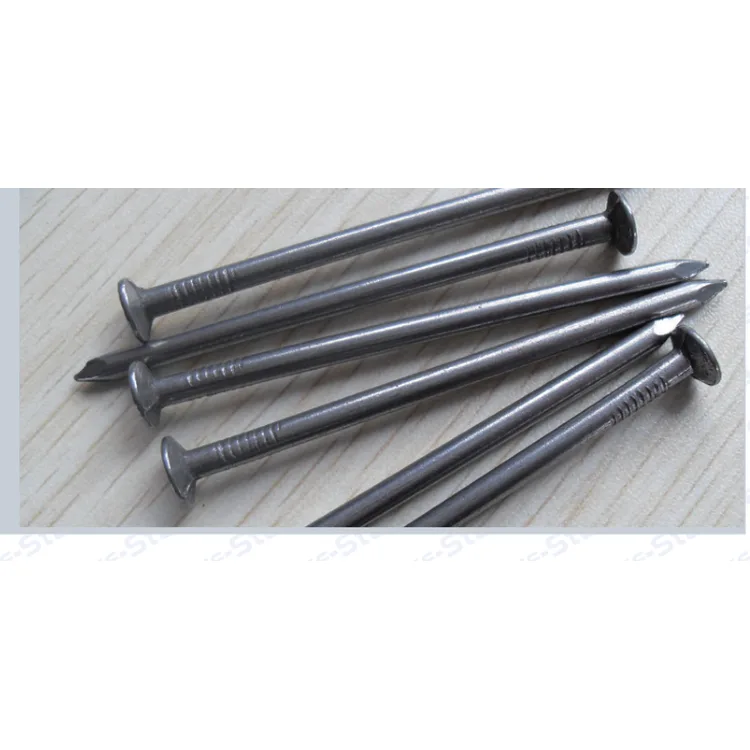
We are Hebei Leeter Import and Export Co., Ltd ("Leeter"), a construction wire, mesh and fencing manufacturer in Dingzhou, Hebei, China, exporting since 2006 to buyers across North America and Europe. Construction nails are one of our founding product lines, and the table below is the family map we use when hardware importers and building-material distributors build a container assortment.
The eight nail families at a glance
| Family | Size range | Gauge / shank | Head | Typical use |
|---|---|---|---|---|
| Common nails | 3/8"–7" (9.5–178mm) | 20–4 BWG, smooth | Common, countersunk or checked | General framing and carpentry |
| Concrete nails | 3/4"–3" | 12–7 BWG, hardened | Flat | Fixing to concrete, block and mortar |
| Cut masonry nails | 1-1/4" 3D–4" 20D | Tempered, tapered flat shank | Flat | Furring strips and sills on masonry |
| Coil roofing nails | 3/4"–2" | Smooth shank, collated | Large flat | Nail-gun roofing, asphalt shingles |
| Umbrella-head roofing nails | 1-3/4"–3" | Plain or twisted shank | Umbrella (dome) | Corrugated metal roof sheets |
| Pallet nails | 1-1/2"–3" | 11–12 ga, ring or spiral | Flat | Pallet and crate assembly lines |
| Duplex nails | 1-3/4" 6D–4" 30D | Smooth | Double head | Concrete formwork, scaffolding, temporary work |
| Finish nails | 1" 2D–4" 20D | Smooth | Cupped (brad) head | Trim, molding, fine carpentry |
Common nails: the volume item
Common nails are the baseline of any nail program: smooth-shank wire nails from tiny 3/8 inch tacks up to 7 inch spikes, drawn from 20 BWG at the fine end to heavy 4 BWG at the spike end. Three head styles are standard — the flat common head for framing, the countersunk head where the nail must sit flush or be filled over, and the checkered ("checked") head whose gridded face keeps the hammer from glancing off. Finishes are polished (bright), electro-galvanized (EG) for a thin zinc layer, or hot-dip galvanized (HDG) for exterior service. For export assortments, the mid lengths from 2 to 4 inches in framing gauges are the fast movers; the extremes sell steadily but thin.
Concrete nails vs cut masonry nails
Two different answers to the same problem — fastening into masonry — and worth stocking both:
- Concrete nails are drawn from hardened steel — 45#, 55# or 70# carbon grades — in 3/4 to 3 inch lengths and 12 to 7 BWG, finished black or electro-galvanized. The hardened, stiff shank drives into concrete, block and mortar joints without bending. Higher carbon grades take harder substrates; 45# suits mortar and green concrete, and 70# is for cured, hard concrete.
- Cut masonry nails are the traditional pattern: a tempered, tapered flat shank with a blunt point, from 1-1/4 inch 3D to 4 inch 20D. The taper wedges into the material and the blunt point crushes rather than splits, which is why carpenters still specify them for nailing furring strips and sill plates to older masonry.
The rule of thumb: round hardened concrete nails for production fixing into modern concrete; cut masonry nails where the trade tradition or the substrate calls for a wedging, non-splitting fastener.
Roofing nails: coil and umbrella head
Roofing splits into two products by roof type. Coil roofing nails — 3/4 to 2 inches, smooth shank, collated in coils — feed pneumatic roofing guns for asphalt-shingle work, where the large flat head holds the shingle without cutting through it. Umbrella-head roofing nails — 1-3/4 to 3 inches with a plain or twisted shank — are hand-driven through corrugated metal and fiber-cement sheets; the domed umbrella head sheds water over the hole, and the twisted-shank version adds withdrawal resistance where roofs see wind load. If your market roofs with shingles, stock coil nails; if it roofs with corrugated sheet (common across developing markets and farm buildings), umbrella heads are the volume item.
Duplex, pallet and finish nails
- Duplex (double-head) nails, 1-3/4 inch 6D to 4 inch 30D, drive to the lower head and leave the upper head standing proud, so formwork, scaffolding and other temporary structures strip fast without destroying the lumber. Any distributor selling to concrete contractors should carry them.
- Pallet nails, 1-1/2 to 3 inches in 11 to 12 gauge with ring or spiral shanks, are built for automated pallet and crate assembly: the deformed shank locks into softwood so pallets survive forklift abuse. Ring shank gives maximum withdrawal hold; spiral (screw) shank drives faster in dense timber.
- Finish nails, 1 inch 2D to 4 inch 20D with a small cupped head, sink below the wood surface with a nail set and disappear under filler — the trim carpenter's nail.
Choosing a finish: polished, EG or HDG
| Finish | Corrosion protection | Where to use it |
|---|---|---|
| Polished (bright) | None — bare steel | Interior framing, pallets, temporary work |
| Electro-galvanized (EG) | Thin zinc layer | Dry-service jobs needing rust delay in storage and light exposure |
| Hot-dip galvanized (HDG) | Thick zinc coating | Exterior framing, roofing, fencing, treated lumber |
The finish decision follows exposure. Bright nails are cheapest and fine indoors; EG covers warehouse shelf life and light-duty exterior; HDG is the answer wherever the nail lives outdoors — and the right companion spec when you also buy fence staples or galvanized metal lath accessories in the same container, so the whole assembly weathers at the same rate.
Building a container assortment
Nails ship dense — cartons on pallets, loaded to container payload — so a mixed order costs little more freight than a single-item order. A typical first container for a hardware importer runs: common nails across the 2–4 inch framing lengths in bright and HDG, concrete nails in two carbon grades, one roofing pattern matched to local roof style, duplex nails for formwork trade, and finish nails in the popular trim lengths. Specify each line as family, length, gauge (BWG), head, shank and finish, plus packing (bulk cartons or small retail boxes). As the manufacturer we draw, cut and head to the ordered gauge, and we hold hardness on concrete-nail grades — the spec that separates a nail that drives from one that bends.
Frequently asked questions
What sizes do common nails come in?
Common nails run from 3/8 inch to 7 inches (9.5 to 178mm) in wire gauges from 20 BWG at the fine end to 4 BWG for spikes. Heads are common flat, countersunk or checkered, and finishes are polished, electro-galvanized or hot-dip galvanized. The 2 to 4 inch framing lengths are the volume sizes.
What is the difference between concrete nails and masonry nails?
Concrete nails are round, hardened-steel nails (45#, 55# or 70# carbon grades, 3/4 to 3 inches, 12 to 7 BWG) that drive stiff and straight into concrete and block. Cut masonry nails are tempered flat nails with a tapered shank and blunt point (1-1/4 inch 3D to 4 inch 20D) that wedge into masonry without splitting it. Both are sold black or electro-galvanized; choose by substrate and trade preference.
What are duplex nails used for?
Duplex nails have two heads on one shank: you drive to the lower head for full holding power, and the upper head stays exposed so the nail pulls easily. They are the standard fastener for concrete formwork, scaffolding and temporary bracing, sized from 1-3/4 inch 6D to 4 inch 30D.
What size are roofing nails?
Coil roofing nails for nail guns run 3/4 to 2 inches with a smooth shank and a large flat head for asphalt shingles. Umbrella-head roofing nails for corrugated sheet run 1-3/4 to 3 inches with a plain or twisted shank; the domed head seals over the hole and the twisted shank resists wind pull-out.
Which nail finish should I buy for outdoor use?
Hot-dip galvanized. Bright (polished) nails rust quickly outdoors and electro-galvanizing only delays it; the thick HDG zinc layer is the standard for exterior framing, roofing and fencing work. Keep bright and EG for interior and dry-service lines where their lower cost wins.
