We are Hebei Leeter Import and Export Co., Ltd ("Leeter"), a wire and fencing manufacturer in Dingzhou, Hebei, China, exporting since 2006 to fence wholesalers and importers across North America and Europe. Chain link fence fabric is one of our highest-volume permanent fencing products, and this guide covers the specification decisions that determine your landed cost and your resale market.
Mesh size: 3/4 in to 4 in
Mesh size is the clear diamond opening, measured between parallel wires. Smaller mesh means more wire per square meter — more security and more cost. We weave the full range from 3/4 in (20x20mm) up to 4 in (100x100mm):
| Mesh size | Metric | Typical use |
|---|---|---|
| 3/4 in | 20x20mm | High-security, anti-climb infill |
| 1 in | 25x25mm | Security fencing, tennis court bottoms |
| 1-1/2 in | 40x40mm | Sports courts, pool fencing |
| 2 in | 50x50mm | The universal commercial/residential standard |
| 2-3/8 in | 60x60mm | Residential and general boundary (metric markets) |
| 3 in | 75x75mm | Light boundary fencing |
| 4 in | 100x100mm | Lowest-cost demarcation, temporary lines |
Two inch (50mm) mesh is the default in North American commercial work; 60x60mm plays the same role in metric-market residential fence. Mesh below 1-1/2 in is a security product and prices accordingly.
Wire gauge: 18 BWG to 8 BWG
Chain link wire is quoted in BWG (Birmingham Wire Gauge) in the export trade — remember that a smaller gauge number means thicker wire. We weave from 18 BWG (1.2mm) light fabric up to 8 BWG (4.0mm) heavy security fabric:
| BWG gauge | Approx. wire dia | Market position |
|---|---|---|
| 8 | 4.0mm (0.157 in) | Heavy security, prisons, highway |
| 9 | 3.8mm (0.148 in) | US commercial standard |
| 10 | 3.4mm (0.134 in) | Commercial |
| 11 | 3.0mm (0.120 in) | US residential standard |
| 12 | 2.8mm (0.109 in) | Residential / light commercial |
| 14 | 2.0mm (0.080 in) | Volume export residential (60x60x2.0) |
| 16 | 1.6mm (0.063 in) | Light-duty, garden |
| 18 | 1.2mm (0.047 in) | Lightest fabric, temporary demarcation |
For the US market, 9 ga x 2 in mesh is the commercial spec that framework, gates and tension hardware are all sized around, and 11–11.5 ga x 2 in covers residential. For PVC-coated fabric the gauge question doubles — you must state both core and finished wire diameter, which we cover in PVC-coated vs galvanized chain link.
Selvage: knuckled vs twisted
Selvage is how the wire ends are finished at the top and bottom edges of the fabric.
- Knuckled selvage bends each pair of wire ends back into a closed loop. Smooth, safe to touch, and the standard for residential fence, schools, parks and pool enclosures. In US practice, fabric under 6 ft (1.8m) is normally knuckled both edges.
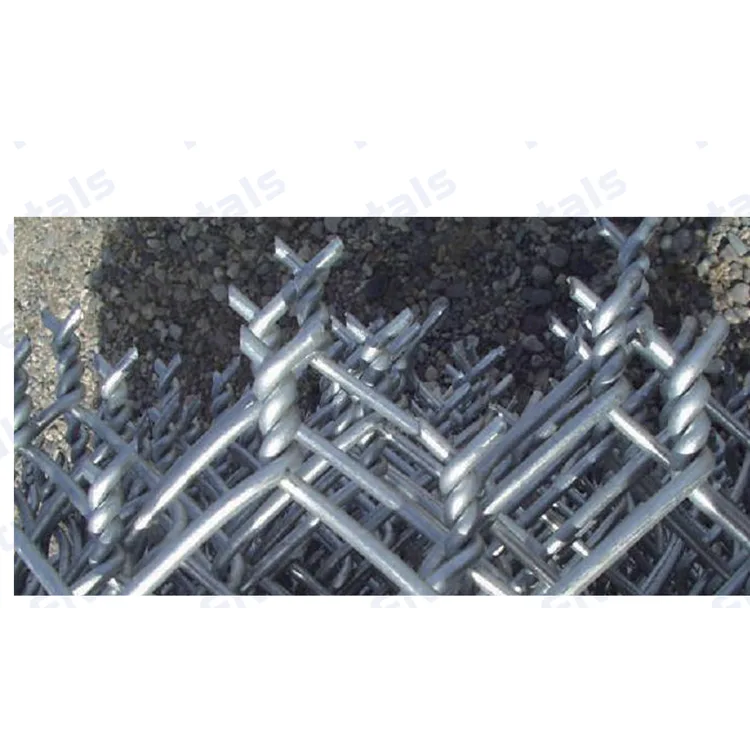
- Twisted (barbed) selvage twists the wire ends together and leaves them cut at a sharp angle, projecting above the top edge. It adds climb deterrence at zero material cost and is standard on 6 ft and taller commercial/industrial fence — knuckled bottom, twisted top.
Specify selvage per edge, e.g. "KK" (knuckled top and bottom) or "KT" (knuckled bottom, twisted top). If the fence line needs more deterrence than a twisted selvage, the usual step up is three strands of barbed wire on extension arms above the fabric, or razor coils for high-security sites.
Heights and roll lengths
We produce fabric heights from 0.5m to 4.0m (1.6–13 ft). The common export heights are 1.0m, 1.2m, 1.5m, 1.8m (6 ft) and 2.0m; taller 2.4–4.0m fabric serves sports courts and security perimeters. Standard roll lengths are 10m, 15m, 20m and 25m — 25m rolls are the volume export standard — while the US retail convention is the 50 ft roll. Rolls are compressed, wrapped and can be palletized; tell us your market's convention and we cut to it, because a distributor selling 50 ft rolls cannot retail 25m stock without repackaging. For retail channels we also apply printed labels or private-label wrap on request, and every quote includes per-roll weights and a container stuffing count so you can calculate landed cost per meter of fence line before you commit.
Chain link fabric is only part of the bill of materials: line posts, terminal posts, top rail, tension bands and ties make up the rest. Many of our buyers consolidate fabric with welded fence panels or field fence in the same container to serve both the urban and agricultural sides of their market from one shipment.
Finishes at a glance
Chain link comes electro-galvanized (economy, dry climates), hot-dip galvanized (the durability standard), or PVC-coated over a galvanized core for color and maximum corrosion resistance. Within galvanized fabric there are two production routes worth knowing: fabric woven from pre-galvanized wire (galvanized before weaving), and fabric woven from bare wire and then hot-dip galvanized as a finished mesh (galvanized after weaving). The after-weaving route seals every cut end and knuckle in zinc, which is why US commercial specifications often call for it by name, while before-weaving fabric is the faster, more economical route for general-purpose fence. State which route your market expects — the two look similar new but weather differently at the selvage. The popular PVC sizes are 50x50mm mesh at 1.8mm core / 2.8mm overall and 60x60mm at 2.0mm core / 3.0mm overall, in widths of 0.5–3m and rolls of 10–25m. The galvanized volume specs are 50x50x1.8mm and 60x60x2.0mm at 1–2m heights in 25m rolls. Which finish to import — and how to avoid the classic core-versus-overall diameter trap — is a big enough question that we wrote a separate guide comparing them.
RFQ checklist for chain link fabric
- Mesh size — 3/4 in to 4 in (20x20 to 100x100mm)
- Wire gauge — 18–8 BWG, stated in mm; for PVC, core and overall diameter
- Height — 0.5–4.0m — and roll length — 10/15/20/25m or 50 ft
- Selvage — knuckled or twisted, per edge
- Finish — EG, HDG or PVC-coated (with color)
- Quantity, packing requirements, destination port and incoterm
Frequently asked questions
What is the standard chain link fence mesh size and gauge?
For US commercial fencing, 2 in (50mm) mesh in 9 BWG (about 3.8mm) wire; for residential, 2 in or 2-3/8 in (60mm) mesh in 11 BWG (about 3.0mm). The volume export specs we ship are galvanized 50x50x1.8mm and 60x60x2.0mm at 1–2m heights in 25m rolls. Smaller 3/4–1 in mesh is used where climb resistance matters.
What is the difference between knuckled and twisted selvage?
Knuckled selvage bends the wire ends into smooth closed loops — safe and standard for residential fence and anywhere the public touches the fence. Twisted (barbed) selvage twists the ends together and leaves sharp projecting points for climb deterrence, normally on the top edge only of 6 ft and taller commercial fence. Specify per edge: knuckled/knuckled or knuckled bottom with twisted top.
How long is a roll of chain link fence?
Export rolls are 10m, 15m, 20m or 25m, with 25m (82 ft) the volume standard; the US retail convention is 50 ft rolls. Heights run 0.5m to 4.0m (1.6 to 13 ft). Order the roll length your retail channel expects — repackaging metric rolls for a 50 ft market erases the savings of a bulk order.
Which is thicker, 9 gauge or 11 gauge chain link?
9 gauge — in BWG, smaller numbers mean thicker wire. 9 BWG is about 3.8mm and is the US commercial standard; 11 BWG is about 3.0mm and covers residential fence. The full range we weave is 18 BWG (1.2mm) to 8 BWG (4.0mm). Always confirm the millimeter diameter on the quote, since gauge systems differ between countries.
Can chain link fabric be made higher than 8 feet?
Yes. We weave fabric up to 4.0m (13 ft) for sports courts and security perimeters. Tall fence is normally 2 in mesh or smaller in 9 BWG or heavier wire, often with a twisted top selvage or barbed wire on extension arms above the fabric.
