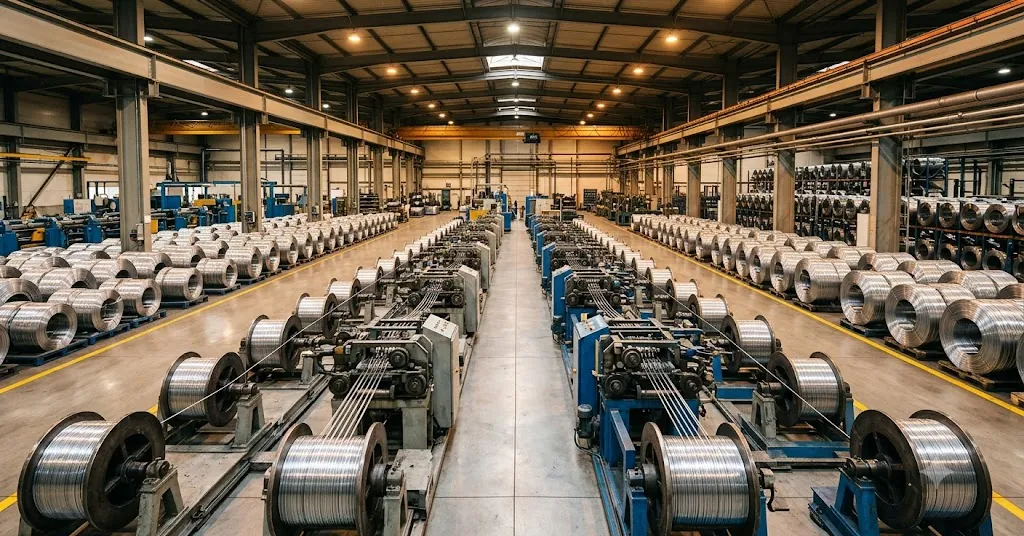
We are Hebei Leeter Import and Export Co., Ltd ("Leeter"), an anchors exporter based in Dingzhou, Hebei, running since 2006 and shipping mostly to North America and Europe. This guide is the honest, checklist-driven version of the conversation we have with new buyers every week. No sales spin, just the trade-offs.
Start with the spec, not the price
Price is the last decision, not the first. Before anyone quotes you, define what an anchor bolt actually has to do on your job. A cast-in-place J-bolt holding a sill plate is a different animal from a headed anchor bolt embedded in a concrete pier, and both differ from a wedge or sleeve expansion anchor drilled into cured slab. If your inquiry only says "anchor bolts, 100,000 pcs," any supplier will fill in the blanks for you, and you may not like the answers.
Write your spec around six data points and share all of them at once:
- Type: cast-in-place (L-bolt, J-bolt, headed, double-end/all-thread) or post-installed (wedge, sleeve, drop-in).
- Diameter and length: metric or imperial, stated clearly, with thread length called out.
- Thread standard: UNC/UNF for imperial, metric coarse for the rest.
- Grade or material: carbon steel, ASTM F1554 grade 36/55/105, or stainless.
- Finish: plain, zinc-plated, hot-dip galvanized, or mechanical galvanized.
- Hardware: how many nuts and washers per bolt, and which grade.
Send drawings when you have them. A dimensioned drawing removes more risk than any email thread, because it becomes the reference both sides inspect against later.
Which grade and certification do you actually need?
Grade is a structural decision, so treat it as one. In North America, structural anchor bolts commonly follow ASTM F1554, which covers three yield grades: 36, 55, and 105. Grade 36 suits general anchorage. Grade 55 is the workhorse for most structural steel bases. Grade 105 handles high-load connections. If your engineer specified a grade, that number is not negotiable to save a few cents, and a good supplier will not encourage you to swap it.
Certification is what proves the steel matches the spec. Ask for a mill test certificate (MTC, often called a 3.1 cert) that ties the heat number of the raw material to its chemical composition and mechanical properties. For a deeper walkthrough of what to look for on these documents, see our companion resource on reading a mill cert correctly. The short version: the cert should name the grade, list yield and tensile values, and trace back to a heat number you can match to the physical goods.
Quick grade and cert reference:
| Grade (ASTM F1554) | Typical use | Cert to request |
|---|---|---|
| 36 | General anchorage, light bases | MTC 3.1 with chemistry + mechanicals |
| 55 | Most structural steel base plates | MTC 3.1, weldability (S1) if welded |
| 105 | High-load, seismic, heavy connections | MTC 3.1 + supplementary testing |
| Stainless (304/316) | Corrosive or coastal exposure | MTC 3.1 + PMI on request |
If a supplier hesitates when you ask for a mill cert, treat that as your answer and keep shopping.
What finish survives your environment?
Finish decides how long the bolt lives once it is in the ground. Zinc electroplating gives a thin, bright, low-cost coating that suits dry, indoor, or short-service applications. Hot-dip galvanizing (HDG) lays down a much thicker zinc layer that holds up outdoors and in wet or coastal conditions, which is why most exterior structural anchors ship hot-dipped.
There is a real trade-off buyers often miss: hot-dip galvanizing adds thickness to threads. The nuts have to be tapped oversize (overtapped) to spin on freely after coating, and that overtapping slightly reduces thread engagement. It is standard practice and perfectly safe when done right, but the nuts and bolts must be galvanized and matched as a set. Mixing a plain nut onto a hot-dip bolt, or vice versa, causes galling and seizing on site. So when you specify HDG, specify it for the whole assembly, not just the bolt.
For coastal or chemical exposure, stainless steel skips coatings entirely and resists corrosion through the material itself, at a higher unit cost. Decide by service life, not by the cheapest line item.
Are the nuts and washers included?
This is where surprise costs hide. An anchor bolt is a system: bolt, nut (sometimes two, for a leveling nut and a top nut), and washer (often a heavy hex or plate washer). Some quotes bundle the hardware. Some quote the bolt alone and add nuts and washers as separate lines. If you compare a bundled quote against a bolt-only quote, the cheaper number can end up costing more once you add the missing pieces.
Spell out per-bolt hardware in your inquiry:
- Nuts per bolt (1 or 2) and grade
- Washers per bolt and type (flat, heavy hex, plate)
- Finish matched across bolt, nut, and washer
- Whether nuts are overtapped for galvanized assemblies
- Whether hardware is pre-assembled or shipped loose
Matched, pre-assembled hardware costs a little more in labor but saves your crew from sorting mismatched parts in the field. That is usually the cheaper choice once you count site time.
How do MOQ, lead time, and container economics really work?
Bulk anchor bolts are heavy and low-value per piece, which flips the usual import math. Freight and steel cost, not the bolt-making labor, drive your landed price. Because the goods are dense, a single 20-foot container often hits its weight limit long before it fills the volume. That is good news: you can move a large quantity in a small box. It also means the sensible order size is frequently "whatever fills a container by weight," and quoting below that leaves the freight per piece high.
Minimum order quantity ties directly to setup. Standard diameters and lengths in common grades carry low MOQs because the tooling and threading are routine. Custom lengths, special bends, unusual grades, or non-stock finishes push the MOQ up, since the run has to justify a dedicated setup. Lead time follows the same logic: stock-pattern orders move faster, while custom geometry, hot-dip galvanizing, and third-party testing each add days.
Landed-cost planning checklist:
| Factor | Ask before you order |
|---|---|
| MOQ | Is my size/grade a standard run or a custom setup? |
| Container fit | Will this order weigh out or cube out a 20ft box? |
| Lead time | Production + galvanizing + testing + booking, in days |
| Incoterm | FOB, CIF, or DAP, and who handles customs |
| Packaging | Bulk in kegs/crates vs. palletized for the yard |
If you are new to importing hardware from China, our broader importing guide walks through incoterms, customs, and documentation in more depth than we can here.
Should you inspect before it ships?
Yes, and the cheapest time to catch a problem is before the container doors close. Inspection does not have to mean a plane ticket. Ask your supplier for documented in-process checks, and consider a third-party inspection agency for large or first-time orders. The point is to verify against your drawing and spec, not against a vague description.
A workable pre-shipment inspection checklist:
- Dimensions match the drawing (diameter, length, thread length, bend)
- Thread gauges pass on a sampled quantity
- Finish thickness meets the galvanizing spec
- Nuts spin freely down the full thread by hand
- Heat number on the goods matches the mill cert
- Quantity and packaging counts are correct
- Marking and grade stamps are legible where required
Approve a physical sample before mass production whenever the part is custom. A sample settles arguments no email can, and it gives your engineer something real to bless. Skipping the sample to save a week is the trade we see backfire most often.
A note on trade-offs
No supplier can give you the lowest price, the shortest lead time, full certification, and custom geometry all at once. Something gives. Standard sizes in stock grades are fast and cheap but may not match a tight engineering spec. Fully certified, custom, hot-dip galvanized assemblies with third-party testing cost more and take longer, and they are worth it when the connection is structural. An honest exporter tells you which lever you are pulling. Decide what the job truly needs, then hold that line.
Frequently asked questions
What is the minimum order for bulk anchor bolts from China?
It depends on whether your size and grade are standard or custom. Common diameters and lengths in stock grades carry low minimums because threading and tooling are routine. Custom lengths, special bends, unusual grades, or non-stock finishes raise the MOQ to justify a dedicated production run. Share your spec and ask directly.
Do I really need a mill test certificate?
For structural anchor bolts, yes. A mill test certificate (3.1) links the steel's heat number to its chemistry and mechanical properties, proving the grade you paid for is the grade you received. It is your defense if a lot is ever questioned on site. Any supplier reluctant to provide one should raise a flag.
Hot-dip galvanized or zinc-plated: which should I choose?
Match the finish to the environment. Zinc plating is thin, bright, and low-cost, suited to dry or indoor use. Hot-dip galvanizing lays down a thick zinc layer that survives outdoor, wet, and coastal exposure, which is why most exterior structural anchors ship hot-dipped. For galvanized assemblies, the nuts must be overtapped and the whole set galvanized together.
Are nuts and washers included in the price?
Not always, so ask. Some quotes bundle a matched nut and washer per bolt; others price the bolt alone. Comparing a bundled quote against a bolt-only quote hides real cost. Specify nuts per bolt, washer type, matched finish, and whether hardware ships pre-assembled or loose before you compare numbers.
How long does a bulk anchor bolt order take?
Lead time stacks: production, then galvanizing if required, then any third-party testing, then booking and ocean transit. Stock-pattern orders in common grades move fastest. Custom geometry, hot-dip galvanizing, and independent inspection each add days. Ask your supplier for a stage-by-stage timeline in days so you can plan the site schedule around it.
Ready to source with a clear spec?
Bring us your drawing, grade, finish, and hardware requirements, and we will quote against exactly what your job needs, no substitutions slipped in to shave the price. If you are still finalizing the spec, we are happy to talk through the trade-offs first. When you are ready, request a quote and we will walk you through MOQ, lead time, certification, and container economics for your bulk anchor bolts.
