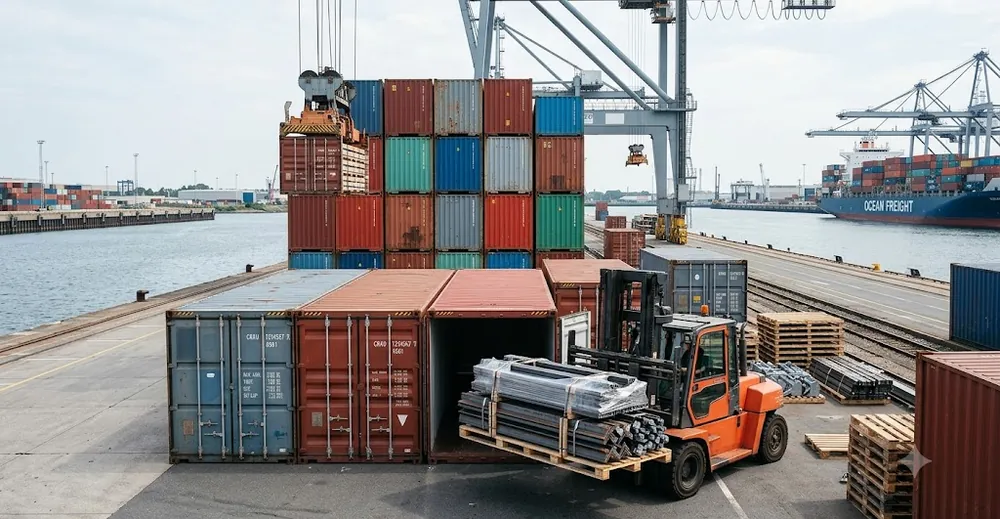
We have exported wire mesh, tie wire, anchor bolts, form stakes and rebar supports from Hebei since 2006, mostly to buyers in North America and Europe. This guide is the process we walk our own customers through, written plainly, including the parts that trip people up.
Key takeaways
- Vet suppliers by confirming a real business license and whether they are a factory or a trader before discussing price.
- Most import disputes trace back to a vague spec or a skipped inspection, not a dishonest supplier.
- Use written Incoterms 2020 terms (FOB or CIF are common for steel goods) so cost and risk transfer are unambiguous.
- A T/T deposit plus balance against documents is standard; an L/C at sight shifts risk to the bank for large first orders.
- Confirm HS codes, duties and anti-dumping status with a licensed customs broker, never with the supplier alone.
Why source construction hardware from China at all?
China produces more than half the world's crude steel — over 1 billion tonnes annually (World Steel Association) — which is why so much construction hardware supply concentrates there. That scale gives buyers competitive pricing, deep raw-material availability and short internal lead times on standardized items like mesh, wire and bolts. The trade-off is distance, communication gaps and the need for disciplined quality control.
In our experience the buyers who do best treat China sourcing as a supply-chain relationship, not a one-off bargain hunt. They accept that a first order costs more in effort, then reorder for years once the spec and packaging are dialed in.
How do you vet a supplier before sending money?
Most cross-border quality and payment problems are preventable with basic due diligence, so vetting is the highest-return hour you will spend on the whole order. Do it before price negotiation, not after.
Start by confirming the company is who it claims to be. Ask for the business license and check the registered name, scope and registration number. Then answer one question that changes everything: are you talking to a factory or a trading company?
Factory or trader, and does it matter?
A factory owns production and controls quality directly; a trading company buys from factories and resells. Neither is automatically wrong. Traders can be useful for mixed small orders across many product types. But for a single high-volume item, buying from the manufacturer usually means better pricing, direct spec control and faster problem-solving.
Here is the honest nuance most guides skip: many "factories" you find online are traders with a rented showroom, and some genuine manufacturers use a trading arm for export paperwork. Do not judge by the website. Ask to video-call the production line, request the machine list, and check that the bank account name matches the licensed company. A mismatch between the invoice name and the bank account is the single biggest red flag we see.
Supplier vetting checklist
- Verified business license (name, scope, registration number)
- Factory versus trader confirmed by video walkthrough of the line
- Export experience to your country or region, with references
- Certifications relevant to your product (mill certs, ISO, CE where applicable)
- Bank account name matches the licensed company exactly
- Responsiveness and clarity in written English communication
- Willingness to provide samples and accept third-party inspection
What should a good RFQ include?
A precise request for quotation removes the guesswork behind most downstream disputes. Vague inquiries get vague prices. A tight RFQ gets you a comparable, defensible quote and signals that you are a serious buyer who will inspect.
Tell the supplier exactly what you need. For steel hardware that means grade, dimensions, tolerances, coating, finish, quantity and packaging. The more you specify, the less room there is for a cheaper substitute to appear in the container.
RFQ checklist for construction hardware
- Product name and standard (for example ASTM, EN, or GB reference)
- Material grade and, for rebar tie wire, gauge and coating (black annealed, galvanized, PVC)
- Exact dimensions and acceptable tolerances
- Finish and coating thickness where relevant
- Quantity, plus expected annual volume for pricing leverage
- Packaging spec (coil weight, carton, pallet, or bundle)
- Required documents (mill test report, packing list, certificate of origin)
- Target Incoterm and destination port
- Requested lead time and any hard deadline
Ask for the price on a stated Incoterm and a stated currency, valid for a stated number of days. Steel prices move, so a quote without a validity window is close to meaningless.
Which Incoterms 2020 should you use for building materials?
Incoterms 2020, published by the International Chamber of Commerce, define exactly where cost and risk pass from seller to buyer, and misreading them is a top cause of unexpected freight bills. For heavy, container-shipped construction hardware, most buyers land on FOB or CIF. Your choice depends on who you trust to arrange ocean freight and insurance.
| Incoterm | Seller pays / risk until | Buyer takes over | Best for |
|---|---|---|---|
| EXW (Ex Works) | Goods at seller's door | Everything after pickup | Buyers with a strong China forwarder |
| FOB (Free On Board) | Goods loaded on vessel | Ocean freight, insurance, import | Most experienced importers |
| CIF (Cost, Insurance, Freight) | Arrival port, incl. insurance | Import duties, inland delivery | Buyers wanting a landed-port price |
| CIP (Carriage and Insurance Paid To) | Named destination, incl. insurance | Import clearance onward | Multimodal or door shipments |
FOB is the workhorse for steel. You control the ocean leg through your own freight forwarder, which usually means better rates and visibility. CIF hands the freight and marine insurance to the seller — simpler for newer importers, but you lose some cost transparency. EXW gives you total control and total responsibility, which suits buyers with a capable China-side forwarder and no one else.
What payment terms are safe when importing from China?
The letter of credit remains one of the most secure instruments in trade finance, but most routine hardware orders run on a simpler telegraphic transfer arrangement. The right choice scales with order size and how well you know the supplier.
The common structure is a T/T deposit, often 30%, with the 70% balance paid against a copy of the bill of lading before the original documents release. That balances risk: the supplier commits materials on your deposit, and you pay the bulk only once goods are loaded and provable.
T/T versus L/C at a glance
| Factor | T/T (bank transfer) | L/C at sight |
|---|---|---|
| Cost | Low, small bank fees | Higher bank charges |
| Speed | Fast to set up | Slower, document-heavy |
| Buyer protection | Moderate, relies on trust | Strong, bank-controlled |
| Best for | Repeat or vetted suppliers | Large first orders, unknown supplier |
| Complexity | Simple | Requires exact document compliance |
We have found that a first-time buyer placing a large order sleeps better with an L/C at sight, even with the extra fees, because the bank releases payment only against compliant documents. Once trust is built over a few clean shipments, most buyers move to straight T/T to save time and cost. Never pay 100% up front to a supplier you have not verified, and never send a balance before the goods are demonstrably loaded.
What about samples, MOQ and lead time?
Approving a physical sample before mass production is the single cheapest insurance in the whole process, catching spec errors that would otherwise fill a 20-foot container. Ask for a production sample, not a showroom piece. For a repeat item, a photo-plus-mill-cert approval may suffice; for a new spec, hold the sample in hand.
Minimum order quantity for construction hardware usually tracks a full or partial container, because ocean freight economics reward volume. Lead time for standardized items like wire, mesh and anchor bolts commonly runs a few weeks after deposit and sample sign-off, longer for custom coatings, non-standard sizes or peak-season steel demand. Get the lead time in writing and tied to the deposit date, not the inquiry date.
Do a pre-production approval on anything custom. A quick drawing sign-off or first-article photo before the line runs prevents the expensive scenario where an entire batch is dimensionally wrong and already coated.
How do you control quality on a steel order?
Documented quality control turns a leap of faith into a checkable process, and third-party pre-shipment inspection catches defects before they cross an ocean. Two pillars matter for steel hardware: the mill test report and an AQL pre-shipment inspection. Skip neither on a first order.
A mill test report (MTR), sometimes called a mill certificate, states the material's chemical composition and mechanical properties against the claimed standard. It ties your delivered goods back to a verifiable heat of steel. For structural items this document is not optional; it is your paper trail if anything is ever questioned on site.
Pre-shipment inspection checklist
- MTR reviewed and matched to the ordered grade and standard
- AQL sampling for visual and surface defects
- Dimensional checks against the approved spec and tolerances
- Coating thickness or galvanizing weight verified where specified
- Quantity and carton or coil count confirmed
- Packaging integrity for sea freight (moisture, corrosion protection)
- Container loading photos or on-site inspector sign-off
A point buyers underrate: dimensional tolerance disputes cause more rejected loads than outright material failures. Wire diameter, mesh opening and bolt length that drift a millimeter out of tolerance still pass a casual glance but fail on a job site. Specify tolerances in the RFQ, then verify them with calipers at inspection. That one discipline prevents most claims.
You can hire an independent inspection agency for an AQL check, use a supplier who welcomes third-party inspectors, or both. A manufacturer confident in its output will not resist an inspector on the floor.
How is a container of steel hardware packed and loaded?
Correct packaging protects both the product and your margin, because corrosion and transit damage in a humid ocean container can write off an otherwise perfect order. Steel wire and mesh are typically coiled, bundled or palletized, then protected against moisture with wrapping and desiccant on long routes. Weight distribution inside the container matters for both safety and customs.
Confirm the packing method in your RFQ and again at inspection. Ask for loading photos. A container packed with dense steel needs even weight distribution and secure blocking so coils do not shift and damage each other or the container in transit.
What should you know about HS codes, duties and trade compliance?
Every imported product needs a Harmonized System code, the classification that determines your duty rate, and getting it wrong risks fines and delays. The honest guidance here is short: confirm your HS classification, applicable duties and any anti-dumping or countervailing duty status with a licensed customs broker in your own country (U.S. Customs and Border Protection publishes the classification framework). Do not rely on the supplier for this.
Certain steel products from China carry anti-dumping or countervailing duties in some markets, and these change. We will not quote rates in this guide because they vary by product, origin and date, and stating a wrong number could cost you real money. Your customs broker checks the current tariff schedule and trade-remedy orders against your exact HS code before you commit to an order. Build that step into your timeline, not after the container ships.
How do you build a supply relationship that lasts?
Reorder economics reward loyalty: repeat orders remove the sampling, vetting and first-article costs, so your effective landed cost drops after the first clean shipment. The most valuable thing you build with a supplier is not a single low price, it is a partner who knows your spec, holds your tooling and prioritizes your restock.
The buyers we have worked with for a decade started with one carefully vetted order, inspected it hard, paid on time, then consolidated volume with us. Predictable reorders let us plan production and hold pricing steadier for them through raw-material swings. Trust, proven over a few clean shipments, is worth more than shaving a few cents on order one.
Frequently asked questions
What is the difference between FOB and CIF when importing from China?
Under FOB, the seller delivers goods loaded on the vessel and you arrange and pay for ocean freight, insurance and import; under CIF, the seller pays freight and marine insurance to your destination port. FOB gives you more cost control through your own forwarder, while CIF is simpler for newer importers who want a single landed-port price.
Is T/T or L/C safer for a first order?
An L/C at sight is safer for a large first order because your bank releases payment only against compliant shipping documents, shifting control to the banks. A T/T deposit plus balance against the bill of lading is faster and cheaper and works well once you have vetted the supplier. Match the instrument to order size and trust level.
What are typical MOQ and lead times for construction hardware?
Minimum order quantity usually tracks a full or partial container because ocean freight rewards volume. Lead time for standardized wire, mesh and bolts commonly runs a few weeks after your deposit and sample approval, and longer for custom coatings, non-standard sizes or peak steel demand. Always get the lead time in writing, dated from the deposit, not the inquiry.
How do I inspect quality before the goods ship?
Review the mill test report against your ordered grade, then arrange an AQL pre-shipment inspection covering visual defects, dimensions, tolerances, coating thickness and quantity. Use an independent inspection agency or a supplier who welcomes third-party inspectors on the floor. Request container loading photos so you have a record before the goods leave the origin port.
How do I verify that a Chinese supplier is legitimate?
Confirm the business license name, scope and registration number, then establish whether you are dealing with a factory or a trader through a live video walkthrough of the line. Check that the bank account name matches the licensed company exactly, ask for export references to your region, and start with an inspected, modestly sized order before scaling volume.
Ready to import construction hardware with a manufacturer that welcomes your inspector and puts terms in writing? Contact our export team at Leeter to request a quote, request a sample, or talk through your spec. We have shipped wire, mesh, anchor bolts and rebar supports worldwide since 2006, and we are happy to walk you through your first order step by step.
