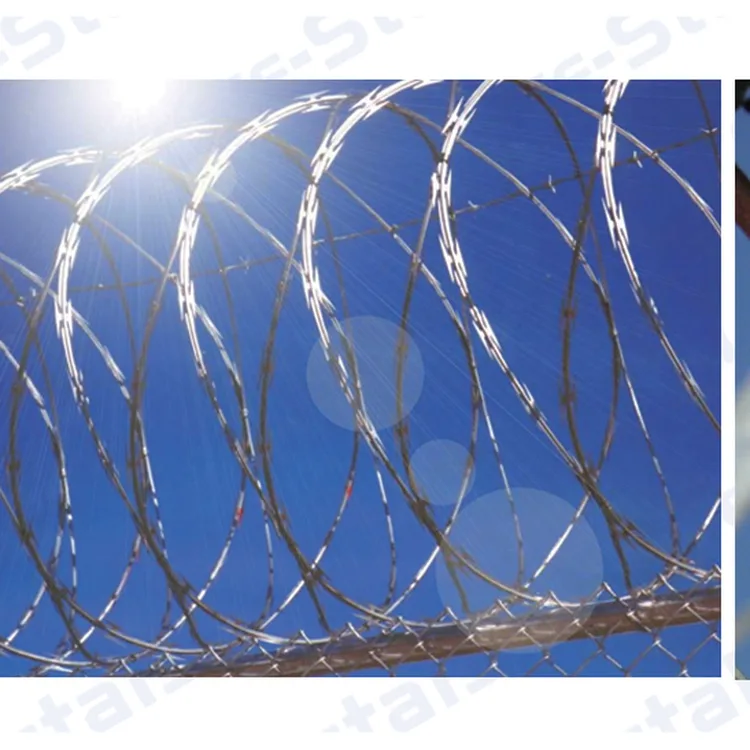
We are Hebei Leeter Import and Export Co., Ltd ("Leeter"), a wire and fencing manufacturer in Dingzhou, Hebei, China, exporting since 2006 to security-fence distributors and importers across North America and Europe. Razor wire is one of our permanent-fencing lines, and every number in this guide is a spec we manufacture to.
What the BTO and CBT codes mean
Razor wire (also called razor barbed tape or concertina wire) is a steel strip punched into a blade pattern and cold-crimped around a high-tensile core wire. The profile code tells you the barb length:
- BTO profiles are short-barb blades. BTO-22 means 22±1mm barbs; BTO-10 means 10mm barbs, and so on up to BTO-30. All BTO profiles use 0.5±0.05mm blade thickness on a 2.5±0.1mm core wire.
- CBT profiles are long-barb blades. CBT-65 has 65±2mm barbs punched from 0.6±0.05mm strip at 100±2mm spacing — fewer, much longer blades that read as visibly more aggressive on a wall or fence top.
Barb spacing scales with barb size in the BTO family: BTO-10 and BTO-12 run at 25±1mm spacing, BTO-22 at 36±1mm, and BTO-28/30 at 45±1mm.
| Profile | Blade thickness | Barb length | Barb spacing | Core wire |
|---|---|---|---|---|
| BTO-10 | 0.5±0.05mm | 10±1mm | 25±1mm | 2.5±0.1mm |
| BTO-12 | 0.5±0.05mm | 12±1mm | 25±1mm | 2.5±0.1mm |
| BTO-18 | 0.5±0.05mm | 18±1mm | confirm at RFQ | 2.5±0.1mm |
| BTO-22 | 0.5±0.05mm | 22±1mm | 36±1mm | 2.5±0.1mm |
| BTO-28 | 0.5±0.05mm | 28±1mm | 45±1mm | 2.5±0.1mm |
| BTO-30 | 0.5±0.05mm | 30±1mm | 45±1mm | 2.5±0.1mm |
| CBT-65 | 0.6±0.05mm | 65±2mm | 100±2mm | — (long-barb strip) |
BTO-22 is the profile most tenders mean when they say "razor wire" without further detail. BTO-10 and BTO-12 are compact profiles for flat-wrap and tight coils; BTO-28 and BTO-30 sit between the standard and long-barb options. CBT-65 is the specification for high-deterrence perimeters where the visual threat of long blades matters as much as the physical barrier.
Single coil vs cross-type (clipped concertina)
The same blade profiles ship in two coil constructions, and the construction changes the coverage per coil more than the profile does.
- Single coil: a plain helical coil with no clips. It expands like a spring and is typically stacked or run as a single line on walls and fence tops. Simple, cheapest per loop.
- Cross-type (clipped concertina): adjacent loops are joined with steel clips at alternating points, so the coil opens into a self-supporting cylinder of crossed loops. It stretches further per coil, holds its shape without sagging, and recovers if compressed. This is the standard for military-style perimeter runs and rapid deployment.
Coverage per coil is a function of coil outside diameter (OD), number of loops, and construction:
| Construction | Coil OD | Loops | Stretched length |
|---|---|---|---|
| Single coil, CBT-65 | 450mm (18 in) | 33 | 8m (26 ft) |
| Single coil, CBT-65 | 500mm (20 in) | 41 | 10m (33 ft) |
| Single coil, CBT-65 | 700mm (28 in) | 41 | 10m (33 ft) |
| Single coil, CBT-65 | 960mm (38 in) | 53 | 13m (43 ft) |
| Cross-type, BTO-12/18/22 | 500mm (20 in) | 102 | 16m (52 ft) |
| Cross-type, BTO-12/18/22 | 600mm (24 in) | 86 | 14m (46 ft) |
| Cross-type, BTO-12/18/22 | 700mm (28 in) | 72 | 12m (39 ft) |
| Cross-type, BTO-12/18/22 | 800mm (31 in) | 64 | 10m (33 ft) |
| Cross-type, BTO-12/18/22 | 960mm (38 in) | 52 | 9m (30 ft) |
Note the pattern: for cross-type coils, a larger OD covers less length per coil, because the loops stand taller and the clip geometry opens less along the run. Distributors quoting an installed perimeter should price per stretched meter, not per coil — a 500mm cross coil at 16m covers nearly twice the distance of a 960mm coil at 9m, but the 960mm coil presents a much taller barrier.
Materials and finishes
The blade strip is either galvanized steel — electro-galvanized for economy, hot-dip galvanized for longer outdoor life — or stainless steel for coastal and long-service installations. The core wire is high-tensile galvanized steel, which is what gives concertina its spring and cut resistance. For most export perimeter work we recommend hot-dip galvanized blades; specify stainless blades when the tender demands a service life that plain zinc cannot meet, and expect a significant price step when you do.
Razor wire is usually one line item in a larger security package. It tops chain link fence runs and walls, and pairs with barbed wire where a tender mixes deterrent levels across zones — we regularly consolidate all three into one container.
Packing and shipping
Concertina coils ship compressed: each coil is squeezed flat against its spring, strapped through the loops, and wrapped — woven cloth, kraft paper or carton, depending on how much handling protection the route needs — then stacked on pallets. Compression is what makes razor wire economical to ship, since a coil that deploys to many meters of perimeter travels as a slim, dense bundle. Two practical points for importers: first, insist that straps are fitted so the coil cannot release in transit, because a sprung coil in a container is genuinely dangerous to unload; second, remind your warehouse that coils must be cut open with the blades pointed away and handled with cut-resistant gloves and eye protection. We mark every pallet with profile, OD, loop count and stretched length so mixed orders can be sorted without opening the wrapping.
How to specify razor wire in an RFQ
A complete razor wire specification has six parts. Missing any one of them is the most common cause of requoting:
- Blade profile — e.g. BTO-22 or CBT-65
- Construction — single coil or cross-type (clipped concertina); for cross-type, state the number of clips per loop pair if your tender defines it
- Coil OD — 450–960mm (18–38 in) per the tables above
- Loops per coil and required stretched length
- Material/finish — electro-galvanized, hot-dip galvanized, or stainless blades
- Packing — coils compressed and strapped, carton or woven-bag wrap, pallet count
If you only know the perimeter length and the security level, send us that instead: we will propose profile, OD and coil count, and show the cost per stretched meter for two or three options.
Frequently asked questions
What does BTO-22 mean in razor wire?
BTO-22 is a short-barb razor blade profile with 22±1mm barbs at 36±1mm spacing, punched from 0.5±0.05mm steel strip and crimped onto a 2.5±0.1mm high-tensile core wire. The number in any BTO code is the barb length in millimeters. BTO-22 is the default profile for general perimeter concertina.
What is the difference between BTO and CBT razor wire?
BTO profiles have short barbs (10–30mm) at close spacing (25–45mm), while CBT-65 has long 65±2mm barbs at 100±2mm spacing punched from thicker 0.6±0.05mm strip. BTO reads as a dense blade pattern; CBT-65 presents fewer but far longer blades. BTO-22 cross-type coils are the general-purpose standard; CBT-65 is specified for maximum visual and physical deterrence.
How long is a coil of concertina razor wire when stretched?
It depends on coil diameter and construction. Cross-type (clipped) BTO coils stretch to 16m (52 ft) at 500mm OD, 14m at 600mm, 12m at 700mm, 10m at 800mm and 9m at 960mm OD. CBT-65 single coils cover 8m at 450mm OD, 10m at 500–700mm, and 13m at 960mm. Always compare quotes on cost per stretched meter.
What is cross-type or clipped concertina wire?
Cross-type concertina joins adjacent loops with steel clips at alternating points, so the coil deploys into a self-supporting cylinder of crossed loops. It stretches further per coil than an unclipped single coil, holds its shape in wind and after impact, and is the standard construction for perimeter security runs.
Should I order galvanized or stainless steel razor wire?
Hot-dip galvanized blades are the export standard and the right choice for most inland perimeters. Specify stainless steel blades for coastal sites, corrosive industrial environments, or tenders that require a service life beyond what zinc coating provides. Electro-galvanized is the economy option for short-term or budget-driven installations.
