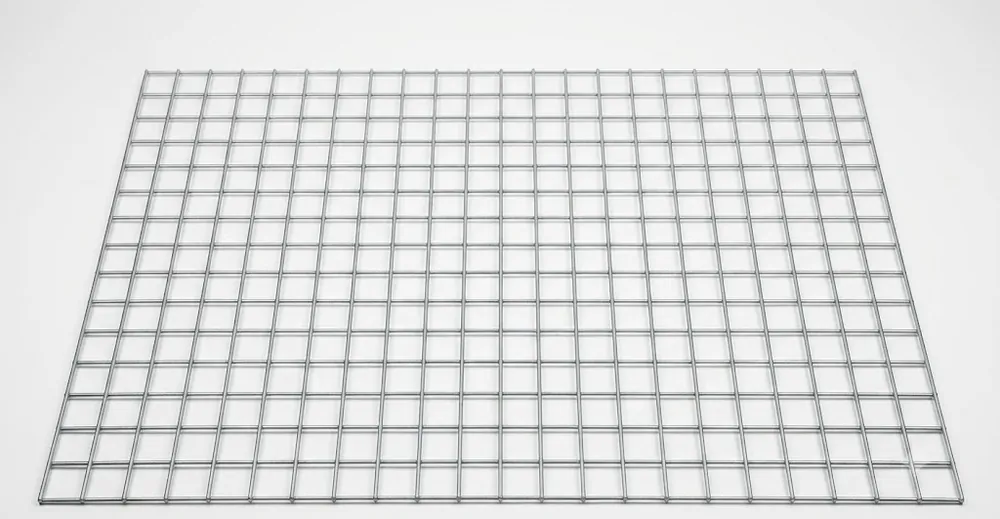
We have manufactured and exported welded wire mesh from Dingzhou, Hebei since 2006, shipping to buyers across North America and Europe. This guide walks through the decisions we help customers make every week.
Key takeaways
- Welded mesh is resistance-welded at each joint, giving it rigidity that woven mesh lacks.
- Four specs drive every order: wire diameter, aperture, finish, and panel vs roll format.
- Galvanized-after-weld (GAW) resists corrosion far longer than galvanized-before-weld (GBW), at higher cost.
- Concrete reinforcing mesh follows ASTM A1064 (formerly A185/A497); light mesh does not.
- Custom aperture, wire gauge, and panel size are standard for us, not premium extras.
What is welded wire mesh and how is it made?
Welded wire mesh starts as cold-drawn steel wire fed from two directions: line wires running lengthwise and cross wires laid perpendicular. At each crossing point, a resistance welder passes a high current through the contact, and the wires fuse under pressure without filler material. The result is a flat sheet or continuous roll with consistent openings and welded joints at every node.
Because the weld happens at the intersection itself, the mesh holds its geometry under load. That rigidity separates it from woven or knitted products. On our lines, weld strength is the number one quality check — we pull-test sample joints against the shear values in the applicable standard before a batch clears QC.
Wire can be low-carbon steel for general use or higher-carbon deformed wire for structural reinforcement. Openings are square or rectangular, and the sheet is cut to length or coiled depending on the format the buyer needs.
Welded wire mesh is produced by resistance-welding line and cross wires at each intersection, with no filler metal. Structural reinforcing mesh in the United States is manufactured to ASTM A1064, which consolidated the earlier A185 (plain) and A497 (deformed) specifications.
Welded mesh vs woven mesh: which should you buy?
The core difference is the joint. Welded mesh is fused at each intersection and stays flat and rigid; woven mesh interlaces wires over and under, so it flexes and can be reshaped. For structural work, sizing screens, and panels that must hold a true plane, welded wins. For filtration, fine sieving, and applications needing very small openings or flexibility, woven is usually the right call.
| Feature | Welded wire mesh | Woven wire mesh |
|---|---|---|
| Joint | Resistance-welded at each node | Interlaced, no weld |
| Rigidity | High, holds a flat plane | Flexible, drapes |
| Typical aperture | 12.7 mm to 150 mm | Fractions of a mm up to ~50 mm |
| Best for | Reinforcement, fencing, panels | Filtration, sieving, screens |
| Cost per m² | Lower at larger apertures | Higher at fine apertures |
| Edge behavior | Stable, cut ends stay put | Can fray or unravel |
Buyers often over-specify woven mesh for fencing because it "feels stronger." In practice, a properly gauged welded panel gives more usable rigidity per kilogram of steel, and it installs faster because the panel does not sag between posts.
How do you choose wire diameter and aperture?
Wire diameter and aperture together set the strength, weight, and cost of the mesh. Thicker wire and smaller openings mean more steel per square metre, higher tensile capacity, and a higher price. We produce wire from 0.5 mm for fine decorative mesh up to 6.0 mm for heavy reinforcing and industrial panels, with apertures from 12.7 mm (1/2") to 150 mm (6").
Match the spec to the job. Light garden and aviary mesh runs 0.7 to 1.5 mm wire on 12.7 to 25 mm openings. General fencing sits around 2.0 to 4.0 mm on 50 to 100 mm openings. Concrete reinforcing mesh typically uses 4.0 to 6.0 mm wire on 100 to 200 mm centres.
Reading aperture in mm and inches
Aperture is the clear opening between adjacent wires, measured centre-to-centre in some standards and clear-opening in others, so confirm which convention your drawing uses. Common conversions: 1/2" = 12.7 mm, 1" = 25.4 mm, 2" = 50.8 mm, 4" = 101.6 mm, 6" = 152.4 mm. When a buyer quotes "2x2 mesh," they usually mean a 2-inch square opening.
A quick way to sanity-check a spec
Divide the opening by the wire diameter. A ratio near or below 25:1 gives a stiff, load-bearing panel; a ratio above 50:1 gives a light, economical mesh that flexes more. It is a rough guide, not a code, but it catches mismatched specs before they reach the factory floor.
Galvanized before vs galvanized after welding: what's the difference?
This choice controls corrosion life and cost. Galvanized-before-weld (GBW) uses pre-galvanized wire that is then welded; the weld points burn off some zinc, leaving small unprotected spots. Galvanized-after-weld (GAW) welds bare wire first, then hot-dips the finished mesh, coating every surface including the joints. GAW lasts significantly longer outdoors, and it costs more.
| Property | Galvanized before weld (GBW) | Galvanized after weld (GAW) |
|---|---|---|
| Process | Weld pre-zinc wire | Hot-dip after welding |
| Weld-point protection | Reduced (zinc burns off) | Full coverage |
| Zinc coating weight | ~10 to 60 g/m² typical | ~60 to 300+ g/m² |
| Appearance | Uniform, brighter | Heavier, slightly rougher joints |
| Corrosion life | Moderate | Long |
| Cost | Lower | Higher |
For coastal projects and long-service fencing we steer customers to GAW almost every time. For indoor cages, temporary enclosures, or short-life applications, GBW is the economical and correct choice. Tell us the environment and expected service life and we will match the coating weight.
Zinc coating on welded mesh is specified by mass per unit area (g/m²). Galvanized-after-weld mesh carries zinc on the weld nodes that galvanized-before-weld loses to the welding heat, which is why GAW delivers longer corrosion life in exposed environments.
When is PVC-coated welded mesh worth it?
PVC-coated mesh adds a fused plastic layer over galvanized wire, combining zinc corrosion resistance with a tough polymer skin. It extends service life in wet and coastal conditions, adds colour (green, black, and grey are common), and gives a safer, smoother surface for animal enclosures and garden fencing. The coating typically adds 0.4 to 1.0 mm of thickness per side over the base wire.
The trade-off is inspection: once PVC is on, you cannot see the steel underneath. We galvanize first so the wire is protected even if the plastic is nicked. For decorative and residential fencing, PVC-coated mesh is often the best-looking and longest-lasting option per dollar.
Panels or rolls: which format fits your project?
Format affects transport, installation labour, and waste. Rolls suit continuous runs like long fence lines and cage manufacturing, where you cut to length on site and minimize offcuts. Rigid panels suit reinforcement, welded fence systems, and anywhere a flat, true plane matters. We supply panels up to roughly 2.4 m x 6 m and rolls in standard heights with lengths to fit container loading.
Panels ship flat-stacked and bundled; rolls ship compact and load densely. The hidden cost in the panel-vs-roll decision is on-site labour, not the mesh price. A crew laying reinforcing panels moves far faster than one wrestling a roll flat, so for slab work the panel premium usually pays for itself before the pour.
Concrete reinforcing mesh vs light mesh vs rebar
For structural concrete, reinforcing mesh and rebar do the same job — resisting tension — but they differ in labour and control. Welded reinforcing mesh arrives as a pre-spaced grid, so placement is fast and spacing is consistent; rebar is tied on site, which is flexible but slower and more error-prone. Light welded mesh is not structural; it is for plaster, stucco, render, and non-load-bearing work.
Reinforcing mesh
Concrete reinforcing mesh uses 4.0 to 12.0 mm wire, often deformed for bond, on 100 to 200 mm centres, manufactured to ASTM A1064 or EN 10080 equivalents. It shines in slabs, driveways, and precast where uniform crack control matters.
Light mesh
Light mesh runs thin wire (0.7 to 2.0 mm) on small openings for render support, brickwork bed reinforcement, and general fabrication. It carries no structural rating.
Rebar
Rebar remains the choice for beams, columns, and heavy footings where bar sizes and bends exceed what sheet mesh can provide. Many projects use both: mesh in slabs, rebar in structural members.
ASTM A1064/A1064M is the current specification governing carbon-steel wire and welded wire reinforcement, plain and deformed, for concrete in the United States. It replaced the separate ASTM A185 (plain) and A497 (deformed) standards, which buyers may still see referenced on older drawings.
How do you size welded mesh for a concrete slab?
Slab mesh sizing follows the engineer's drawing, but the common defaults are useful to know. Residential slabs and driveways often use mesh roughly equivalent to 6 mm wire on 150 to 200 mm centres, positioned in the upper third of the slab for crack control. The mesh should sit on chairs, not on the ground, or it does nothing.
Lap and overlap
Adjacent sheets must overlap so the reinforcement is continuous. A widely used rule is a minimum overlap of two full mesh squares, or around 150 to 300 mm depending on the design and code. Tie the laps so they cannot shift during the pour. Under-lapping is one of the most common site failures we hear about, and it is entirely avoidable.
Which standards and how do you calculate weight?
Specify to a standard so both sides measure quality the same way. The main references are ASTM A1064 (the current US standard, superseding A185 and A497), ASTM A497 for deformed reinforcement on legacy specs, and EN 10218 for general steel wire and mesh in Europe. Naming the standard on your purchase order removes ambiguity about wire strength, weld shear, and tolerances.
Weight is straightforward to estimate. Steel weighs about 7.85 g/cm³, and a single wire's mass per metre is 0.00617 x d² kg (d in mm). Multiply by the total wire length in the sheet — line wires plus cross wires — to get panel weight. Across our export orders, calculated theoretical weight lands within roughly 2 to 3 percent of actual shipped weight once galvanizing and cutting tolerance are included, which is what we quote freight against.
How do you prevent corrosion and pack for export?
Corrosion protection is a system: base steel, zinc coating weight, and optional PVC, matched to the environment. For long outdoor life, we recommend GAW with a heavier zinc coating, PVC over galvanizing in coastal or high-humidity zones, and full-coverage finishes on cut edges. Under-specifying the coating to save a little money is the most expensive mistake in mesh procurement.
Packaging and container loading
Panels ship flat-stacked on pallets or in steel-strapped bundles with edge protection; rolls are wrapped and stacked to prevent crushing. We plan loads for full 20 ft and 40 ft containers to maximize density and minimize movement in transit. For North American and European buyers we label every bundle with spec, size, and coating so receiving crews can sort on arrival without opening packaging.
For wall and masonry projects, mesh often ships alongside brick wall ties and concrete accessories, which we consolidate into one container to save freight.
Frequently asked questions
What is the difference between welded mesh and woven mesh?
Welded mesh is fused at each wire intersection by resistance welding, so it stays flat and rigid. Woven mesh interlaces wires without welds, so it flexes and can fray when cut. Choose welded for reinforcement, panels, and fencing; choose woven for filtration and fine sieving.
Should I choose galvanized-before-weld or galvanized-after-weld mesh?
Pick galvanized-after-weld (GAW) for long outdoor life, because hot-dipping after welding coats the weld nodes that galvanized-before-weld loses to heat. Choose galvanized-before-weld (GBW) for indoor, temporary, or budget applications. Tell us the environment and service life, and we match the zinc coating weight.
Is welded reinforcing mesh better than rebar for a slab?
For flat slabs, reinforcing mesh is usually faster and more consistent because the grid is pre-spaced and placement is quick. Rebar suits beams, columns, and heavy footings needing large bars and bends. Many projects use mesh in slabs and rebar in structural members, following the engineer's drawing.
How do I select the right aperture and wire diameter?
Match specs to load. Light garden and aviary mesh uses 0.7 to 1.5 mm wire on 12.7 to 25 mm openings; fencing uses 2.0 to 4.0 mm on 50 to 100 mm; reinforcing mesh uses 4.0 to 6.0 mm on 100 to 200 mm. Smaller openings and thicker wire mean more strength and higher cost.
Do you make custom sizes, and what is the minimum order?
Yes. Custom aperture, wire diameter, panel size (up to about 2.4 m x 6 m), finish, and PVC colour are standard for us, not premium extras. Minimum order quantity depends on the spec and finish, and we typically plan around efficient container loads. Send your drawing and we will confirm feasibility and MOQ.
Ready to specify your mesh? Send us your wire diameter, aperture, finish, and format, or your slab drawing, and we will quote against the right standard and a full container plan. Request a quote and we will reply with specifications, weights, and lead time.
