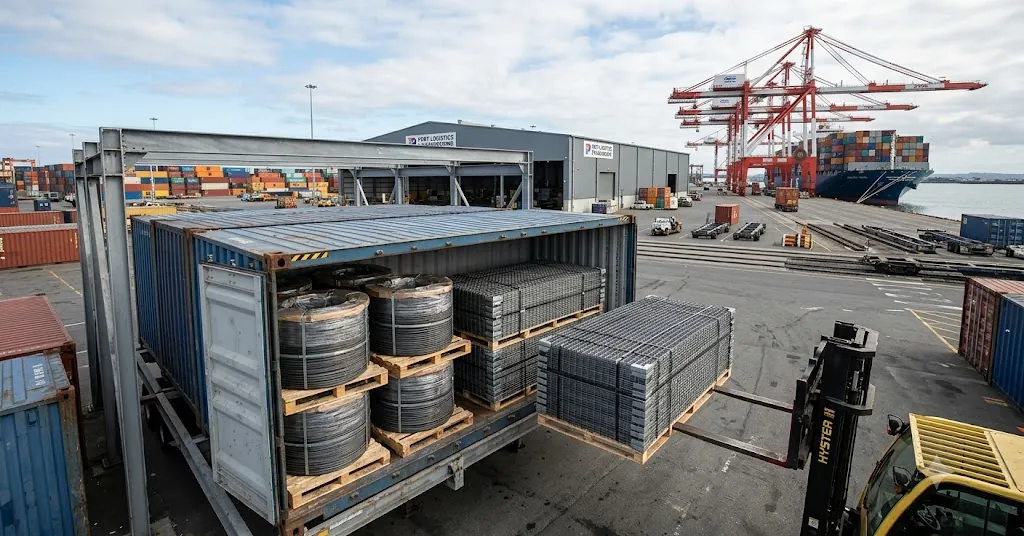
We are Hebei Leeter Import and Export Co., Ltd ("Leeter"), a wire and mesh exporter based in Dingzhou, Hebei, working since 2006. Most of our containers head to North America and Europe, which means long ocean transits, multiple port handlings, and inland trucking at the far end. This guide shares how we actually pack and load welded wire mesh, and what you should ask any supplier before you commit to an order.
Why packing decides the fate of a mesh shipment
Mesh is deceptively fragile in transit. A welded panel is rigid in its own plane but easy to bow across the diagonal. A roll holds shape until something presses on its side. The threats are consistent across every route: point loads from forklifts, sliding during rough seas, moisture from condensation inside a steel box, and simple mishandling when a container is stripped by hand at destination.
Packing is not a cost line to shave. It is insurance you pay once. We have seen buyers switch suppliers not over price, but because the last shipment showed rust bloom on the outer wraps and crushed corners on the top panels. When a claim happens, everyone loses time. Photos get emailed back and forth, surveyors get involved, and the reorder slips by weeks. Solid welded mesh packing avoids all of that before the container doors ever close.
How should welded mesh panels be packed?
Panels ship flat-stacked in bundles, squared up, then strapped through with edge protection at every strap line. We keep bundles to a weight and height a forklift can lift cleanly, usually with the wires running so the load sits on the strongest axis. The goal is a rigid block that behaves as one unit, not a loose pile that shifts.
Bundling and strapping
We stack panels of one spec together so the bundle is uniform in thickness and weight. Timber bearers, or skids, go underneath so forks can enter from either side without touching the wire. Steel or heavy PET strapping wraps the bundle at several points along its length, and we always run angle protectors, plastic or cardboard, under each strap. Without those protectors the strap tension bites into the outer wires and leaves marks or bends.
For heavier panels, we add cross battens on top so the strapping pulls against timber rather than directly onto the mesh face. This keeps the top layer flat and gives the forklift a defined lifting surface.
Waterproofing and surface protection
Galvanized and PVC-coated panels still need protection from condensation. Inside a sealed container crossing temperature zones, moisture forms on the steel walls and drips. We use waterproof wrapping on bundles that will sit against container walls, and we keep the wrapping breathable enough that trapped humidity does not sit on the coating. For bright or electro-galvanized mesh, this step matters even more, since light coatings show white rust fast when packed damp.
Mesh panel bundling for mixed orders
Mixed orders need clear separation. When one container holds several panel sizes or coatings, we bundle each spec on its own and never nest a smaller panel loosely inside a larger bundle. Each bundle carries its own label, and we plan the stacking order so the site crew unloads in a sensible sequence. This bit of mesh panel bundling discipline saves hours of sorting at the yard.
How are welded mesh rolls packed differently?
Rolls are wrapped around the circumference to lock the coil, then protected on the flat sides and ends to prevent the crushing that flattens a round roll into an oval. Where panels fear bending, rolls fear side pressure. A crushed roll will not feed straight off a dispenser and often has to be scrapped at the edges.
We bind each roll with wire ties or strapping at several points so it cannot telescope or unwind. Then we sleeve the roll in film or woven fabric. For export, we often add end caps or a light timber frame on pallets of rolls, so nothing presses directly on the coil faces during stacking. Heavier gauge rolls tolerate more, but fine welded mesh rolls need the gentlest handling of anything we ship.
Standing versus lying is a real decision. Rolls stacked lying down can flatten under the weight above them, so we limit stack height and add dunnage between layers. Rolls stood on end resist crushing better but take more floor area. We choose based on gauge, roll weight, and how the container fills out.
Panel packaging vs roll packaging at a glance
The two formats share goals but differ in method. The table below sums up how we approach each, and where the risks sit.
| Factor | Welded panels | Welded rolls |
|---|---|---|
| Primary risk | Bending and corner crush | Side crushing, telescoping |
| Base unit | Flat-stacked bundle on skids | Bound coil, often palletized |
| Fastening | Steel or PET straps with angle guards | Ties around the coil, end restraint |
| Edge protection | Angle protectors under every strap | Sleeves, end caps, frames |
| Moisture control | Waterproof wrap on outer bundles | Film or woven sleeve over coil |
| Stacking rule | Heaviest and largest on the bottom | Limited height, dunnage between layers |
| Label location | On the wrap, both long sides | On the coil face and sleeve |
What edge protection and labeling matter most?
Edge protection means angle guards under straps, corner caps on bundles, and end restraint on rolls, so fasteners never cut into the product. This is the cheapest part of welded mesh packing and the one buyers notice first when it is missing. A strap without a guard leaves a permanent dent line across a panel face, and that panel becomes the one the site rejects.
Labeling has to survive the whole journey. We mark each bundle and roll with the specification, mesh opening, wire diameter, panel size or roll length, coating, quantity, and the order or item number. Labels go on protected surfaces and, for sea freight, under the outer wrap or on waterproof stock so seawater spray and rain at the port do not erase them. A clear label lets the receiving crew verify count against the packing list without cutting anything open.
We also match physical labels to the packing list and container load plan. When a receiver opens the doors, the front bundles should be the ones the paperwork says are there. That alignment is what makes a clean, fast delivery acceptance.
How do you load a container for mesh, weight or volume?
Mesh loading is usually a weight game, not a volume game, because steel is dense and a full-volume container of heavy mesh would exceed the payload limit. We plan each load against the container's rated payload first, then fill the remaining space, keeping the center of gravity low and centered so the box is road-legal and stable.
Weight limits and payload planning
Although a standard 20-foot container is rated by ISO for a slightly higher maximum payload than a 40-foot (about 28 t versus 26.7 t), destination road weight limits often cap both to similar practical payloads, so heavy-gauge panels still "weigh out" a 20-foot before it is full. Lighter mesh and rolls tend to "cube out," filling the space before hitting the weight cap. We calculate both and pick the container and stack pattern that ships the most product safely per box. Overloading is never worth the risk of a refused or fined container at the port.
Bracing, dunnage, and load stability
Once bundles are in, movement is the enemy. We block and brace with timber so nothing can slide when the container pitches at sea or brakes on the road. Airbags or timber fill close the gaps between stacks. Heavy panel bundles go on the bottom, lighter or more fragile units on top, and rolls are chocked so they cannot roll. Good bracing is what keeps a perfectly packed bundle from becoming a claim in the last mile.
Mesh container loading in practice
In real mesh container loading, we load from the nose forward, keep aisles for the forklift as long as possible, and finish with hand-placed pieces near the doors. We photograph the load at stages so both sides have a record. If a buyer wants a specific unloading order, we plan the stow to match, since the last thing loaded is the first thing seen.
Getting the packing spec right before you order
Agree the packing details in writing before production starts. That means bundle weights, strapping type, edge protection, wrapping, labeling content, and the container plan. When exporting wire mesh across an ocean, assumptions are expensive, and a short packing annex on the purchase order prevents most disputes.
Ask your supplier for photos of a previous export load, not a showroom sample. Ask how they handle condensation, how they restrain rolls, and what their claim rate looks like honestly. A supplier who talks openly about the failure modes above is one who has actually shipped mesh, not just made it. If you want to align a spec for your route, request a quote and we will put the packing plan in writing with the price.
Frequently asked questions
How are welded mesh panels protected from bending in transit?
Panels are flat-stacked into uniform bundles on timber skids, then strapped with angle guards under each strap so the tension never bites the wire. Cross battens on heavier bundles keep the top layer flat. In the container, bundles are blocked and braced so they cannot slide or flex during ocean and road transit.
Do galvanized or PVC-coated meshes still need waterproof packing?
Yes. Sealed containers crossing temperature zones create condensation that drips onto the load, and even galvanized mesh can show white rust if packed damp. We add waterproof, breathable wrapping to bundles against container walls and sleeve rolls in film. Light electro-galvanized coatings need this protection most, since they mark fastest.
Should I order welded mesh as panels or rolls for export?
It depends on your end use and handling. Panels ship rigid and install fast but take more careful stacking. Rolls save space and suit continuous applications but risk side crushing if mishandled. Tell us your application and unloading equipment, and we will recommend the format that ships and installs with the least waste.
Will a container weigh out or cube out with mesh?
Heavy-gauge panels usually weigh out, hitting the payload limit before the box is full, while lighter mesh and rolls tend to cube out. We calculate both for your exact spec and choose the container size and stack pattern that ships the most product safely without overloading or wasting space.
What should a mesh packing agreement include?
Put bundle weights, strapping and edge protection type, wrapping and moisture control, full label content, and the container load plan in writing before production. A short packing annex on the purchase order removes ambiguity. It also gives both sides a clear reference if a survey or count check is ever needed at destination.
Solid packing is not a luxury on a mesh order; it is the difference between a smooth delivery and a claim. If you are exporting wire mesh to North America or Europe and want a packing and loading plan matched to your route, request a quote and we will lay it out with the numbers.
