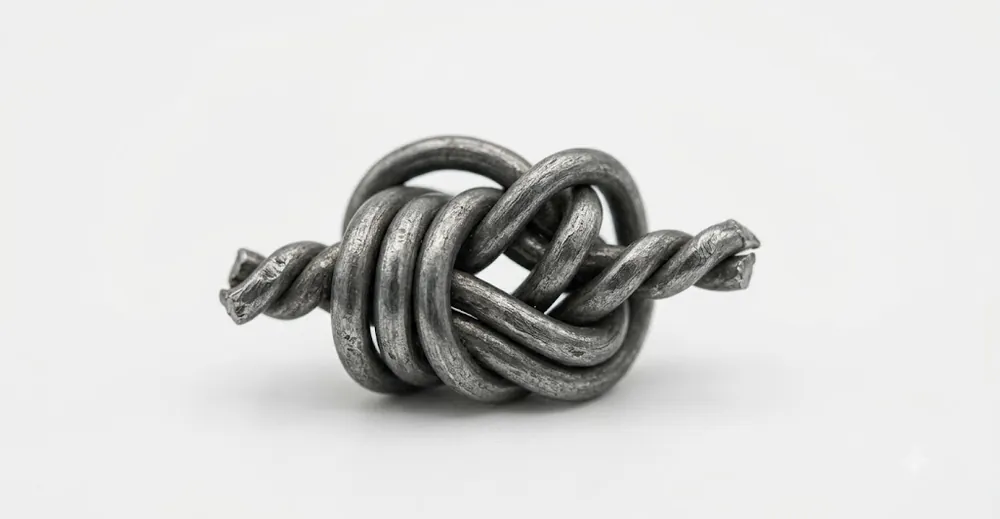
This guide walks through what tensile strength actually tells you, why temper matters more, how annealing produces the right temper, and how to verify what you are buying before it lands on site.
What tensile strength really measures
Tensile strength is the maximum stress a wire withstands before it fractures, expressed in megapascals (MPa) or pounds per square inch (psi). For a 1.57 mm (16 gauge) soft-drawn tie wire, a typical result lands between 350 and 550 MPa. That range sounds modest next to structural rebar, which starts around 500 MPa yield and climbs higher. The comparison is misleading, because a tie wire is never asked to carry a structural load.
A tie has one job: hold two bars in position until the concrete sets. It resists the small forces of workers walking the mat, the shove of a concrete hose, and the shake of an immersion vibrator. None of those forces approach the wire's breaking point. So a higher tensile number buys you almost nothing in the field, and in most cases it works against you.
Here is the trade-off buyers miss. As you raise tensile strength, you usually lose ductility. A hard, high-tensile wire is stiff and springy. It fights the twist, and when the tool releases, it recoils and loosens the knot. That recoil, not fracture, is the real enemy of a clean tie.
Why temper matters more than the headline number
Temper describes how hard or soft a wire is, and therefore how it bends, twists, and holds a set. For tie wire, soft temper is the target. A softly tempered wire wraps around a bar intersection, takes a full twist without cracking, and stays where the tool left it. It has low springback, so the knot seats and holds.
Think of temper as the wire's willingness to stay bent. A high-elongation, low-temper wire yields early and plastically. Once you twist it, it has no memory of being straight, so it does not unwind. A stiffer wire behaves the opposite way: it stores elastic energy in the twist and releases it the moment tension comes off the pliers or the auto-tie tool.
In our experience supplying both manual coil and spool wire for battery tools, the complaints that come back are almost never about broken wire. They are about ties that loosened, wire that cracked at the twist, or coils that would not feed. Every one of those traces back to temper, not to a tensile shortfall.
| Property | Typical soft tie wire | Why it matters |
|---|---|---|
| Tensile strength | 350 to 550 MPa | High enough for handling; not a structural value |
| Elongation | 12% or more | Ductility; the ability to twist without cracking |
| Temper | Dead soft to soft | Low springback; the knot stays tight |
| Wire diameter | 0.8 to 1.6 mm (21 to 16 ga) | Drives twist count and tie speed |
| Coating (galvanized) | 8–25 g/m2 (EG) to ~40–150 g/m2 (HDG) zinc | Corrosion resistance; must survive the twist |
How a tie actually fails on site
The dominant field failure mode is loosening, not fracture. When a knot springs open, the bars shift during the pour, cover spacing drifts, and the mat loses the geometry the engineer specified. On a suspended slab or a bridge deck, that movement can turn into a rejection or a repair.
Two mechanisms cause it. The first is elastic springback from a too-hard wire, as described above. The second is cracking at the twist: an over-hard or brittle wire develops micro-fractures at the tightest bend, and even if it does not break outright, the joint is weakened and can release under vibration. Both point back to temper.
Fracture does happen, but it is the minority case and it usually signals a real defect, not a design margin problem. Wire that snaps at low twist counts is often over-drawn, under-annealed, or contaminated at the surface. A properly annealed soft wire will take three or more full twists on a standard test before it parts. So when a buyer tells us the wire is "too weak," the fix is almost always more annealing, not a stronger alloy.
Why annealing produces the right temper
Annealing is the heat treatment that softens cold-drawn wire, and it is the single most important step in tie wire production. Drawing steel down to gauge work-hardens it: the grains stretch and the wire becomes strong but brittle. Left in that state, it is useless for tying. Annealing heats the wire so the grain structure recrystallizes, relieving internal stress and restoring ductility.
Our black annealed binding wire runs through controlled-atmosphere or oxidizing anneal cycles depending on the finish. Temperature and dwell time set the final temper. Anneal too little and the wire stays springy and cracks at the twist. Anneal too much and it goes limp, snaps at low twist counts, and feeds poorly through auto-tie tools. The window is real, and hitting it consistently across a production lot is where manufacturing discipline shows.
The dark oxide layer on black annealed wire is a byproduct of that heat treatment. It is not a corrosion coating, and it will mark hands and formwork, but it signals that the wire has been through the anneal furnace. For corrosion protection you move to a galvanized product, which introduces its own temper question.
How galvanizing changes the equation
Galvanized tie wire adds a zinc layer for corrosion resistance, and the coating has to survive the twist without flaking. Zinc weights on tie wire typically range from about 8 to 25 g/m2 on a light electro-galvanized finish up to roughly 40 to 150 g/m2 on hot-dip. Heavier zinc lasts longer in damp or coastal exposure, which matters for ties left proud of the concrete or used in marine and infrastructure work.
Coating adhesion is the property to watch. When a galvanized wire twists tightly, the zinc at the bend is under strain. A well-bonded coating flexes with the steel; a poorly bonded one cracks and sheds, exposing bare steel exactly where corrosion starts. We test adhesion by twisting samples and inspecting the bend for flaking under magnification. A good coating shows fine crazing at worst, not sheets lifting off.
There is a temper interaction here too. Hot-dip galvanizing runs the wire through a molten zinc bath, and that thermal cycle partially anneals the steel. Electro-galvanizing does not, so it preserves the base temper. When you specify galvanized tie wire, tell your supplier the coating method and the temper target together, because one affects the other.
How to verify temper before you buy
The simplest field check is the twist test, and any buyer can run it. Take a sample, clamp a fixed gauge length, and rotate one end until the wire fails, counting full 360-degree twists. A soft, correctly annealed tie wire should reach several twists with a smooth, even helix and no premature cracking. Early fracture or a rough, split break means the temper is off.
For a quick receiving-dock check, bend a length back and forth by hand. Soft wire folds and stays folded with little spring. If it fights you and tries to straighten, it is too hard for reliable tying. Pair that with a look at the twist knots your crew is actually producing: knots that back off within minutes of tying are telling you the temper is wrong regardless of any certificate.
For documented lots, ask for the tensile and elongation values on the mill certificate, and confirm elongation is reported, not just tensile. A cert that lists only a high tensile number and no elongation is hiding the property that matters. We provide both, plus twist-test data on request, because a strength figure alone does not describe a tie wire.
Specifying tie wire the right way
Lead with temper and elongation, then treat tensile strength as a sanity band, not a target. A workable specification reads something like: soft-annealed low-carbon steel, 1.57 mm nominal, tensile 350 to 550 MPa, elongation 12% minimum, dead-soft temper, with a defined coating and zinc weight if corrosion resistance is needed. That tells a manufacturer exactly what to make.
Match the gauge to the tool and the bar. Manual tying of heavy bar often uses 16 gauge; automatic tools and lighter mats run finer wire on spools. Then decide the finish: black annealed for dry interior pours and cost-driven work, galvanized where the wire sees moisture. Get those three choices right, temper, gauge, and coating, and the tensile number takes care of itself.
Frequently asked questions
What tensile strength should tie wire have?
Most soft tie wire falls between 350 and 550 MPa, which is ample for handling and pour forces. Chasing a higher number usually reduces ductility and causes knots to spring loose. Specify elongation of 12% or more alongside tensile, and treat temper as the primary requirement rather than raw strength.
Is higher tensile strength better for tie wire?
No. A tie wire is not a structural load member, so extra tensile strength gives little benefit and often hurts. Harder, higher-tensile wire is springy, resists twisting, and loosens after the tool releases. Soft, ductile wire holds the knot far better, which is why we anneal tie wire to a soft temper.
What is the twist test for tie wire?
Clamp a fixed gauge length, rotate one end until the wire breaks, and count full 360-degree twists. A correctly annealed soft wire reaches several twists with a smooth helix and no early cracking. Premature or rough fracture indicates over-hard, under-annealed, or contaminated wire that will fail at the knot.
Why is annealed tie wire softer than drawn wire?
Cold drawing work-hardens steel, making it strong but brittle and unfit for tying. Annealing heats the wire so its grain structure recrystallizes, relieving internal stress and restoring ductility. The result is a soft-temper wire that twists cleanly and holds its set instead of springing back and loosening the tie.
Does galvanizing weaken tie wire?
Galvanizing adds corrosion protection and slightly changes temper. Hot-dip galvanizing runs wire through molten zinc, which partially anneals and softens it, while electro-galvanizing preserves the base temper. Neither meaningfully weakens the tie. The property to verify is coating adhesion at the twist, since poorly bonded zinc flakes off and exposes bare steel.
Talk to a wire manufacturer
If you are specifying tie wire and want the temper right the first time, we can match gauge, finish, and elongation to your tools and exposure. Compare our rebar tie wire and black annealed binding wire, then request a quote with your gauge, coating, and coil format, and we will send test data with the offer.
