The key references at a glance
Tie wire sits at the intersection of two worlds: steel wire made for concrete reinforcement, and general-purpose carbon steel wire that happens to be soft enough to twist. In North America the most cited documents are ASTM A82 and its successor ASTM A1064, which govern steel wire for concrete reinforcement, together with ASTM A641 for zinc-coated (galvanized) carbon steel wire. In Europe the parallel references are EN 10218 for general steel wire dimensions and tolerances and EN 10244 for metallic coatings on steel wire. Each addresses a different property, and no single document covers everything.
Here is the short version before we go deeper:
| Standard | Scope | Region |
|---|---|---|
| ASTM A82 | Steel wire, plain, for concrete reinforcement (historical) | North America |
| ASTM A1064 | Steel wire and welded wire reinforcement, plain and deformed, for concrete | North America |
| ASTM A641 | Zinc-coated (galvanized) carbon steel wire | North America |
| ASTM A853 | Steel wire, carbon, general use | North America |
| EN 10218 | Steel wire and wire products: general, dimensions and tolerances | Europe |
| EN 10244 | Steel wire and wire products: non-ferrous metallic coatings on steel wire | Europe |
| EN 10016 | Non-alloy steel rod for drawing and/or cold rolling (feedstock) | Europe |
Read the table as a menu, not a single dish. A complete tie wire specification usually pulls from more than one line, because you are specifying the base steel, the mechanical condition, and the coating separately.
What does ASTM A82 cover, and why do people still ask for it?
ASTM A82 was for decades the reference for plain steel wire used in concrete reinforcement, setting requirements for the wire's material and mechanical properties. It has been withdrawn and consolidated into ASTM A1064, yet many drawings, project specs, and long-standing purchase templates still name A82 out of habit. When a buyer writes "wire per ASTM A82," what they almost always mean today is A1064-grade steel wire for reinforcement use.
We still honor A82 callouts, but we confirm with the buyer that A1064 is acceptable as the current equivalent. The practical point for you is this: do not treat an A82 reference as proof of "tie-ability." A82 and A1064 were written around structural reinforcing wire, where higher strength is often the goal. Tie wire is the opposite problem. You want the wire soft and ductile so it twists tightly and snaps cleanly. That behavior comes from temper, which the reinforcement standards do not primarily target.
What does ASTM A1064 govern?
ASTM A1064 is the current standard for steel wire and welded wire reinforcement, plain and deformed, for concrete. It covers the base material, tensile and yield requirements, bend behavior, and dimensional tolerances for wire intended to reinforce concrete. For a tie wire buyer, A1064 is the honest reference to cite when you want documented steel quality and a recognized production and testing regime behind the product.
There is a nuance worth stating plainly. A1064 defines minimum strength levels appropriate for reinforcement. Annealed tie wire, the black soft wire most crews prefer, is deliberately drawn down in strength through annealing so it can be twisted by hand or by a battery tool. So when we quote annealed tie wire "to A1064 base material," we mean the steel and manufacturing pedigree conform, while the delivered temper is set by annealing to a soft condition. Spell that out in your RFQ so nobody expects a reinforcement-grade tensile figure on a product that is meant to be soft.
What does ASTM A641 cover for galvanized wire?
ASTM A641 is the reference for zinc-coated (galvanized) carbon steel wire, and it defines the coating class and the wire's general characteristics. If you are buying galvanized tie wire for corrosion resistance, this is the document to name alongside your base-wire reference. A641 recognizes different coating weights, commonly described as classes, so the amount of zinc per unit area is specified rather than left vague.
Coating class is where a lot of value hides. A heavier zinc class costs more and lasts longer in exposed or coastal conditions; a lighter class is cheaper and fine for interior, short-duration ties. When you request a quote, tell us the class you need, or tell us the environment and let us recommend one. A quote that just says "galvanized" is impossible to price fairly, because the difference between a light and heavy coating changes both the zinc consumption and the wire's feel in the hand.
How do EN 10218 and EN 10244 fit European projects?
For buyers specifying to European norms, EN 10218 and EN 10244 are the workhorses. EN 10218 addresses general requirements for steel wire and wire products, including dimensions and tolerances, so it governs how close the delivered diameter must sit to nominal. EN 10244 covers non-ferrous metallic coatings on steel wire, which is the European route to specifying zinc or zinc-alloy coatings and their coating masses.
European and American systems are not interchangeable line for line, and we do not pretend they are. What we do is map your requirement across both. If a European contractor is used to EN 10244 coating masses and an American spec on the same job references A641 classes, we align the two so the physical product satisfies whichever inspector shows up. Feedstock matters too: European rod for drawing is often specified to EN 10016, and naming it upstream keeps the whole chain traceable.
How should buyers use standards in an RFQ?
A strong RFQ names four things: diameter, temper or condition, coating and coating weight, and the governing standard for each. In our experience, the RFQs that go wrong are the ones that name only one or two. When you send us "1.57 mm annealed black tie wire, soft temper, uncoated, base material to ASTM A1064," we can quote, produce, and certify without a single follow-up email. When you send "16 gauge tie wire," we have to guess.
Think of the standard as the shared language between your inspector, our mill, and the third-party lab. It removes interpretation. A good specification also states what documentation you expect: a mill test certificate showing chemistry, tensile results, and coating figures where relevant. Ask for it up front, because a certificate produced after the fact is harder to trust and harder to trace back to the actual coil you received.
Below is a simple RFQ skeleton we hand to new importers:
| RFQ field | Example entry | Why it matters |
|---|---|---|
| Diameter | 1.57 mm (16 ga) | Sets tool compatibility and coverage per kg |
| Temper / condition | Soft annealed | Controls tie-ability, not covered by strength specs |
| Coating | Black annealed or galvanized, class stated | Drives corrosion life and price |
| Standard(s) | A1064 base, A641 coating | Shared reference for inspection |
| Documentation | Mill certificate with tensile and coating | Traceability and dispute prevention |
Why do standards alone not guarantee tie-ability?
This is the point most catalogs skip. A wire can conform to the named steel and coating standards and still tie poorly, because the property that governs tie-ability is temper, and temper is verified by testing the finished wire, not by the material spec alone. Reinforcement standards set strength floors; tie wire needs controlled softness. Those goals point in different directions, so conformance to A1064 or EN 10218 does not, by itself, promise a wire that twists tight and snaps clean.
We settle this with temper testing on the finished product: bend and twist behavior, elongation, and hand-feel checks that tell us whether a coil will actually perform at the rebar intersection. A wire that is too hard springs back and refuses to hold; one that is too soft breaks before the twist locks. The window between those failures is narrow, and it is a production outcome, not a line item you can copy from a standard. This is exactly why we treat annealing and temper verification as core to our rebar tie wire process rather than an afterthought.
So use standards to fix the steel, the dimensions, and the coating. Use temper testing to fix performance. A serious supplier will document both, and a serious buyer will ask for both. If a quote references a standard but goes silent on temper, that silence is the risk.
What documents should appear on the mill certificate?
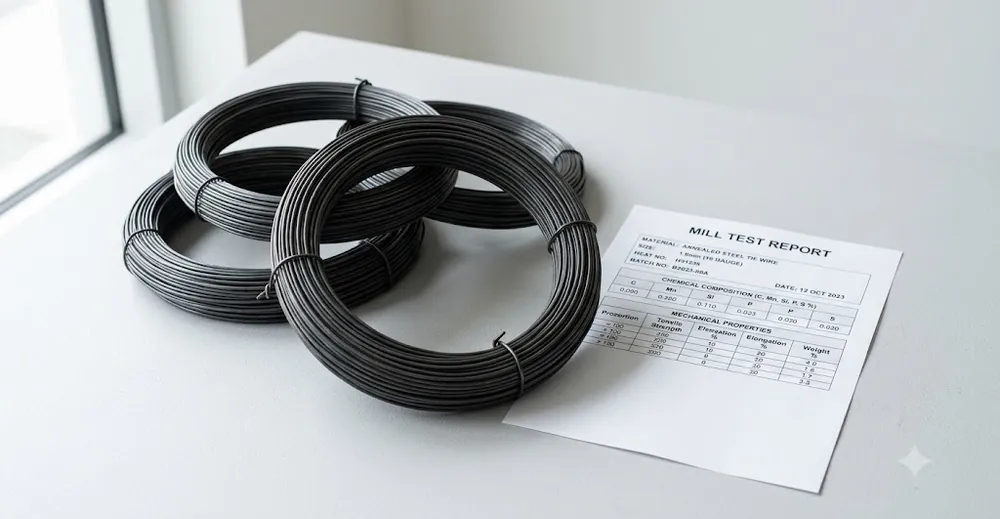
A usable mill certificate ties a specific coil or lot to measured results, not to a generic claim. At minimum it should show the heat or lot identity, the chemical composition of the steel, tensile or breaking-load figures for the delivered condition, and, for coated wire, the coating type and weight. For galvanized product, the zinc class or coating mass should read back against A641 or EN 10244 as applicable.
Match the numbers to the condition you ordered. If you bought soft annealed tie wire, expect a low tensile figure consistent with a soft temper, and be suspicious of a reinforcement-grade tensile printed on a product sold as soft. Consistency between the order, the standard, and the certificate is the whole game. When those three agree, inspection is a formality; when they disagree, you have leverage before the container ships rather than a headache after it lands.
Frequently asked questions
Is ASTM A82 still a valid tie wire standard?
ASTM A82 has been withdrawn and consolidated into ASTM A1064. Many drawings and purchase templates still name A82 out of habit, and we honor those callouts by supplying A1064-equivalent steel wire for concrete reinforcement. If your spec references A82, confirm with your supplier that current A1064 material is acceptable, since that is what the market now produces.
Which standard should I cite for galvanized tie wire?
For galvanized tie wire in North America, cite ASTM A641 for the zinc coating and pair it with a base-wire reference such as A1064. In Europe, use EN 10244 for the metallic coating and EN 10218 for the wire itself. Always state the coating class or coating mass, because "galvanized" without a class cannot be priced or inspected reliably.
Does conformance to ASTM A1064 mean the wire will tie well?
Not on its own. A1064 governs the steel and its mechanical properties for reinforcement, but tie-ability depends on temper, the controlled softness of annealed wire. A wire can meet A1064 base material and still twist poorly if the temper is wrong. Ask your supplier for temper or twist test results on the finished product, not only material conformance.
What is the difference between the ASTM and EN systems?
The ASTM and EN systems are parallel, not identical. ASTM A1064 and A641 dominate North American concrete-reinforcement and galvanizing practice, while EN 10218 and EN 10244 cover wire dimensions and metallic coatings in Europe. Coating classes and mass units differ between them. We map requirements across both systems so the physical product satisfies whichever inspection regime applies to your project.
What should I request on the mill certificate?
Request the heat or lot identity, steel chemistry, tensile or breaking-load results for the delivered condition, and coating type and weight for galvanized product. The certificate should tie back to the specific coil you received. For soft annealed tie wire, expect a low tensile figure that reflects the soft temper rather than a reinforcement-grade strength.
Talk to us before you write the spec
Getting the standard right early saves money and rework later. If you are drafting a tie wire specification and want a second set of eyes from the production side, request a quote and tell us your diameter, coating, environment, and the standard your project references. We will confirm the correct combination, propose the right temper, and put the documentation in writing before anything ships.
