We are Hebei Leeter Import and Export Co., Ltd ("Leeter"), a construction hardware manufacturer in Dingzhou, Hebei, China, exporting since 2006 to buyers across North America and Europe. We produce all three stake profiles in plain and galvanized steel, and this guide reflects what our contractor and distributor customers tell us about how each one performs on the job.
The three profiles compared
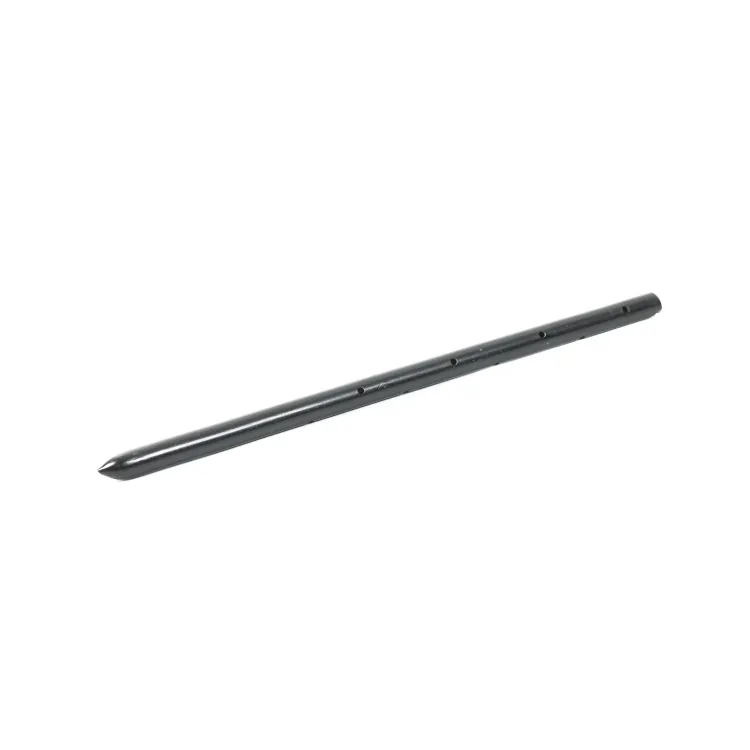
Each profile is smooth steel with staggered nail holes and a driven point. The difference is the cross-section, which changes how the stake nails, drives, and resists bending.
| Feature | Round stake | Flat stake | Square stake |
|---|---|---|---|
| Cross-section | 3/4" (19 mm) round bar | Flat bar, wide face | Square bar |
| Nailing | Nail holes on shaft | Largest board-contact face | Nail holes, flat faces |
| Driving | Easiest, low resistance | Moderate | Highest resistance |
| Bending/twist resistance | Good | Resists twist, wide face | Highest stiffness |
| Pulling / reuse | Cleanest, best reuse | Good | Good, more effort |
| Relative cost | Lowest | Moderate | Highest |
| Best for | General slab, curb, sidewalk | Alignment, board contact | Tall footings, heavy pours |
Which stake for curb, slab, and footing
For slab-on-grade, sidewalks, and curbs, round nail stakes are the workhorse. They drive quickly with a hammer or driver, the round shaft pulls free without tearing up the grade, and they stack and ship efficiently in bulk. Most crews standardize on a 3/4" round stake for everyday flatwork.
For form alignment and tight board contact, flat stakes shine. The wide flat face sits flush against the form board, so nailing is solid and the stake resists twisting when you snug a wale or brace against it. Crews forming long straight runs or stepped edges often prefer the flat profile for a cleaner line.
For footings, grade beams, stem walls, and heavy wet pours, square stakes give the most stiffness and bearing area against the soil. When lateral concrete pressure is high or the ground is soft, the square section resists bending better than a round bar of similar size, at the cost of higher driving effort.
Nail hole patterns and points
All three profiles carry staggered nail holes down the shaft. Staggering lets you nail the form board at several heights without splitting a single line of steel, and it lets one stake serve boards of different thicknesses. Hole diameter is sized for common duplex and form nails.
Points are typically a chisel or diamond point. A chisel point drives straight and bites in firm soil; a diamond point centers well in mixed ground. For rocky sites, a robust point protects reuse.
Bulk sourcing as a manufacturer
Form stakes are a high-volume, freight-sensitive item, so most importers buy by the container. A few points that matter when you source wholesale:
- Finish: plain steel is cheapest; hot-dip galvanized resists rust for stakes stored outdoors or reused across seasons.
- Length range: 12, 18, 24, 30, 36, and 48 inch (305 to 1219 mm) covers curb through footing work.
- Consistency: uniform hole spacing, straight shafts, and clean points reduce field waste and support reuse.
As a China manufacturer, Leeter supplies round, flat, and square stakes to one spec sheet, so distributors carry a full line from one supplier in one container.
Frequently asked questions
What is the difference between round, flat, and square form stakes?
Round stakes are round bar that drive and pull the easiest and reuse the longest, making them the default for general flatwork. Flat stakes have a wide flat face that gives better board contact and resists twisting, good for alignment. Square stakes are the stiffest and carry the most bearing area, best for tall footings and heavy pours, but cost more and drive harder.
Which form stake is best for concrete forming?
For most slab, curb, and sidewalk work, a 3/4" (19 mm) round nail stake is the best all-around choice because it is fast, reusable, and economical. Step up to flat stakes when you need clean alignment and strong board contact, and to square stakes for footings, grade beams, or soft ground where bending resistance matters.
What diameter is a round form stake?
The standard round form stake is 3/4 inch (19 mm) in diameter. This size balances driving effort, bending resistance, and reuse for typical forming. Heavier work may use a larger diameter, while light curb and edge work can use the same 3/4" stake in a shorter length.
Are form stakes reusable?
Yes. Smooth steel stakes with clean points and undamaged holes reuse for many pours. Round stakes reuse best because they pull cleanly; galvanizing extends life for stakes stored outdoors. Straightening bent stakes and keeping points intact preserves reuse and lowers cost per pour.
