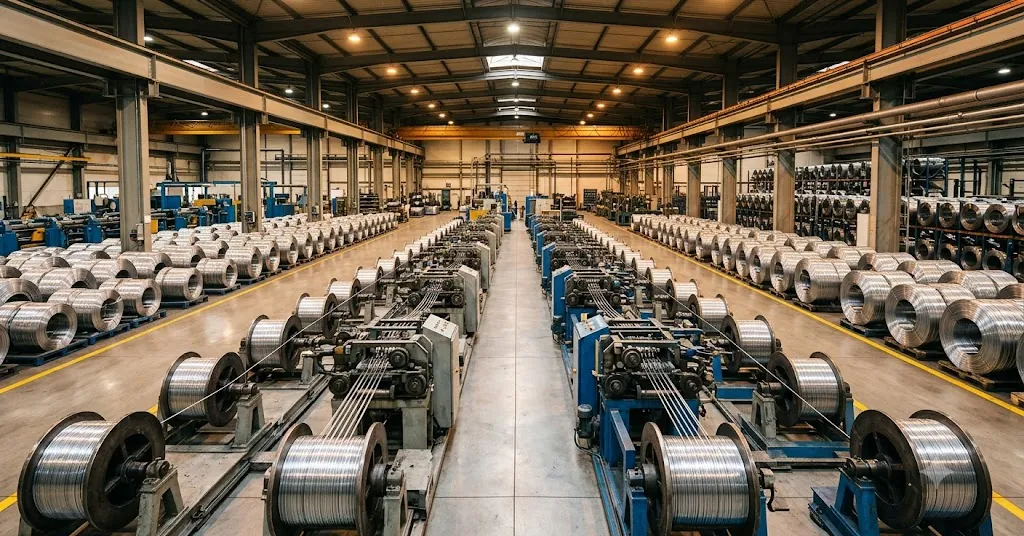
We are Hebei Leeter Import and Export Co., Ltd, a construction hardware manufacturer and exporter based in Dingzhou, Hebei, working since 2006 with buyers across North America and Europe. This guide reflects how we actually run restocking arrangements with long-term partners, not a sales pitch. We will be honest about what a program can and cannot fix.
What a restocking program actually is
A restocking program is a standing agreement between you and your factory to reproduce the same products, to the same specifications, on a recurring basis. It is not a contract that forces you to buy. It is a framework that removes repeated setup work. Once the first order is approved, the factory retains your approved samples, tooling, drawings, and packaging artwork. Future orders reference that record instead of starting from zero.
Think of it as institutional memory. In a normal spot-buy, each order risks small drift: a slightly different wire gauge, a new box design, a different galvanizing thickness. Those small changes create friction at your receiving dock and complaints from your own customers. A restocking program freezes the agreed baseline so that reorder number twelve looks exactly like reorder number one.
The practical result is speed. Instead of days spent on quotes, samples, and approvals, a reorder becomes a short confirmation. You send quantities, the factory confirms the schedule, and production begins against a known standard.
Why lock specs and tooling before you scale
Locking specifications early is the single most valuable step in a restocking relationship. When specs float, quality control becomes reactive, and every shipment is a small gamble. When specs are frozen and documented, quality control becomes a checklist. Both sides know exactly what "correct" looks like.
For construction hardware, the details that matter are concrete: material grade, wire diameter and tolerance, coating type and coating weight, tensile requirements, dimensional limits, and packaging counts. Write these down once, approve a golden sample, and reference that sample forever. If your product needs custom tooling such as a die, a mould, or a specific bending fixture, keeping that tooling reserved for your account prevents mix-ups and shortens lead time.
Locked tooling also protects pricing. A factory that does not need to re-tool or re-sample for every order carries lower internal cost, and that saving is easier to pass back to a repeat buyer. It is the difference between a vendor quoting a stranger and a partner reproducing a known job.
How do you set up predictable reorders?
Predictable reorders start with a written baseline and a simple trigger rule. The baseline is your locked spec sheet plus approved samples. The trigger rule is the inventory level that tells you to reorder. When your stock of a given item drops to that level, the reorder goes out automatically, before you run short.
Here is a straightforward way to structure it. First, agree on a reorder point for each SKU based on your sales rate and the total lead time. Second, agree on a standard reorder quantity, often a full pallet, a full carton multiple, or a container share. Third, agree on how you send the order: a short purchase order that references the program number, not a fresh RFQ.
The reason this works is that it removes decisions from the critical path. Nobody has to re-negotiate, re-sample, or re-approve. The factory sees a program PO and knows precisely what to build. In our experience, buyers who formalize this cut days off every cycle and almost eliminate spec disputes.
How much should you forecast and share?
Sharing a rolling forecast is the most underused lever a distributor has. You do not need a perfect forecast. You need a directional one, updated regularly, that lets the factory plan raw material and capacity ahead of your firm orders. A shared forecast turns your supplier from a reactive job shop into a planning partner.
A practical rhythm is a rolling three to six month view, refreshed monthly. Mark which quantities are firm and which are estimates. The factory then buys steel, wire rod, or zinc ahead of demand and slots your production into a smoother schedule. That advance planning is what shortens lead times and protects you from raw material price spikes and seasonal congestion.
Forecasts also build trust. When your estimates track reasonably close to your firm orders over time, the factory extends more flexibility: shorter lead times, priority slots during busy seasons, and better payment discussions. Accuracy is not the point. Consistency and honesty are.
Safety stock and lead time: who holds the buffer?
Safety stock is the inventory cushion that absorbs the gap between demand you cannot perfectly predict and supply that cannot arrive instantly. Ocean freight from China to North America or Europe takes weeks, so someone must hold a buffer. The question in every restocking program is who holds it, and where.
There are three common models, and the right one depends on your storage cost, cash position, and how volatile your demand is.
| Buffer model | Who holds stock | Best when | Trade-off |
|---|---|---|---|
| Buyer-side safety stock | Distributor warehouse | Demand is steady, warehouse space is available | Ties up your cash and space |
| Factory-side finished buffer | Factory holds agreed finished units | Demand is spiky, you want faster dispatch | Requires trust and a commitment window |
| Split buffer | Both parties share the cushion | Long relationship, shared forecast | Needs clear rules on ownership |
We often recommend a split buffer for established partners. You carry enough to cover normal lead time, and the factory keeps an agreed finished or semi-finished quantity ready to dispatch when your reorder lands. That combination shortens your effective replenishment time without forcing you to warehouse a full year of stock.
Whatever model you pick, calculate your reorder point honestly: expected sales during the full lead time, plus a margin for variability. Set it too low and you stock out during a container delay. Set it too high and you drown in carrying cost.
Can consolidated containers lower your landed cost?
Consolidating your reorders into full containers is one of the clearest ways to reduce per-unit landed cost. A full container load spreads ocean freight, documentation, and handling across the maximum number of units. Partial shipments and frequent small orders do the opposite: they multiply fixed costs across fewer pieces.
A restocking program makes consolidation natural because you can plan mixed loads in advance. If you buy several categories of construction hardware, the factory can combine them into one optimized container instead of shipping each SKU separately. That planning depends on the shared forecast and the reorder schedule you already set up.
Consolidation has a second benefit: fewer, larger shipments mean fewer customs entries, fewer freight bookings, and less administrative overhead on your side. For a distributor managing dozens of SKUs, that reduction in paperwork is real money and real time. The container becomes a planning unit, not just a shipping unit.
One honest caution: consolidation only helps if the combined order still matches your true demand. Filling a container with slow-moving stock to hit a freight target just moves your cost from freight to carrying. Balance the load against real sell-through.
Why the long relationship beats the lowest quote
The value of a long factory relationship compounds in ways a single low quote never captures. A supplier who has run your program for years knows your quality bar, your packaging, your paperwork preferences, and your seasonal patterns. That knowledge prevents errors that cost far more than a small price gap.
Consider what a stranger quote hides. A new factory may quote lower, then charge for tooling, send a first article that misses spec, and take weeks to correct it. Meanwhile your shelves sit empty. A proven restocking partner reproduces a known job with predictable quality and timing. The lowest number on a spreadsheet is not the lowest total cost.
Long relationships also give you leverage when things go wrong, because they always will at some point. A container gets delayed, a raw material price jumps, a customer needs an emergency top-up. A partner who values years of steady orders will work with you on those problems. A one-time vendor has no reason to.
Putting the program in motion
Starting a program is simpler than it sounds. Approve your specs and samples once, document them, agree on reorder points and quantities, share a rolling forecast, and pick your buffer model. From there, each reorder is a short confirmation instead of a fresh project. The setup work is front-loaded on purpose, so the ongoing work stays light.
If you distribute construction hardware and you are tired of re-quoting the same items every quarter, a restocking arrangement is the fix. Send us your current SKUs, volumes, and pain points, and we will map out how a program would run for your account. You can request a quote or open a conversation through our contact page.
Frequently asked questions
Does a restocking program require a minimum commitment?
Not usually. A program is a framework, not a forced purchase. You agree on specs, reorder points, and pricing structure, but you order when your inventory triggers it. Some buyers add a soft volume estimate through a rolling forecast, which helps the factory plan raw material, but firm quantities still come from your actual reorders.
How does a program change my pricing?
Pricing tends to stabilize rather than swing. Because the factory reuses your approved tooling, samples, and packaging, it carries less setup cost per order, and repeat production is more efficient. That efficiency supports steadier quotes. Raw material moves still affect price, but a shared forecast lets the factory buy ahead and smooth out some of the volatility.
What if I need to change a specification later?
You update the locked baseline together and approve a new golden sample before the change takes effect. The point of locking specs is not to freeze them forever. It is to make sure every change is deliberate and documented, so it never drifts in by accident. Once approved, the new spec becomes the reference for all future reorders.
How much forecast accuracy do I really need?
Directional accuracy is enough. A rolling three to six month view, refreshed monthly and marked for firm versus estimated quantities, gives the factory what it needs to plan. Forecasts do not have to be precise to be useful. Consistency and honesty matter more than hitting exact numbers, and trust builds as your estimates track your real orders over time.
Can a small distributor run a restocking program?
Yes. Programs scale down as well as up. A smaller distributor benefits from locked specs, predictable reorders, and consolidated containers just as much as a large one, sometimes more, because setup friction hurts small teams disproportionately. The reorder quantities are simply sized to your sell-through, and the buffer model is matched to your storage and cash position.
Ready to stop re-quoting the same hardware every quarter? Send us your SKUs and volumes through our contact page, and we will outline a restocking program built around how your business actually reorders.
