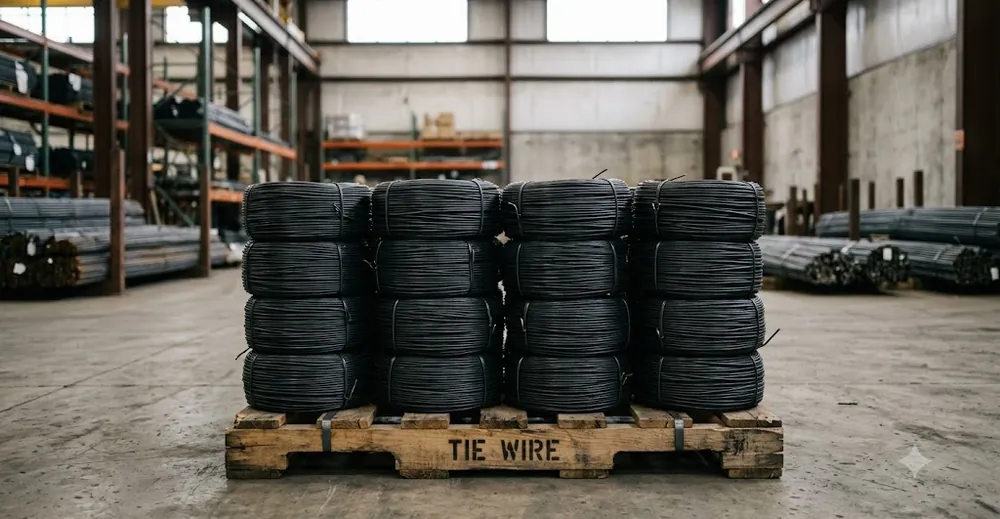
We wrote this pillar for contractors, precast plants, rebar fabricators and distributors who buy tie wire by the pallet and need to specify it correctly. It walks through gauge, finish, format, consumption per ton, tying technique, standards and export packaging.
What is rebar tie wire and why is it annealed?
Tie wire is drawn low-carbon steel (typically SAE 1006–1010) that gets annealed to make it dead-soft and bendable. Annealing heats the wire to roughly 700–900 °C in a controlled furnace, then cools it slowly. This relieves the work-hardening from drawing and drops tensile strength into the 350–550 MPa range for soft temper, with elongation often above 12%.
Why does temper matter so much? A hard wire springs back and snaps mid-twist. A properly annealed wire wraps tight, twists two or three turns, and shears clean without cracking. That single property, ductility, is what separates real rebar wire from generic binding wire. We test every annealing batch for temper before it goes on the coiler, because an over-annealed wire is too weak to hold a saddle tie and an under-annealed wire fatigues the tie-tool motor.
Which gauge of tie wire should you use?
The three working gauges are 16GA, 16.5GA and 18GA, and gauge is the first thing an estimator specifies. Here are the diameters and the jobs they suit:
| Gauge | Diameter (mm) | Diameter (in) | Typical use |
|---|---|---|---|
| 16GA | 1.60 mm | 0.063" | Heavy hand-tying, large bar, structural mats |
| 16.5GA | 1.47 mm | 0.058" | Balanced strength/speed, most general work |
| 18GA | 1.22 mm | 0.048" | Fast hand-tying, light mesh |
16GA holds the most load per tie and resists loosening under vibration, but it's slower by hand and needs more grip strength. 18GA ties fastest by hand on light mesh, though a single 18GA tie holds less, so crews often double it on heavy intersections. 16.5GA is the common compromise and the gauge most North American distributors stock as their default black annealed line.
One field note from our customers: match the gauge to the tie method, not just the bar size. Battery-powered tiers are a separate system: their tool-fed reels run dedicated 19–21GA (0.8–1.0 mm) wire, not these hand-tie gauges, while hand crews on #6 bar and up prefer 16 or 16.5GA.
Black annealed vs galvanized tie wire: which finish?
Finish decides corrosion life and price. Black annealed tie wire is the annealed steel with no coating; the surface is a dark oxide from the furnace, sometimes lightly oiled. It's the economical, dominant choice for interior structural concrete where the tie is fully embedded and protected by cover.
Galvanized tie wire carries a zinc coating for corrosion resistance, and it comes in two types:
- Electro-galvanized (EG): a thin, bright zinc layer applied electrolytically. Cheaper, smoother, good for indoor damp conditions and cosmetic work.
- Hot-dip galvanized (HDG): a thicker, dull zinc coating from a molten bath. Far more durable, the choice for coastal, marine, bridge deck and exposed applications.
Here's the honest trade-off. EG gives you rust protection for handling and storage but thin coverage; HDG gives real service-life protection but costs more and is slightly stiffer to twist because the coating adds diameter and hardness. If the structure sees chlorides or long outdoor exposure, specify HDG. If it's dry embedded concrete, black annealed is the correct, cost-effective call. See our full galvanized tie wire range for EG and HDG options.
Rule of thumb we give buyers: black annealed for embedded structural, EG for indoor/storage protection, HDG for corrosive or exposed environments. Don't pay for HDG where cover concrete already does the protecting.
What coil formats and packaging exist?
Format controls how fast a crew works and how you store the product. The common formats:
- Small coils: loose rings, often 1.5 lb (0.68 kg) or 3.5 lb (1.6 kg), or metric 1–2 kg hanks. Cheap, simple, tied by hand.
- Spools: larger continuous wound units, 25 kg, 45 kg or 50 kg, feeding tie-off stations or precast benches with less reloading.
- Tool reels: precision-wound cartridges sized for battery-powered rebar tiers. These snap into the tool and need consistent tension and clean payoff.
Small coils dominate hand-tying because a worker clips one to a belt and burns through it fast. Spools win on production floors where reloading wastes labor. Tool reels are a different product entirely: wind quality matters more than raw wire quality, because a tangle stops the tool mid-tie. We produce dedicated tie wire reels wound to tool tolerances so the payoff stays snag-free.
For distributors, the packaging above the coil matters too. We box small coils in cartons, then palletize and shrink-wrap for container loading, with moisture barriers on galvanized lines to protect zinc during ocean transit.
How much tie wire do you need per ton of rebar?
Plan on roughly 8 to 14 kg of tie wire per metric ton of rebar (about 16–28 lb per US ton), with the number driven by bar size, tie spacing and gauge. Smaller bars mean more intersections per ton, so consumption climbs. This is the single most-asked estimating question we get, so here's how to bracket it.
Across order histories from our contractor customers, hand-tying with 16.5GA on typical slab and column mats lands near 10–12 kg per ton. Light mesh with #3–#4 bar and 18GA can run higher on an intersection-count basis but lighter on a mass basis. Heavy foundation work with wide spacing sits lower, near 8 kg per ton.
A quick estimating method: count intersections to tie, allow 300–350 mm (12–14 in) of wire per single tie, then multiply by gauge weight. Add 10–15% for waste, reties and off-cuts. Over-order slightly; running out of tie wire stalls a whole pour.
What are the main tying techniques?
Three ties cover most work: the snap tie, the saddle tie, and the wrap (or figure-8) tie. The snap tie is a simple twist across the intersection, fast and fine for flat mats that won't be walked hard. The saddle tie wraps under both bars and up, giving far better hold against displacement, and it's the standard for walls and columns.
The wrap-and-twist and double-strand ties add holding power where bars carry load during placement. On epoxy or heavy structural bar, crews often step up to a manufactured connector like double loop bar ties, which are pre-cut loop ties that install with a twist tool at speed and consistent tension.
The failure we see most isn't wire quality, it's technique plus wrong temper. A crew fighting springy wire ties loose knots to save their hands, and inspectors flag movement during the pour. Correctly annealed 16.5GA fixes both: it twists tight with less effort and holds the saddle.
What tensile and temper specs matter?
Soft-temper tie wire should sit around 350–550 MPa tensile with elongation typically 12% or higher, low enough to twist by hand, high enough to hold. Temper is the governing spec because a tie fails by springing loose, not by breaking. Buyers who only ask for diameter and coil weight miss the property that actually determines performance on the deck.
Two coils can share the same 1.60 mm diameter and the same "black annealed" label yet perform completely differently, because one was annealed to a proper soft temper and the other was rushed. Diameter is easy to verify with calipers; temper you only learn by twisting or testing. That's why we log furnace time and temperature per batch and twist-test samples, and it's the gap most low-price imports hide.
For galvanized wire, also check coating weight and adhesion. Zinc that flakes when the wire bends fails in the field, so we bend-test HDG samples to confirm the coating stays bonded.
Which standards apply to rebar tie wire?
The core North American references are ASTM A82 and ASTM A1064 for steel wire for concrete reinforcement, which cover the base wire material and mechanical properties. In Europe, buyers reference EN 10218 for steel wire general requirements, plus EN 10244 for zinc coating on steel wire. For galvanized coatings specifically, ASTM A641 governs zinc-coated (galvanized) carbon steel wire.
Standards give you a common language with inspectors and a baseline for material and coating. They don't fully specify "tie-ability," which is why a reputable manufacturer supplements standard compliance with in-house temper and twist testing. When you request a quote, ask for the mill test data and the coating spec, not just a conformance claim.
How is tie wire manufactured and quality-checked?
Production runs wire rod through drawing to reach final diameter, then annealing to set soft temper, then coiling or spooling, and for galvanized lines, a zinc coating step. The quality-critical stage is annealing, because temper decides field performance more than any other variable.
Common defects and what we check for:
- Over/under-annealing: wire too weak or too springy — caught by twist and tensile tests.
- Diameter drift: worn drawing dies — caught by inline micrometer checks.
- Surface rust on black wire: poor storage or oil control — visual and handling checks.
- Coating flaws on galvanized: thin spots, flaking — coating-weight and bend-adhesion tests.
- Tangled reel winds: ruins tool feed — payoff testing on tool reels before packing.
How should distributors handle packaging and export?
For container export we carton small coils, palletize, strap and shrink-wrap, then load for full-container shipment with clear labeling by gauge and finish. Galvanized lines get moisture barriers and desiccant because ocean humidity attacks unprotected zinc and bare steel over a 30–45 day transit. Getting packaging wrong turns a good product into a warranty claim.
For distributor buyers, we print your gauge, finish, coil weight and lot on cartons for shelf-ready stocking, and we palletize to your break-bulk preference. Consistent lot coding matters for traceability if an end customer ever questions temper or coating.
What about MOQ and buying?
Manufacturers price tie wire by container economics, so minimum order quantities usually start around one pallet for stocked items and scale to full-container loads for custom gauge, finish or private packaging. Black annealed in standard gauges ships fastest because it's the highest-volume line. Custom HDG coating weights, special reel winds or branded cartons carry longer lead times and higher MOQs.
Before ordering, confirm gauge in both GA and mm, finish (black / EG / HDG), format (coil / spool / tool reel), coil weight, and whether you need mill test reports. Lock those five and pricing and lead time are straightforward. We ship worldwide from Hebei with a focus on North American and European distributors, and we consolidate mixed gauges and finishes into one container to help you round out an order.
Frequently asked questions
What gauge tie wire is best for rebar?
For general structural work, 16.5GA (1.47 mm) is the most popular balance of strength and tying speed. Step up to 16GA (1.60 mm) for heavy bar and maximum hold, or down to 18GA (1.22 mm) for fast hand-tying on light mesh. Battery tiers take their own 19–21GA (0.8–1.0 mm) reels. Match the gauge to your tie method and bar size.
Should I use black annealed or galvanized tie wire?
Use black annealed tie wire for embedded structural concrete where cover protects the steel; it's the economical standard. Choose galvanized when the wire faces moisture or exposure: electro-galvanized for indoor damp or storage protection, and hot-dip galvanized for coastal, marine and exposed structures that need real corrosion service life.
How much tie wire do I need per ton of rebar?
Budget roughly 8–14 kg of tie wire per metric ton of rebar (about 16–28 lb per US ton). Smaller bars and tighter tie spacing push consumption to the high end, wide-spaced heavy foundation work to the low end. Estimate 300–350 mm of wire per tie, then add 10–15% for waste and reties.
Can I use coil tie wire in an automatic rebar tying tool?
No. Battery-powered rebar tiers need purpose-wound tool reels, not loose coils, because the tool depends on clean, tangle-free payoff at consistent tension. Use reels sized to your tool brand, usually 19–21GA (0.8–1.0 mm); hand-tie 16–18GA coils are not compatible. A loose coil will jam the feed and stop the tool mid-tie.
What is the minimum order quantity for tie wire?
Stocked black annealed gauges typically start around one pallet, while custom finishes, special reel winds or private-label packaging scale toward full-container loads. Standard black annealed ships fastest; HDG coatings and branded cartons carry longer lead times. Confirm gauge, finish, format and coil weight to get exact MOQ and pricing.
Ready to specify the right gauge, temper and finish for your next project or stocking order? We manufacture the full tie wire line — black annealed, EG and HDG — in coils, spools and tool reels, and we ship container loads to distributors across North America and Europe. Tell us your gauge, finish and format, and request a quote from Leeter today.
