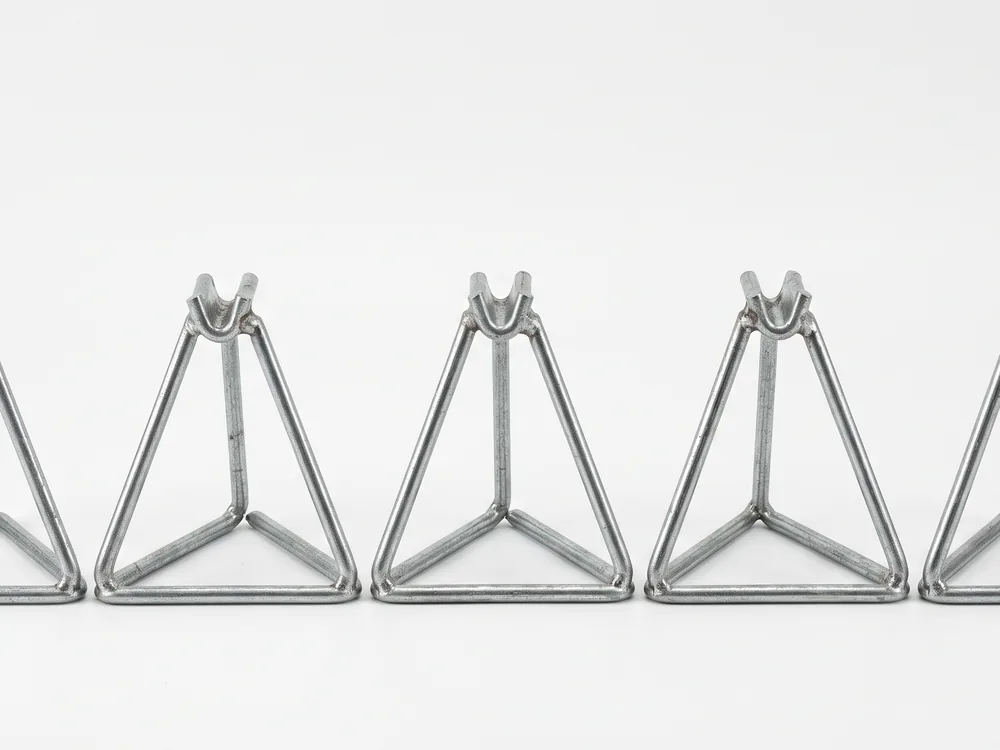
At Hebei Leeter Import and Export Co., Ltd ("Leeter"), an exporter of concrete accessories from Dingzhou, Hebei, since 2006, we spend a lot of time helping North American and European contractors match the right support to the right job. This guide explains what actually drives capacity, how the common support materials behave under load, and how to size supports to your mat weight.
What load does a rebar support actually carry?
A rebar support carries two very different loads, and both matter. The first is the static, or dead, load: the self-weight of the reinforcement resting on the chair. The second is the live, or construction, load: workers walking the mat, wheelbarrows, buggies, screed rails and vibrating tools during the pour. The live load is usually the harder test.
Here is the point contractors often miss. The dead weight of a rebar mat is rarely the reason a chair fails. A single #4 bar weighs roughly 0.67 pounds per foot, and even a dense mat spreads that weight across dozens of supports. The failure almost always comes from a boot. A worker stepping directly on a chair, or on a bar span between two chairs, applies a concentrated point load that can briefly exceed 200 pounds. That short, sharp load bends thin wire and cracks brittle plastic.
So when you evaluate a support, ask the practical question: will it hold a person standing on it during the pour? If the answer is yes, the dead load takes care of itself.
What drives rebar chair load capacity?
Three variables control capacity: wire gauge (or leg thickness), base geometry, and how the support transfers load to the formwork. Change any one and the numbers shift. Understanding all three lets you specify a support that holds without over-paying for steel you do not need.
Wire gauge and leg thickness
Wire gauge is the single biggest lever on capacity. A heavier gauge means a thicker leg, and a thicker leg resists bending far better than a thin one. Bending stiffness does not rise in a straight line with thickness. It climbs steeply, so a small jump in wire diameter produces a large jump in resistance to deformation. This is why a slightly heavier chair often solves a sagging problem that closer spacing alone cannot.
Wire chairs typically run from about 5 to 9 gauge for standard slab-on-grade work, with heavier stock used for tall bar-support work in bridge decks and thick footings. The taller the chair, the more the leg wants to buckle sideways, so tall supports need heavier wire or extra bracing legs to stay stable.
Base width and footprint
Base width controls two things: overturning stability and bearing pressure. A wide base resists tipping when a mat is nudged sideways, and it spreads the load over more formwork or soil so the chair does not punch through. On a poly sheet over gravel, a narrow foot sinks. A broad plastic base or a runner bar stays put.
For soft or granular subgrades, plate-style or sled-style bases outperform point-leg chairs every time. The bearing area is simply larger.
Height and slenderness
Height works against you. As a support gets taller, its legs behave like slender columns and grow more prone to buckling under the same load. A 1 inch chair is almost impossible to overload by hand. A 6 inch or taller bar support in the same wire gauge is a different animal and needs closer spacing or a wider, braced base to stay reliable.
How do wire, plastic and precast supports compare under load?
The three main support types behave very differently once a load hits them. Wire yields and bends but rarely snaps without warning. Plastic flexes and can craze or crack in cold weather. Precast concrete blocks barely move at all because they carry load in compression. Matching the failure behaviour to the site condition matters as much as the raw number.
Steel rebar chairs give the best strength-to-height ratio, which is why they dominate tall bar-support applications. Plastic wins on corrosion resistance and on protecting epoxy-coated bar, and modern plastic rebar chairs with wide bases handle normal slab loads comfortably. Precast blocks and dobies shine on the ground where you want maximum bearing and zero worry about a chair tipping.
| Support type | Load behaviour | Best height range | Subgrade suitability | Cold-weather notes |
|---|---|---|---|---|
| Wire chair | Bends before failing, predictable | Low to very tall | Firm formwork or plate base | Stays ductile in cold |
| Plastic chair | Flexes, wide base spreads load | Low to medium | Good on poly and gravel | Can turn brittle in hard frost |
| Precast block / dobie | Rigid, carries compression | Low, on grade | Excellent on soil and gravel | Unaffected by cold |
| Continuous high chair (bar) | Shares load along a run | Medium to very tall | Needs firm bearing | Ductile steel option |
None of these is universally best. The right pick depends on cover depth, bar coating, subgrade and temperature at the time of the pour.
How do you match support strength to mat weight?
Match support to mat by working from the heaviest realistic load down to spacing, not the other way around. Start with the construction live load, because a worker standing on the mat almost always governs. Then confirm the chosen chair carries that point load at your planned spacing with a safety margin. Only after that do you check the dead weight of the reinforcement, which is usually the easy part.
Use this simple field process:
- Estimate the mat dead load. Multiply bar weight per foot by total bar length per square area. A #4 top-and-bottom mesh mat is light. A double #8 bridge mat is heavy.
- Assume a construction point load of at least 200 pounds at any single support, because that is a person plus tools.
- Pick a wire gauge or plastic base rated to hold that point load without permanent set.
- Set spacing so no single chair or bar span carries more than its rated load. Heavier bar and taller cover both push spacing tighter.
- Check the subgrade. Soft ground means a wider base regardless of the strength calculation.
In our experience shipping supports for slab, footing and deck work, the two mistakes we see most often are choosing a chair by height alone and ignoring the subgrade. A tall chair in light wire on a poly sheet will pass a catalogue load rating and still fail on site, because the base sinks long before the wire bends. Always judge capacity as a system: leg strength, base bearing and spacing acting together.
A quick spacing rule of thumb
Tighter spacing multiplies effective capacity because it splits the traffic load across more supports. If a mat feels bouncy underfoot during a walk-through, add a row of chairs before you add gauge. It is often cheaper and always faster. For heavy bridge and industrial mats, though, do both: heavier stock and closer rows.
How do you keep supports stable during the pour?
Stability during placement comes down to preventing three movements: sinking, tipping and sliding. A support that holds its vertical load but slides sideways under a screed still ruins your cover. Tie supports to the reinforcement, use bases wide enough to resist tipping, and set them on firm bearing so they do not sink as the crew loads the mat.
Concrete placement is a violent moment for a rebar cage. Vibration liquefies the mix around every leg, and the buoyant fresh concrete tries to float the whole assembly. Tying the mat to the chairs turns a loose stack of parts into one rigid unit that resists all three failure modes at once. On deck pours especially, a well-tied cage on properly based supports is the difference between spec cover and a punch-through that shows up only when a slab starts spalling years later.
Frequently asked questions
How much weight can a rebar chair hold?
Capacity depends on wire gauge, base width and height, so there is no single number. A well-made low slab chair should comfortably hold a worker stepping on it, roughly a 200 pound point load, without permanent deformation. Taller bar supports need heavier wire or closer spacing to carry the same load safely, and soft subgrades reduce real-world capacity regardless of the rating.
Are plastic or wire rebar supports stronger?
Steel wire gives more strength per unit of height, which is why it dominates tall bar-support work. Plastic chairs with wide bases handle normal slab loads well and resist corrosion, but they can grow brittle in hard frost. For heavy mats and tall cover, wire usually wins. For shallow slabs on poly over gravel, a wide plastic base often performs better.
What wire gauge do I need for a rebar chair?
Most standard slab-on-grade chairs use roughly 5 to 9 gauge wire. Lighter gauge suits low chairs and light mesh. Heavier gauge suits tall chairs, thick footings and bridge decks where legs act like slender columns and want to buckle. When in doubt, step up one gauge rather than relying on spacing alone, because bending stiffness rises steeply with thickness.
How does spacing affect rebar support capacity?
Closer spacing multiplies effective capacity by sharing both dead and construction loads across more supports. If a mat feels bouncy underfoot, adding a row of chairs is usually cheaper and faster than switching to heavier wire. Heavier bar, taller cover and softer subgrade all call for tighter spacing. For heavy industrial mats, combine closer spacing with heavier stock.
Why do rebar supports sink into the ground?
Supports sink when the base bearing area is too small for the subgrade under a concentrated load. Point-leg chairs punch through gravel and soft soil, while plate, sled or precast bases spread the load and stay put. On poly sheets and granular fill, always choose a wide base. Judge capacity as a system: leg strength and base bearing must both suit the ground.
Talk to us about the right support for your load
Choosing supports is a balance of strength, height, subgrade and budget, and the right answer changes from one pour to the next. If you are unsure which chair, gauge or base fits your mat weight and cover requirement, we are happy to help you work it through. Leeter has supplied rebar supports to contractors across North America and Europe since 2006, and we can advise on gauge, base style and spacing for your specific job. Request a quote or send us your mat details, and our team will recommend a support that holds cover through placement and pour.
