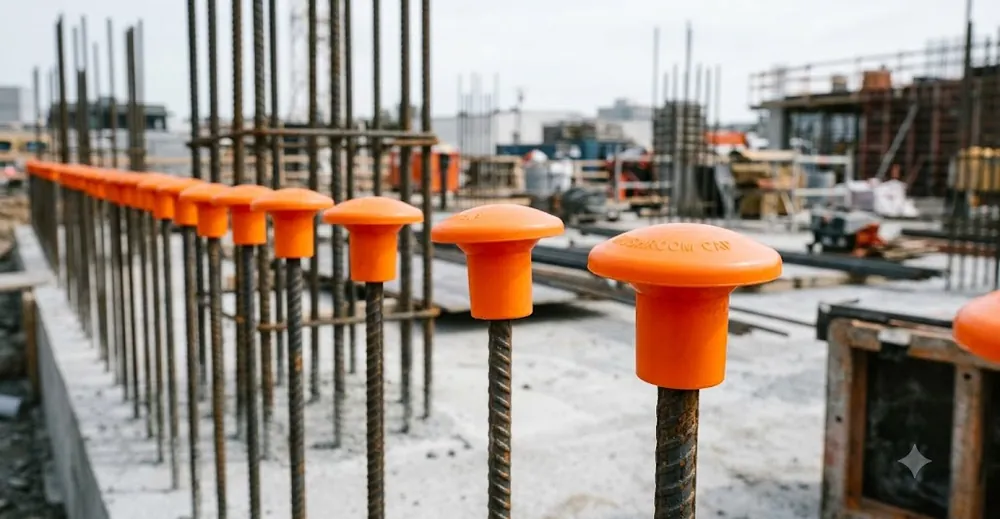
This guide explains what rebar safety caps do, how OSHA guidance frames impalement protection, and how a safety manager or purchasing lead should choose the right cap for the bar sizes and fall conditions on site. We will keep the regulatory references general and honest, because the final call always belongs to OSHA's published standards and your competent person on the ground.
What rebar impalement protection actually means
Impalement protection is the set of measures that stop a worker from being pierced by protruding reinforcing steel. Exposed vertical dowels, wall starter bars, column cages, and footing stubs all present upward-facing points. A fall of only a meter or two onto an uncapped bar can cause fatal internal injuries, which is why the hazard is taken so seriously across the trade.
OSHA's construction rules address protruding reinforcing steel directly. In broad terms, the guidance requires that where employees are working at grade or on the same level near exposed rebar ends, those ends be guarded to eliminate the hazard of impalement. Where workers can fall from a height onto rebar, ordinary guarding is not enough on its own. The protection has to be capable of resisting the energy of a falling body, which is where cap selection becomes a real engineering and compliance decision rather than a box-ticking exercise.
Two ideas drive everything that follows. First, not every cap is built to stop a fall. Second, the right choice depends on whether the exposure is a same-level trip hazard or a genuine fall-onto-rebar scenario.
What are rebar safety caps and how do they work?
Rebar safety caps are protective covers that fit over the cut end of a reinforcing bar. The classic design is the mushroom cap: a broad, rounded plastic dome mounted on a socket that grips the bar. The wide top spreads contact area so that a worker who brushes against the bar meets a blunt surface instead of a cutting edge. That broad face is the whole point, since it converts a concentrated point load into a distributed one.
There are two functional families, and confusing them is the most common and most dangerous mistake we see buyers make.
Plain plastic mushroom caps guard against scrapes, cuts, and eye injuries from same-level contact with protruding bar. They are inexpensive, brightly colored, and quick to install by hand. They are appropriate where workers move around exposed rebar at grade but are not exposed to a fall onto it.
Steel-reinforced caps contain an embedded steel plate or insert inside the plastic housing. That internal plate is designed to prevent a falling worker's body from being driven down onto, and pierced by, the bar. When there is any credible fall-onto-rebar exposure, this is the category OSHA-aligned practice points toward, because a plain plastic dome can split or be pushed aside under the load of a falling person.
When is each type of cap required?
The choice between plain and steel-reinforced caps comes down to one question: can a worker fall onto this bar? OSHA guidance separates same-level hazards from fall hazards, and your competent person should make that determination for each area of the site. The table below summarizes how the two families map to typical exposures.
| Cap type | Protection level | Typical use |
|---|---|---|
| Plain plastic mushroom cap | Guards against cuts, scrapes, and eye injury from same-level contact | Workers walking or working at grade near exposed bar, no fall exposure |
| Steel-reinforced cap | Designed to resist a body falling onto the bar and reduce impalement risk | Formwork, elevated decks, edges, and any area with a credible fall onto rebar |
| High-visibility cap (either family) | Adds conspicuity so bar ends are seen before contact | Congested layouts, low light, high foot traffic |
A practical rule of thumb: if you are in doubt about fall exposure, treat the area as a fall zone and specify steel-reinforced caps. The cost difference per cap is small compared with the consequence of getting it wrong. We would rather a customer over-specify protection than discover a plain cap sitting where a fall could happen.
Remember that caps are one layer in a hierarchy of controls. Guardrails, covers, bending the bar over, and personal fall arrest all play a role. Caps do not replace fall protection where fall protection is required; they backstop it.
How do you choose the right cap for the bar size?
Correct fit is what makes a cap perform, so match the cap socket to the bar diameter before anything else. A cap that is too loose can be knocked off; a cap forced onto the wrong size can crack. Most of our rebar safety caps are offered in ranges that cover the common reinforcing sizes, with the widest demand sitting at #4 through #8 bar.
Reinforcing bar sizes in the imperial system are numbered by eighths of an inch. A #4 bar is roughly 1/2 inch in diameter, a #5 about 5/8 inch, a #6 about 3/4 inch, and a #8 a full inch. Caps are typically supplied to fit a band of sizes rather than a single diameter, and the socket has some grip tolerance built in.
Match the socket to the bar range
Check the manufacturer's stated fit range against the bars actually on your job. A cap rated for #4 to #8 will seat securely across that band, while very small or very large bars need their own size. If your project mixes light dowels and heavy column steel, plan on stocking more than one size so crews are never tempted to jam the wrong cap on.
Confirm the reinforcement matters for fall zones
For fall zones, confirm the cap is the steel-reinforced type and that the internal plate is intact and correctly seated. A steel-reinforced cap only performs if that plate is present; a look-alike plastic dome in the same color will not do the job. Buyers should ask suppliers directly whether a given part contains a steel insert, and keep documentation on file.
Why does high-visibility color matter?
High-visibility color helps workers see protruding bar before they contact it, which supports the primary goal of preventing contact in the first place. Bright orange, yellow, and red caps stand out against soil, concrete, and formwork, especially in congested cages where individual bar ends blend into the background. Conspicuity is a real safety feature, not just a cosmetic choice.
Color also supports housekeeping and inspection. A field of bright caps lets a foreman scan an area quickly and spot any bar that has been missed or left uncapped. In our experience supplying crews across different climates and lighting conditions, high-visibility caps get installed more consistently because they are easy to account for at a glance. We recommend choosing a color that contrasts with your typical site background and using it consistently across the project.
How should buyers document and verify compliance?
Documentation turns a purchase into a defensible safety program, so keep records that tie each cap type to the exposure it protects. OSHA's standards and interpretation letters are the authoritative source, and a competent person must apply them to your specific conditions. As a supplier, our job is to give you accurate product information; the compliance determination stays with you.
We encourage buyers to build a short verification routine. Confirm the fit range for every bar size on site. Confirm which areas are fall zones and specify steel-reinforced caps there. Keep the product data and any manufacturer statements about steel reinforcement on file. Inspect caps periodically, because sun, weather, and rough handling can degrade plastic over time, and replace any cap that is cracked, brittle, missing, or knocked loose. Treat a missing cap the same way you would treat a missing guardrail: fix it before work continues.
One honest caveat. Be cautious of vague marketing claims. If a cap is sold as impalement-protective, ask what makes it so and whether it carries a steel insert. Avoid relying on unverified load figures, and lean on OSHA's published guidance and your competent person rather than on a slogan printed on a box.
Frequently asked questions
Are plastic rebar caps enough for OSHA impalement protection?
Plain plastic mushroom caps guard against cuts and scrapes from same-level contact, but they are generally not sufficient where a worker could fall onto the bar. For fall-onto-rebar exposures, OSHA-aligned practice points to steel-reinforced caps. Your competent person should determine the exposure for each area and specify accordingly.
What is the difference between a mushroom cap and a steel-reinforced cap?
A mushroom cap is the broad, rounded plastic dome that blunts contact with a bar end. A steel-reinforced cap has that same protective shape but contains an internal steel plate designed to stop a falling body from being pierced. The steel insert is the key difference, so always confirm it is present for fall zones.
What bar sizes do rebar safety caps fit?
Caps are typically supplied to fit a range of bar diameters rather than one exact size. The most common demand covers #4 through #8 bar, which spans roughly 1/2 inch to 1 inch in diameter. Check the manufacturer's stated fit range against the bars on your job and stock multiple sizes if your project mixes light and heavy steel.
Do rebar caps replace fall protection?
No. Rebar caps are one layer in the hierarchy of controls and do not replace guardrails, covers, or personal fall arrest where those are required. Caps backstop your fall protection by reducing impalement risk if a fall does occur. Use them alongside, not instead of, the primary fall protection your site requires.
How often should rebar safety caps be inspected?
Inspect caps regularly as part of routine site walkdowns. Plastic can become brittle from sun and weather, and caps can be knocked loose during work. Replace any cap that is cracked, missing, damaged, or the wrong type for its exposure. Treat a missing cap on a fall zone with the same urgency as a missing guardrail.
Get the right caps for your site
Choosing compliant rebar safety caps comes down to matching the cap to the bar size and the exposure, and never confusing a plain plastic dome with a steel-reinforced one. If you want help specifying the correct caps for your bar sizes and fall zones, or you need consistent high-visibility supply for a large project, request a quote and our team will help you get it right.
