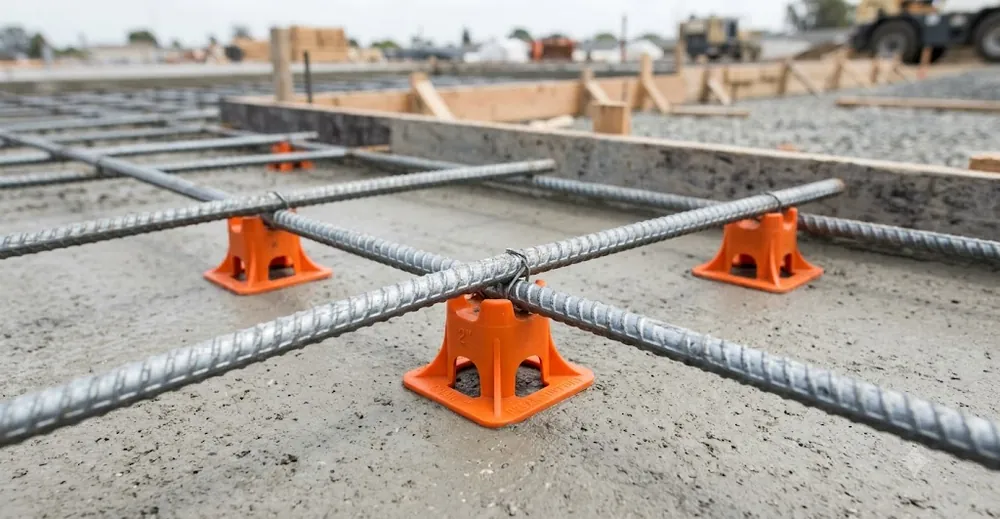
Corrosion is not a mysterious event. It is a predictable chemical process that a good detailing and placement plan can hold off for decades. This guide explains the mechanism, then shows exactly where cover, mix design, and the small accessories under the steel make the difference.
Why rebar corrodes in the first place
Fresh concrete protects steel naturally. The cement paste creates a highly alkaline environment, usually above pH 12, and that alkalinity forms a thin passive oxide film on the bar surface. As long as that film stays intact, the steel does not rust, even though it sits inside a moist, porous material.
Two things break the film. The first is carbonation. Carbon dioxide from the air slowly reacts with the concrete and lowers the pH near the surface. Over years, this carbonation front creeps inward. When it reaches the depth of the steel, the passive film loses its protection and general corrosion can begin.
The second, and more aggressive, threat is chloride attack. Chlorides come from de-icing salts, seawater, marine air, and sometimes from contaminated aggregates or admixtures. Once chloride ions accumulate at the bar surface above a critical threshold, they destroy the passive film locally, even when the pH is still high. This produces pitting corrosion, which is dangerous because it concentrates the damage in small spots.
The damage does not stay hidden. Rust occupies far more volume than the original steel, up to several times as much. That expansion pushes outward on the surrounding concrete. The result is cracking, delamination, and eventually spalling, where chunks of cover break away and expose the bar. Once the bar is exposed, corrosion accelerates and the section loses load capacity.
So the whole strategy for preventing rebar corrosion is really one idea repeated in different forms: keep the aggressive agents away from the steel, and keep the environment around the steel alkaline for as long as possible.
How much does concrete cover matter?
Concrete cover is the single most important defense, because carbonation and chloride ingress are both depth-dependent. The deeper and denser the cover, the longer it takes for either front to reach the bar. Doubling the cover can dramatically extend the time before corrosion starts, since diffusion roughly scales with the square of distance in many exposure models.
Cover requirements are set by design codes and vary with exposure. A slab cast on the ground, a bridge deck exposed to de-icing salt, and an interior beam in a dry office all call for different minimums. Structural codes such as ACI 318 in North America and the Eurocode exposure classes in Europe give the required nominal cover for each condition. The wetter and saltier the environment, the more cover the code demands.
But specifying cover on a drawing is not the same as achieving it on site. Cover is only real if the steel actually sits at the correct height and clear distance from every form face throughout the pour. Bars tied into a cage tend to sag between supports, float upward when workers walk the mat, or get pushed down as concrete is placed. That is why supports and spacers exist, and why we treat them as corrosion-control components rather than minor hardware.
For a deeper breakdown of code minimums and tolerances, our team maintains a separate reference on cover requirements, and the supports below are what turn those numbers into reality on the job.
Cover, exposure, and typical support choice
The table below shows how exposure severity drives both cover expectations and the practical accessory decision. Values are illustrative of common practice; always follow the governing code and project specification.
| Exposure condition | Cover priority | Typical accessory approach |
|---|---|---|
| Dry interior slabs and beams | Standard | Plastic or standard wire chairs |
| Exterior, humid or freeze-thaw | Elevated | Plastic-tipped or galvanized supports |
| De-icing salt, parking decks | High | Galvanized supports, tight tie discipline |
| Marine and splash zones | Very high | Corrosion-resistant supports, epoxy or galvanized bar systems |
What role do rebar chairs play in preventing rust bleed?
Rebar chairs and spacers hold the steel at the specified cover, and that positioning is what keeps the outer bars far enough from the surface to resist carbonation and chloride ingress. Without reliable supports, a mat designed for correct cover can end up with bars sitting only a few millimeters below the finished surface, where corrosion begins almost immediately.
There is a second, subtler issue: the support itself contacts the concrete surface or sits very close to it. If that support is bare carbon steel, it can rust and telegraph a stain, or a small spall, straight through the cover. This is the classic rust bleed problem, where tiny brown spots appear on a clean slab soffit or a fair-faced wall, tracing the exact pattern of the bar supports underneath.
Our rebar chairs address both problems at once. They fix the bar at the right height, and depending on the version, they either isolate the steel bar support from the surface with a plastic body or plastic feet, or they use galvanized wire so the support itself resists corrosion. For visible concrete, the goal is simple: nothing that can rust should touch the cover zone.
Spacing of the chairs matters too. If supports are set too far apart, bars sag between them, and the effective cover drops in the middle of each span even when the chair height is correct. Following the manufacturer and code spacing guidance keeps the whole mat at the intended depth, not just the points directly over each chair.
Galvanized versus plastic accessories: which should you choose?
Both galvanized and plastic accessories prevent rust bleed, and the right choice depends on load, exposure, and finish requirements rather than one being universally better. Plastic supports never corrode and are economical for slabs on grade and general work. Galvanized supports carry higher loads, tolerate hot concrete and rough handling, and pair well with heavy top mats and structural decks.
Plastic chairs and spacers shine where the support only needs to carry light mesh or modest bar weight, and where the priority is eliminating any metal near the surface. They are stable, quick to place, and immune to chlorides. Their limits show up under heavy point loads, in high heat during placement, or where a very stiff support is needed for a thick top mat.
Galvanized wire supports handle heavier reinforcement and construction traffic. The zinc coating gives the steel a sacrificial barrier, so even at contact points the support resists corrosion far longer than bare wire. For decks exposed to salt, galvanized supports paired with disciplined tie work are a strong, cost-effective package.
Tie wire deserves the same thinking. Every intersection tied with bare wire is a small piece of steel near or at the cover zone. Using galvanized tie wire removes those little rust points and prevents the fine staining that untreated ties can cause on exposed surfaces. On architectural concrete, we routinely recommend galvanized ties for exactly this reason.
A quick comparison
| Factor | Plastic supports | Galvanized supports |
|---|---|---|
| Corrosion resistance | Immune | High, sacrificial zinc |
| Load capacity | Light to moderate | Moderate to heavy |
| Heat tolerance during pour | Lower | High |
| Best fit | Slabs on grade, mesh, light bar | Structural decks, salt exposure, top mats |
| Rust bleed risk | None | Very low |
How do concrete quality and placement practices help?
Dense, low-permeability concrete slows every corrosion mechanism, because carbonation and chloride diffusion both depend on how easily gases and ions travel through the pore structure. A lower water-cement ratio, good compaction, and proper curing produce a tighter matrix that resists ingress far better than a weak, porous mix at the same cover depth.
Water-cement ratio is the lever with the biggest effect. Excess water creates a more open capillary network once the concrete hardens, giving chlorides and carbon dioxide easy paths inward. Keeping the ratio low, and resisting the temptation to add water for workability on site, is one of the cheapest corrosion defenses available. Supplementary materials such as fly ash or slag can further refine the pore structure.
Curing is where good intentions often fail. Concrete that dries too fast never develops the dense skin it needs, and that surface layer is precisely the zone that must resist ingress. Moist curing for an adequate period, or a quality curing compound, protects the outer few centimeters that do the most work in preventing rebar corrosion.
Placement discipline ties it all together. Consolidate to remove voids and honeycombing, since a single honeycomb pocket next to a bar is a direct highway for moisture and chloride. Avoid cold joints that leak. And keep the reinforcement clean and correctly positioned right up to the pour, because the best mix design cannot compensate for a bar sitting at the wrong depth.
What about aggressive exposures like salt and seawater?
In chloride-rich environments, layered protection is essential, because no single measure fully stops such an aggressive agent. Marine structures and salted decks combine generous cover, low-permeability concrete, corrosion-resistant supports and ties, and often protected bar systems such as epoxy-coated or galvanized reinforcement. Each layer buys time; together they can extend service life by decades.
Design detailing helps as well. Drainage that moves salt water off surfaces quickly, sloped decks, and sealed joints all reduce how long chlorides sit in contact with the concrete. Sealers and membranes on parking decks and bridge surfaces add a further barrier that slows chloride entry into the cover zone.
For the small components, this is where cutting corners costs the most. In a splash zone or a salted parking structure, bare wire supports and ties can begin to stain and spall within a short time. Specifying corrosion-resistant supports and galvanized ties throughout the mat is inexpensive relative to the deck and pays back in a cleaner, longer-lasting surface. We help customers match the accessory grade to the exposure so nothing in the cover zone becomes the weak link.
Putting a prevention plan together
A workable prevention plan starts at design, follows through procurement, and finishes on site. Set the cover from the correct exposure class. Specify a mix with a suitably low water-cement ratio and a real curing plan. Then choose supports and ties that will not corrode where the structure demands it. When all three align, corrosion protection is built in rather than bolted on later.
The most common failures we see are not exotic. They are ordinary: cover lost because supports were spaced too far apart, rust bleed from bare wire on an exposed soffit, or a porous surface from a rushed cure. Each is avoidable with modest attention and the right small components. If you want help matching supports, spacers, and tie wire to your exposure class and reinforcement layout, our team is glad to spec it with you, and you can request a quote with your drawings.
Frequently asked questions
How much concrete cover is needed to prevent rebar corrosion?
The required cover depends on the exposure class and the governing code, such as ACI 318 or the Eurocode exposure classes. Dry interiors need less, while salt-exposed and marine structures need substantially more. Always follow the project specification, and use correctly spaced supports so the specified cover is actually achieved on site.
Do plastic or galvanized rebar supports prevent rust better?
Both prevent rust bleed effectively. Plastic supports never corrode and suit slabs on grade and lighter reinforcement. Galvanized supports carry heavier loads, tolerate hot concrete, and resist salt exposure well. Choose based on load, temperature during placement, exposure severity, and whether the finished surface will be visible.
What causes brown stains on a finished concrete surface?
Those stains are usually rust bleed from bare carbon steel supports or tie wire sitting in the cover zone. As the small metal parts corrode, the rust telegraphs through the thin surface layer. Using plastic supports or galvanized wire supports and galvanized tie wire prevents this staining on exposed concrete.
Can good concrete alone stop corrosion without special accessories?
Dense, low-permeability concrete slows corrosion significantly, but it cannot compensate for lost cover or corroding supports in the cover zone. Concrete quality and correct bar positioning work together. You need both a good mix with proper curing and reliable, corrosion-resistant supports and ties to protect the steel.
Is galvanized tie wire worth the extra cost?
For exposed and salt-exposed concrete, yes. Bare tie wire creates many small rust points at bar intersections near the surface, causing staining and localized spalling. Galvanized tie wire adds a zinc barrier at each tie for a modest cost, and it noticeably improves durability and appearance on architectural work.
Talk to us about your project
If you are planning reinforcement for a slab, deck, or marine structure, matching the right supports, spacers, and tie wire to your exposure class is one of the easiest ways to build in corrosion protection. We are glad to review your drawings and recommend a package. Contact us to get started.
