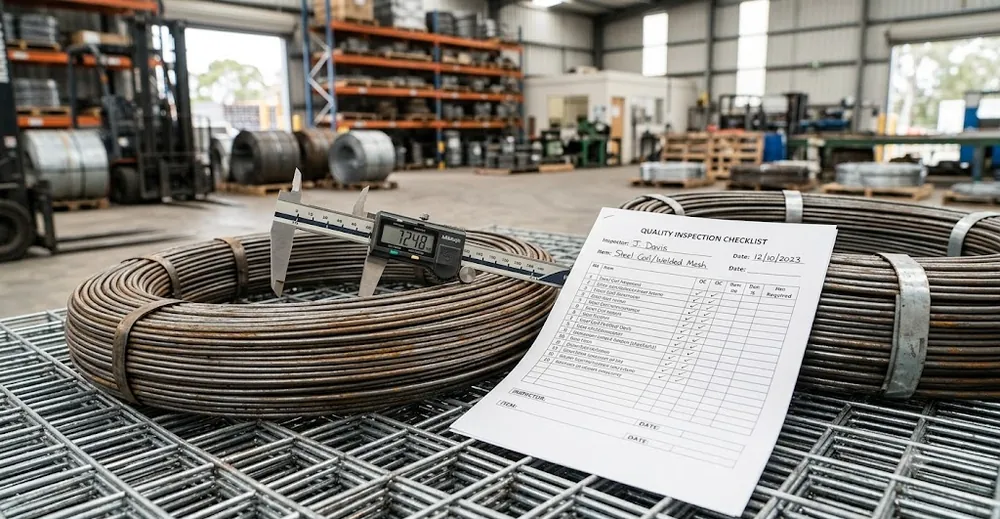
We are Hebei Leeter Import and Export Co., Ltd ("Leeter"), a construction hardware exporter based in Dingzhou, Hebei, China, working since 2006 with buyers across North America and Europe. This guide walks through how we approach a pre-shipment inspection on steel hardware, what to check, how AQL sampling works, and when to bring in an independent agency.
Why steel hardware needs a dedicated inspection
Steel hardware is deceptive. A pallet of anchor bolts, brackets, or connector plates can look perfect from three feet away and still be out of spec in ways that only show up on a job site. That is the whole reason a formal pre-shipment inspection exists: to verify, before payment and before loading, that what was made matches what was ordered.
The stakes are higher than with many other product categories. Steel parts often carry a structural or safety role. A joist hanger that is 2 mm short on a flange, or a bolt with a thread that gauges out of tolerance, does not just annoy a customer. It can fail an incoming quality check, get flagged by an engineer, or trigger a full-container return. Once a container is on the water, your options shrink to expensive ones.
There is a second reason. Production runs drift. The first article a factory produces is usually made with care and full attention. By the ten-thousandth piece, tooling has worn, a coil of steel has been swapped, an operator has changed shift. Inspection at the end of the run confirms the whole batch held up, not just the sample you approved weeks earlier.
What does a pre-shipment inspection actually check?
A pre-shipment inspection covers five practical areas: visual quality, dimensions and tolerances, coating and finish, quantity, and packaging with loading. Each one maps to a common cause of rejection. Skip any of them and you leave a gap that a marginal batch can slip through.
Here is the checklist we work from on a typical steel hardware order:
| Check area | What we verify | Common failure |
|---|---|---|
| Visual | Burrs, cracks, weld quality, rust, surface scratches | Sharp burrs on cut edges |
| Dimensions | Length, width, hole spacing, thread pitch, thickness | Hole position drift |
| Coating | Zinc or paint thickness, coverage, adhesion | Thin or patchy galvanizing |
| Quantity | Piece count per carton, total order count | Short count per carton |
| Packaging | Carton strength, labelling, moisture protection | Crushed cartons, no desiccant |
| Loading | Container condition, stacking, load securing | Poorly braced pallets |
Working from a written checklist matters more than any single item on it. It forces the inspector to look at everything, in order, every time. In our experience the checks people skip are the boring ones, quantity and packaging, and those are exactly the ones that generate the angry email after the container lands.
Visual and workmanship checks
Visual inspection sounds soft, but for steel it is concrete. The inspector looks for cracks near welds, incomplete welds, sharp burrs left after cutting or punching, surface rust, and coating runs or bare spots. On fabricated parts like brackets and hangers, weld quality is often the single most revealing check. A cold or porous weld tells you the whole batch may have been rushed.
How does AQL sampling work for steel parts?
AQL sampling lets you inspect a small, statistically chosen sample instead of every piece, then accept or reject the whole lot based on how many defects turn up. AQL stands for Acceptable Quality Limit. It comes from the ISO 2859 / ANSI ASQ Z1.4 standard, and it is the backbone of nearly every third-party inspection you will commission.
The logic is simple once you see it. You pick a sample size code based on your total order quantity, then choose an AQL level for each defect category. The inspector counts defects in the sample. If defects stay at or below the acceptance number, the lot passes. Cross it, and the lot fails.
Defects get sorted into three classes:
- Critical: a defect that makes the part unsafe or unusable. For structural steel hardware, most buyers set this at AQL 0, meaning zero tolerance.
- Major: a defect that will likely cause the product to fail its function or be returned. Common setting is AQL 2.5.
- Minor: a cosmetic or slight defect unlikely to affect use. Common setting is AQL 4.0.
For safety-relevant steel parts, we recommend tightening the major level below the default. A joist hanger with a bent flange is not a cosmetic problem. Talk with your inspection agency about the ISO 2859 general inspection level (Level II is standard) and whether a tighter level fits your risk. The numbers are not sacred. They are a shared language you and your supplier agree on in writing before the order runs.
One honest caveat: AQL is a sampling method, not a guarantee. It manages risk across a large lot economically. It does not promise every single piece is perfect. If your application genuinely needs 100 percent verification, say so up front, because that is a different, more expensive process.
Getting dimensions and tolerances right
Dimensional checking is where most steel hardware rejections actually originate, so it deserves the sharpest attention. The inspector measures real parts against the approved drawing using calipers, thread gauges, micrometers, and go/no-go gauges where relevant. Hole spacing, overall length, material thickness, and thread pitch are the usual suspects.
The key is to inspect against a signed drawing with explicit tolerances, not a vague sample. "Same as before" is not a spec. If your drawing says a hole sits 40 mm from the edge, it should also say plus or minus how much. Without a stated tolerance, an inspector cannot fairly pass or fail a part, and any dispute later becomes your word against the factory's.
For threaded parts, we always ask that thread gauges be used, not just a caliper on the outside diameter. A thread can measure correct on the outside and still not accept a matching nut. On plate and sheet parts, thickness gets checked at several points, because rolled steel can vary across a coil. These are small measurements. They are also the ones an engineer on the receiving end will check first.
Checking coating and finish
Coating thickness is the check buyers most often forget, and it is one of the most expensive to get wrong. For galvanized steel hardware, the inspector uses a coating thickness gauge to confirm the zinc layer meets your specified micron value at multiple points on multiple parts. Hot-dip galvanizing, zinc plating, and powder coating each have their own thickness and adhesion expectations.
Thin coating is a slow-motion failure. The part looks fine at delivery, passes a glance, then starts rusting months later in the field. By then the container is long gone and the warranty argument is awkward. Measuring microns at the factory, before shipment, is the cheapest insurance you can buy against corrosion complaints.
The inspector should also check coverage and adhesion: no bare patches at weld seams or recesses, no flaking when the surface is scored. For hot-dip galvanized parts, drainage holes and excess zinc buildup ("spikes" or "runs") matter too, since those can interfere with assembly. Ask that coating results be recorded as actual numbers on the report, not just a pass/fail tick.
Quantity, packaging, and loading photos
The inspection is not finished until quantity, packaging, and loading are verified with photos, because these three account for a surprising share of post-delivery disputes. The inspector counts a sample of cartons to confirm the piece count per carton, cross-checks against the total, and inspects packaging for strength, correct labelling, and moisture protection like desiccant or VCI film.
Loading is the final gate. Steel is heavy and dense, so how a container is packed decides whether parts arrive intact or arrive as a shifted, dented mess. Good practice includes:
- Photographing the empty container to confirm it is clean, dry, and undamaged.
- Photographing pallets and cartons as they go in, so stacking and bracing are documented.
- Recording the container number and seal number in the report.
- Confirming heavy items are evenly distributed and secured against movement.
Insist on these photos. A loading report with dated images gives you leverage if a claim is ever needed, and it tells you whether your supplier packs with care or just fills space. We include this documentation as standard, and we think every serious exporter should.
Using an independent inspection agency
An independent third-party agency inspects on your behalf, at the factory, with no stake in the sale, which is why many experienced importers use one even when they trust the supplier. Firms such as SGS, Bureau Veritas, TÜV, and Intertek offer standardized man-day inspections against your written spec and AQL settings. Smaller specialist agencies do the same at competitive rates.
Should you always hire one? Not necessarily. For a long-running relationship with a supplier who has a strong track record, a documented in-house inspection with photos and measurements may be enough. For a first order, a large order, or a safety-critical part, an independent set of eyes is cheap relative to the risk of a bad container. A single inspection typically costs one man-day, a small fraction of a container's value.
Whichever route you take, the principle holds: inspect before you pay the balance and before the container ships. As a manufacturer, we welcome third-party inspection on our construction hardware, because a clean report protects both sides. If you want to discuss inspection terms on an order, request a quote and we will set expectations in writing before production starts.
Frequently asked questions
What is the difference between a pre-shipment inspection and factory audit?
A pre-shipment inspection checks a finished, near-complete order for defects, dimensions, coating, quantity, and packaging before it ships. A factory audit evaluates the supplier's overall systems: equipment, quality processes, certifications, and capacity. The audit vets the company, the inspection vets a specific batch. Most importers do both at least once.
When should the inspection happen during production?
The inspection should happen when at least 80 percent of the order is produced and packed, with the rest close behind. Inspect too early and you cannot verify the full quantity or final packaging. Inspect after loading and it is too late to fix anything. The 80 percent point is the practical sweet spot most agencies use.
What AQL level should I use for structural steel hardware?
For safety-relevant steel hardware, we suggest AQL 0 for critical defects, meaning zero tolerance, and a tightened major level rather than the default. Cosmetic minor defects can sit at the standard AQL 4.0. Agree the exact numbers in writing with your supplier and inspector before production, because AQL is only useful when everyone shares the same target.
Can I inspect the goods myself instead of hiring an agency?
Yes, especially with a trusted supplier and a clear written checklist. Many buyers rely on a documented in-house inspection with measurements and dated photos. For first orders, large volumes, or safety-critical parts, an independent agency adds impartial verification at roughly one man-day's cost. The right choice depends on your risk and your history with the supplier.
What happens if the inspection fails?
A failed inspection means the lot did not meet the agreed AQL or spec, and you hold the balance payment as leverage. Typical next steps are rework or sorting by the factory, then a re-inspection of the corrected lot. Because the container has not shipped, you fix the problem cheaply at the source instead of after delivery.
Ready to ship with confidence?
A clean pre-shipment inspection protects your money, your schedule, and your reputation with your own customers. We build inspection access and loading documentation into every order as standard. If you are sourcing steel construction hardware and want a supplier who welcomes third-party checks, request a quote and let us set clear quality terms before production begins.
