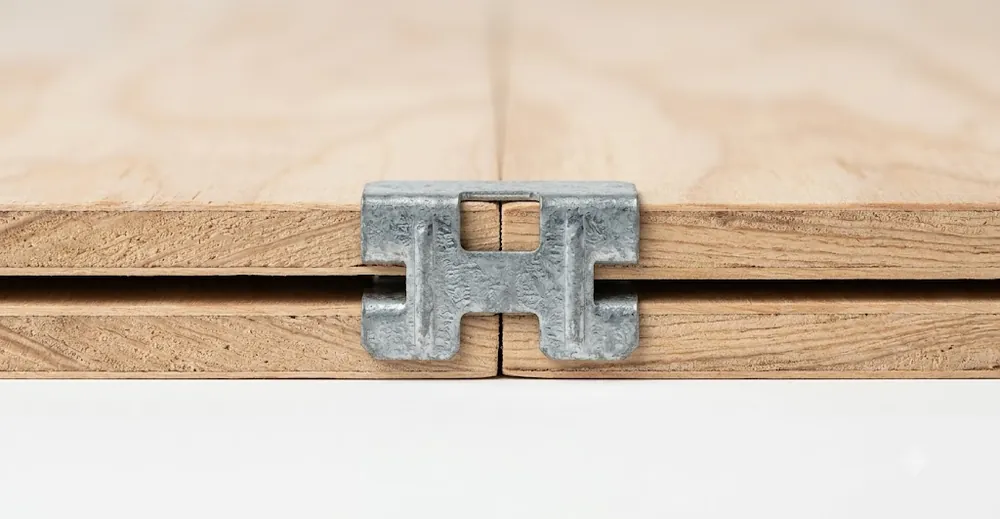
We are Hebei Leeter Import and Export Co., Ltd, a wire, mesh, anchor, and building-support manufacturer based in Dingzhou, Hebei, China, exporting to North America and Europe since 2006. We stamp and form plywood clips in volume, so the notes below reflect what actually moves through our lines and what our buyers ask before they place an order.
What do plywood clips actually do?
A plywood clip does three jobs at once. First, it transfers vertical load from one panel edge to the next, so a foot stepping near an unsupported edge does not deflect the panel more than its neighbor. Second, it enforces a spacing gap, usually about 1/8 inch, that lets the wood expand when it takes on moisture without buckling. Third, it lets a builder skip solid blocking between rafters or trusses, which saves lumber and labor.
The clip is stamped from a strip of spring steel and bent into an H profile. The two channels of the H slide onto the meeting edges of two panels, and the web of the H holds the gap. When the roof or floor is loaded, the clip ties the two edges so they deflect together. Building codes in the United States and Canada recognize panel edge clips as an accepted alternative to tongue-and-groove edges or solid blocking on roofs, provided the panel span rating matches the framing spacing.
Here is the practical payoff. On a typical roof framed 24 inches on center with 7/16 or 15/32 sheathing, one clip is placed at the midpoint of each unsupported panel edge. That single stamped part replaces a run of 2x blocking, cuts install time, and keeps the deck flat under foot traffic and snow load. For a buyer, that means high volume and steady reorders, because every sheet of roof deck with an unsupported edge needs one.
How do you size plywood clips to panel thickness?
Sizing is the part buyers get wrong most often, and it is simple once you see it. The clip channel must match the nominal thickness of the sheathing so the panel seats fully without slop or force. A clip that is too wide rattles and does not grip. A clip that is too tight tears the veneer or refuses to seat. You size the clip to the panel, not the framing.
Sheathing in North America is sold in a handful of common thicknesses, and each maps to a clip size. Note that many panels carry a "performance" thickness slightly under the nominal call-out, for example 15/32 for a nominal 1/2 inch and 7/16 for a nominal 7/16 inch. Reputable clips are formed to seat these real-world dimensions, not just the round number on the label.
| Panel nominal thickness | Common performance thickness | Plywood clip size |
|---|---|---|
| 3/8 in (9.5 mm) | 3/8 in | 3/8 in clip |
| 7/16 in (11.1 mm) | 7/16 in | 7/16 in clip |
| 1/2 in (12.7 mm) | 15/32 in | 1/2 in clip |
| 5/8 in (15.9 mm) | 19/32 in | 5/8 in clip |
| 3/4 in (19.1 mm) | 23/32 in | 3/4 in clip |
The takeaway: order clips by the thickness stamped on the sheathing you will buy, and confirm whether your panels run nominal or performance rated. When a customer sends us a spec, we ask for the exact panel call-out and the framing spacing so we can confirm the clip fits and the span is code-appropriate. If you carry several sheathing grades, stock the 7/16 and 1/2 inch clips deepest, since those cover the bulk of residential roof and wall work.
Where are H-clips used: roof, wall, or subfloor?
H-clips earn their keep mostly on roofs, but they show up on walls and floors too, and the rules shift with each. Roof decks are the classic case. Whenever the panel edge runs perpendicular to and between the rafters or trusses with no support underneath, a clip goes at each unsupported edge, spaced by the number the panel span rating allows. For 24 inch on center framing you place one clip per edge; wider or thinner assemblies may call for two.
Wall sheathing uses clips less often, because walls carry less out-of-plane load and studs at 16 inches on center leave shorter unsupported spans. Some engineers still specify clips on wall panels where a smooth, flush face is needed for cladding, or where the panel span rating requires edge support. When they do, the sizing logic is identical: match the clip to the panel thickness.
Subfloor is the exception where clips are usually the wrong answer. Floor decks take heavy concentrated loads and are typically joined with tongue-and-groove edges glued and nailed to the joists, which handle load transfer far better than a clip. We tell buyers plainly: do not sell H-clips as a subfloor edge solution unless a specific engineer's detail calls for them. Pushing clips where T&G belongs invites squeaks and callbacks, and it damages your reputation with the framing crew.
Why galvanized spring steel matters
The material spec is where a cheap clip fails and a good one lasts. Plywood clips must be springy enough to grip the panel edge under repeated flexing yet hard enough not to splay open, so they are formed from spring-tempered steel rather than mild sheet. That temper is what lets the H channel clamp the two panels and hold the gap through the roof's service life. A soft clip opens up, loses its grip, and stops transferring load.
Coating is the second half of the story. Roof and wall assemblies see condensation, and a bare steel clip embedded in a moist deck will rust and stain the wood. We supply plywood clips in hot-dip or electro-galvanized finishes so the zinc layer resists corrosion in normal enclosed-assembly service. For coastal or high-humidity markets, ask about a heavier zinc weight. In our experience the coating question rarely comes up until a buyer has fielded a rust complaint, so it is worth settling up front.
One honest caveat from the factory floor: not every "galvanized" clip carries the same zinc thickness. Thin flash coatings look identical in the box and corrode years sooner. When you compare quotes, ask for the coating weight and the steel temper, not just the price per thousand. Those two numbers tell you whether you are buying a clip that performs or one that only looks the part.
How are plywood clips packaged and ordered in bulk?
Plywood clips are a bulk commodity, so packaging is built for volume and clean counting. We pack clips loose in cartons by count, commonly 250, 500, or 1,000 pieces per box, then palletize the cartons for container shipment. Because the parts are small and dense, a single pallet holds a very large piece count, which keeps freight cost per clip low even across an ocean.
For distributors we can print carton labels with your SKU, size, and count, and we sort strictly by clip size so a 7/16 box never mixes with a 1/2 box. Minimum order quantities are set at the container or partial-container level for export; smaller trial orders are possible when you are qualifying a new supplier. If you also stock ground hardware, many of our clip buyers add form stakes to the same shipment to consolidate freight, since both are stamped steel commodities from the same plant.
When you request a quote, send us the clip sizes and quantities, your preferred coating, and the carton count you want per box. We will confirm the fit against your panel spec, quote the piece price and the loaded pallet count, and give you a production lead time. Clear specs up front mean the clips that land at your dock match the sheathing on your shelves.
Frequently asked questions
What is the difference between a plywood clip and an H-clip?
There is no difference; they are two names for the same part. "H-clip" describes the H-shaped cross section, and "plywood clip" or "panel edge clip" describes the job. You will also hear "sheathing clip." All refer to the small formed-steel connector that fits between two panel edges to transfer load and hold the spacing gap.
Do I need plywood clips on every sheathing edge?
No. Clips go only on unsupported panel edges, meaning edges that run between framing members with nothing solid beneath them. Edges that land directly on a rafter, truss, or stud are already supported and need no clip. On a standard roof, that usually means one clip at the midpoint of each horizontal edge between the framing.
Can I use the wrong-size clip if it is close?
We advise against it. A clip sized under the panel thickness will not seat and can tear the veneer; a clip sized over it rattles and fails to grip, so it stops transferring load. Always match the clip to the sheathing's actual thickness, remembering that many panels run at a performance thickness slightly under the nominal number.
Are galvanized plywood clips required by code?
Code focuses on structural performance and edge support spacing rather than mandating galvanizing in every case, but corrosion resistance is strongly advised because clips sit in an assembly that sees condensation. Galvanized spring steel resists rust and prevents staining of the wood. For coastal or humid regions, specify a heavier zinc coating for longer service life.
How many plywood clips will one roof need?
Estimate one clip per unsupported panel edge. A rough rule for a common roof framed 24 inches on center: count the number of full sheets, then figure roughly one clip per sheet for the horizontal edge between framing, adding more where two clips per edge are specified. Order a modest overage to cover waste and dropped parts on the deck.
Order the right clips for your sheathing
Sizing plywood clips is straightforward once you match the clip to the panel and pick the right coating for your climate. If you are stocking H-clips for roof, wall, or specified floor work, send us your panel specs and quantities and we will confirm the fit before you commit. Contact Leeter for factory-direct pricing, coating options, and bulk carton packaging built for distributors.
