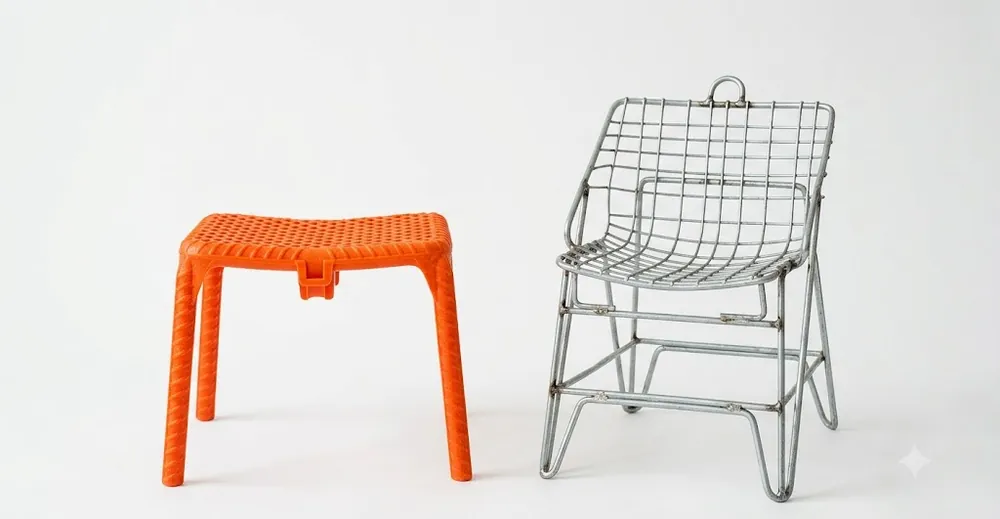
Get the support choice wrong and the cost shows up later: rust stains bleeding through a fair-faced wall, bars pushed out of position under a crew, or chairs crushed before the concrete ever arrives. Get it right and the reinforcement sits at the correct cover, every time, across the whole slab.
The short answer, by exposure and load
Pick the support around two questions: will the surface be exposed, and how much load lands on the chair before and during the pour? Wire wins on raw strength. Plastic wins wherever rust is unacceptable. Precast wins on heavy traffic and rough subgrades. Here is the comparison we give buyers.
| Support type | Load capacity | Corrosion / rust risk | Best use |
|---|---|---|---|
| Wire bar chair | Highest per unit; handles crew weight and vibration | Bare wire can rust; needs plastic-tipped or coated feet at exposed faces | Suspended slabs, beams, heavy mesh, high point loads |
| Plastic rebar chair | Moderate to high; wide feet spread load | None; will never rust or stain | Exposed concrete, architectural faces, water tanks, marine, decks |
| Precast concrete block | High and stable; broad base | None from the block; embedded tie wire can rust if exposed | Ground slabs on grade, heavy traffic, uneven or soft subgrade |
Most jobs use a mix. A parking structure might run precast blocks on the mud slab, wire chairs in the suspended decks, and plastic at any exposed soffit. Matching the support to the location beats forcing one product across the whole project.
Which rebar chair carries the most load?
Wire bar chairs carry the most concentrated load. The steel wire forms a rigid, welded frame that holds its height when a worker steps on it or a power buggy rolls past. Higher chairs, the tall continuous types supporting top mats in thick slabs, are almost always wire for this reason. When the reinforcement is heavy and the chairs are tall, steel is the honest choice.
Load is not only about the material. It is about foot area and spacing too. A plastic chair with a wide, ribbed base can spread load across soft ground better than a narrow wire foot that punches in. On a firm formwork deck the wire wins on point strength; on a loose granular subgrade the plastic or precast base often performs better because it does not sink.
For heavy top mats, deep beams, and anything a crew walks across during placement, we steer buyers toward wire bar chairs or precast blocks. Reserve lighter plastic clips and chairs for the bottom mat and moderate spans where the load per support stays low.
A note on spacing
Even the strongest chair fails if you space it too far apart. Reinforcement sags between supports under its own weight and under traffic. Follow the spec or standard spacing tables, tighten the grid where crews walk, and treat the chair rating as a per-support figure, not a licence to stretch the layout. A cheaper chair at correct spacing beats a premium chair placed too sparsely.
When does rust make plastic the only sensible choice?
Rust decides more support selections than load does. Any steel that reaches or nears the concrete surface can corrode, and the stain bleeds through to the face as a brown streak that no amount of washing removes. On architectural, exposed, or fair-faced concrete, that risk alone rules out bare wire feet. This is where plastic rebar chairs earn their place.
Plastic never rusts, full stop. That makes it the default for water-retaining structures like tanks and reservoirs, marine and coastal work where chloride attack is aggressive, exposed slab soffits, polished floors, and any surface an architect will look at. The chair sits inside the cover zone permanently, so a non-corroding support removes one long-term failure path entirely.
Wire is not disqualified near surfaces, but it needs help. Plastic-tipped feet or a fully coated chair keep the steel off the formwork and away from the air, cutting the rust-bleed risk sharply. For interior structural elements with generous cover, plain wire is fine because the steel stays buried deep in sound, alkaline concrete that protects it. Ask one question first: will anyone ever see this face, or will it hold water? If yes, lean plastic.
Where do precast concrete blocks beat both?
Precast concrete supports, often called dobies or spacer blocks, win on ground slabs and rough conditions. They are heavy, broad-based, and effectively immovable once placed, so a crew can drag mesh and walk across a slab-on-grade without kicking supports out of line. On soft, wet, or uneven subgrade, that stability is worth more than a few grams of extra load rating.
Because the block is concrete, it becomes part of the pour with matched thermal and durability behaviour, and it will not rust. The one caveat is the tie wire cast into many blocks: if that wire reaches an exposed face it can stain, so keep precast on buried, on-grade, or hidden locations. For a mud slab under a foundation, a warehouse floor, or a paving job on graded stone, precast blocks are often the most forgiving and lowest-fuss option on site.
Their weakness is handling. Blocks are heavy to ship and to carry around the deck, and you cannot clip them onto bars the way you snap a plastic chair. On suspended formwork, where every kilogram of dead weight and every hour of labour counts, lighter chairs usually win.
How do the costs really compare?
Unit price rarely tells the whole cost story. Plastic chairs are typically the lowest cost per piece and the cheapest to ship because they are light and nest together. Wire chairs cost more per unit as steel and welding add up, especially in tall continuous forms. Precast blocks are cheap to make but expensive to freight because you are paying to move concrete and taking up volume.
Look past the piece price to installed cost. Plastic clips on fast and needs no tie wire, which saves labour. Precast is slow to distribute by hand but bombproof once down. Wire may need extra plastic tips for exposed work, adding a line item. On a large slab-on-grade, we have seen buyers save more on freight and labour by choosing the right support than they ever save chasing the lowest unit price. Buy for the total, not the sticker.
Ordering and lead time
Standard plastic and wire chairs ship from stock quickly and in high volume, so they suit tight programmes. Custom heights, special clip designs, or coated feet add lead time, so send drawings early. Precast, if you buy rather than cast on site, is best sourced close to the pour because freight dominates the cost. When you request a quote, give us the bar diameters, cover, slab thickness, and exposure class, and we will match the support and quantity to the job.
A quick decision guide
Run through this order and the choice usually settles itself. First, is the face exposed, architectural, or water-retaining? If yes, choose plastic, or fully coated wire at minimum. Second, is it a ground slab on rough or soft subgrade with heavy traffic? Precast blocks or wide-foot plastic. Third, is it a suspended slab, beam, or heavy top mat where crews walk? Wire chairs for strength.
When two answers pull in different directions, exposure beats load, because you can always add supports or tighten spacing to handle load, but you cannot un-rust a stained wall. Mix products across one project without hesitation; the best-run sites we supply rarely use a single support type everywhere. Match each element to its own exposure and load, and the reinforcement stays exactly where the designer intended.
Frequently asked questions
Are plastic rebar chairs strong enough for structural slabs?
Yes, for most bottom mats and moderate loads, quality plastic chairs are strong enough, especially wide-foot designs that spread load. For tall top-mat supports, deep beams, or areas where crews walk heavily, wire chairs or precast blocks carry concentrated load better. Match the chair rating to the actual point load and keep spacing tight.
Will wire bar chairs rust and stain my concrete?
Bare wire feet can rust if they sit at or near an exposed surface, and the stain bleeds through the face. For interior structural work with good cover, plain wire stays buried and protected, so it is fine. Near any visible face, use plastic-tipped or fully coated wire chairs, or switch to plastic.
What is the difference between a plastic chair and a precast block?
A plastic chair is light, clips onto the bar, and ships cheaply, making it ideal for exposed faces and fast placement. A precast concrete block is heavy, sits immovably on the subgrade, and resists traffic, making it ideal for ground slabs. Neither rusts, though tie wire cast into a block can stain an exposed face.
Which rebar support is cheapest overall?
Plastic usually wins on total installed cost because it is light to freight and fast to fit without tie wire. Precast has a low material cost but high freight because you are shipping concrete. Wire sits in between. Always compare installed cost, including labour and freight, rather than the piece price alone.
Can I use different rebar supports on the same project?
Absolutely, and we recommend it. Use precast blocks on the mud slab, wire chairs in suspended decks and heavy top mats, and plastic at any exposed soffit or water-retaining face. Matching each support to its own exposure and load gives better results than forcing one product across the whole job.
Talk to us before your next pour
Choosing between plastic, wire, and precast rebar supports gets simple once you know the exposure and the load. If you want a second opinion on a specific slab, wall, or tank, send us the details and we will recommend the right mix. Request a quote with your bar sizes, cover, and exposure class, and we will match supports and quantities to your project.
