The quick answer
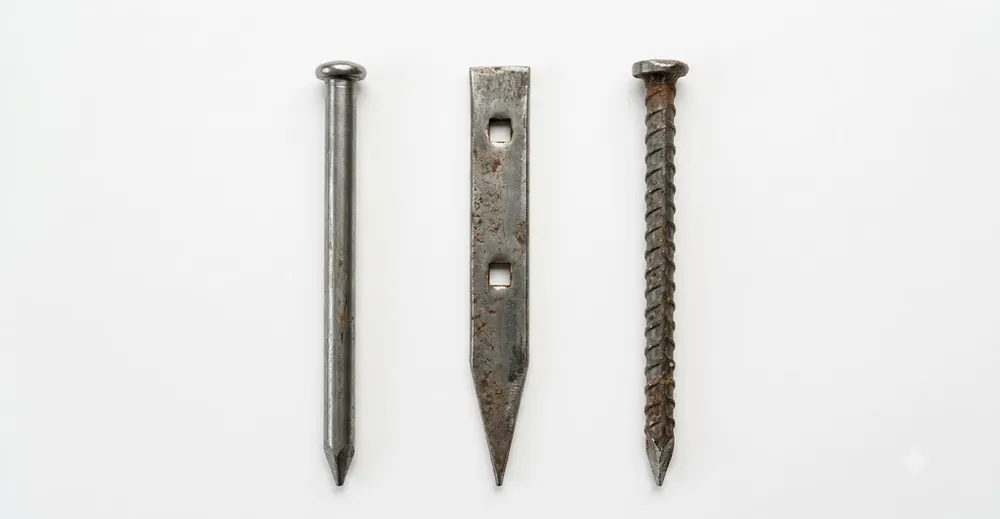
Round nail stakes give you the best balance of holding power, driveability, and reusability, and the staggered holes let you fasten forms at almost any height. Flat stakes shine when you need a wide bearing face against plywood or a low profile in tight spots. Rebar stakes are the cheapest to buy and the hardest to pull back out, which makes them a one-way ticket for permanent or throwaway work.
None of these is "best" in the abstract. A crew pouring residential driveways with reusable steel forms wants something very different from a crew setting a foundation footing that will never be disturbed. Below we walk each type honestly, trade-offs included.
Round nail stakes
Round nail stakes are hardened steel rods, typically 3/4 inch diameter, with holes punched at intervals down the shaft and a chisel or diamond point at the bottom. We stagger those holes on alternating faces so a nail driven through one hole clears the nail below it. That staggering matters more than most buyers expect. It lets you nail a form board at whatever height the grade demands, then add a second nail lower down for a stake that will not rock.
Driveability is good. The round cross-section splits soil rather than shearing a wide slot, so a 3/4-inch stake sinks with fewer swings than a comparable flat bar. Because the shaft is round, it also pulls straight back out without the suction a wide plate can create in clay.
Reusability is where round nail stakes pay for themselves. A quality hardened stake driven and pulled with reasonable care will run through dozens of pours. The nail holes take abuse, and the points can be re-sharpened on a grinder when they mushroom. For contractors who own their forms and reuse everything, this is usually the lowest cost per use even though the sticker price sits above rebar.
The main downside is the round bearing face. Where the stake meets the form, contact is a line, not a plane. Against thin steel forms that is fine. Against soft plywood, a hard-driven nail can let the board pivot slightly under vibration. Most crews solve this with two nails at different heights, which the staggered holes make easy.
Flat form stakes
Flat form stakes, sometimes called plate stakes or strap stakes, are punched from flat steel bar. They present a wide, flat face to the form and carry pre-punched nail holes down the length. That flat face is the whole point. When you nail a plywood or dimensional-lumber form to a flat stake, the board sits against a real surface, so it resists twisting and holds a cleaner line.
Holding against the form is excellent. Holding in the ground is more situational. A flat blade drives well into loose or sandy soil, but in dense clay or gravel the wide profile fights you, and you will swing the sledge more times per stake. Pulling out can also be stubborn, because the flat face grabs compacted soil.
Flat stakes reuse reasonably well, though the wider steel is more prone to bending if a crew member hammers off-axis or hits buried rock. A bent flat stake is harder to straighten than a bent round rod. For finish work, edge forms, and anywhere the appearance of the concrete edge really counts, many of our customers still prefer the flat face despite the extra driving effort.
Rebar stakes
Rebar stakes are exactly what the name says: cut lengths of deformed reinforcing bar, often #4 (1/2 inch) or #5 (5/8 inch), sometimes with a formed point. They are the cheapest option on the shelf, and the deformations that grip concrete also grip soil, which is a double-edged trait.
Holding power in the ground is very high. Once a rebar stake is driven, the ribs resist pull-out aggressively. That is great when you want the stake to stay put and terrible when you want it back. Rebar stakes are hard to remove cleanly, and crews often cut them off at grade or leave them buried rather than fight them. For that reason we treat rebar as a single-use or permanent-anchor solution, not a reusable form stake.
Rebar stakes also lack pre-punched nail holes. You either tie or wire the form to the bar, weld a bracket, or drill on site. That adds labor. Where rebar earns its keep is deep anchoring, holding the base of tall forms, pinning down curb forms in soft ground, and any application where the stake is meant to disappear into the finished work.
Side-by-side comparison
| Factor | Round nail stakes | Flat form stakes | Rebar stakes |
|---|---|---|---|
| Bearing face on form | Line contact (use 2 nails) | Wide flat face, best hold | None; tie or weld |
| Nail-hole flexibility | High; staggered holes | Good; punched holes | None as supplied |
| Driveability in hard soil | Very good | Moderate | Very good |
| Pull-out effort | Low, easy to reuse | Moderate to hard | Very hard |
| Reusability | Excellent, dozens of pours | Good, can bend | Poor; single use |
| Purchase cost | Moderate | Moderate to high | Lowest |
| Cost per reuse | Lowest for owned forms | Moderate | High if pulled |
| Best for | General formwork, steel forms | Plywood edges, finish work | Permanent anchoring, soft ground |
How to choose for your job
Start with one question: are you pulling these stakes back out? If yes, round nail stakes are almost always the right call. Their easy pull-out and long service life make them the workhorse for reusable formwork, and the staggered holes handle uneven grade without extra parts. This is what most of our repeat customers order in volume.
If your priority is a dead-flat form face for architectural edges, exposed slabs, or crisp curb lines, weigh flat stakes for the runs that show. Many crews mix types on one pour, running flat stakes on the visible edge and round stakes everywhere else. There is nothing wrong with that; matching the stake to the exposure is smart buying.
Reach for rebar when the stake is staying in the ground or when soil is so soft that only deep, ribbed anchoring will hold a tall form. Just budget the labor to tie forms to bar, and accept that you probably will not get those stakes back.
Soil is the quiet deciding factor. In loose or sandy ground, holding power drops, so favor length and the flat face. In dense clay or gravel, favor round stakes for driveability and easy removal, and never underestimate how hard a wide flat blade fights compacted soil on the way in and out.
A note on quality and steel
Not all stakes of the same shape perform alike. The steel grade, hardness, and how the point is formed decide whether a stake drives straight, holds its edge, and survives being pulled. Cheap, soft stakes mushroom at the head, bend on the first buried rock, and split at the nail holes. We harden our round nail stakes so the holes stay round and the points can be re-sharpened, because a stake that lasts thirty pours instead of five changes the real math entirely.
Length selection matters just as much as type. A stake that is too short will not develop enough ground grip no matter how good the steel is. If you are unsure how deep to go for your form height and soil, we cover that in our companion guide, and we are happy to advise on your specific pour when you request a quote.
Frequently asked questions
What are staggered nail holes and why do they matter?
Staggered nail holes sit on alternating faces of a round stake so nails driven through them do not collide. This lets you fasten a form board at nearly any height to match uneven grade, then add a second nail lower down. Two nails at different heights stop the form from rocking under vibration during the pour.
Can I reuse rebar stakes like I reuse round nail stakes?
Rarely. Rebar's ribbed surface grips soil so strongly that pulling stakes back out is difficult, and crews often cut them off at grade instead. Rebar stakes also have no pre-punched holes, so removing forms means cutting ties or welds. Treat rebar as single-use or permanent anchoring, and choose round nail stakes when you need to reclaim the stake.
Which stake holds forms best in soft or sandy soil?
In loose ground, favor length and bearing area over shape. Flat stakes present a wider face that resists movement, and rebar's ribs anchor deep. Round nail stakes still work if you drive them deeper. The real fix in poor soil is a longer stake, so step up length before you assume a shape change will solve the problem.
Why choose round nail stakes over flat stakes for general work?
Round nail stakes drive faster because the round shaft splits soil rather than shearing a wide slot, and they pull straight out without the suction a flat plate creates in clay. They also resist bending better and last through more pours. For everyday reusable formwork, that combination gives the lowest cost per use.
Do flat stakes work with plywood forms?
Yes, and this is where flat stakes are strongest. Their wide flat face sits flush against plywood, so the board resists twisting and holds a cleaner edge line than it would against a round stake. For architectural edges and finish work, many crews run flat stakes on the visible face and round stakes elsewhere.
Choosing with confidence
The right stake is the one that matches your soil, your form material, and whether you plan to pull it back out. Round nail stakes cover the widest range of formwork, flat stakes win on finished edges, and rebar handles permanent anchoring. Tell us your form heights, soil type, and reuse expectations, and we will spec the type, diameter, and length that gives you the best cost per pour. Request a quote and we will get you sorted.
