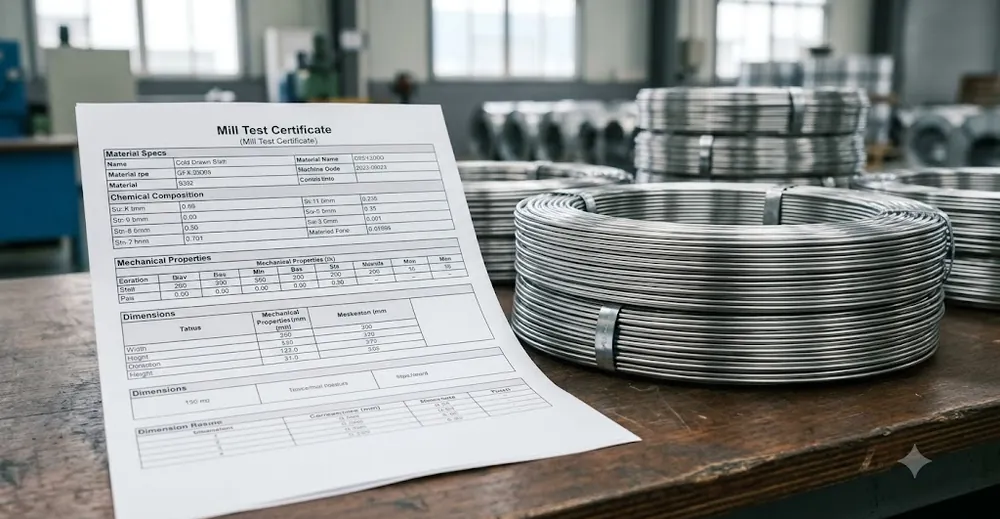
This guide walks through what an MTR actually contains, how to read the chemistry and the mechanical numbers, how to match both to the standard you ordered, and how to request and verify a certificate you can trust.
What is a mill test report?
A mill test report is a certified record produced by the steel mill that melts and rolls the material. It documents the results of laboratory and physical testing on a specific batch of steel, then certifies that those results meet a named specification. The mill signs it, dates it, and stamps it. That signature is the mill putting its name behind the numbers.
The key word is certified. An MTR is not a marketing sheet or a general product brochure. It is a legal document tied to a production run. When people say a shipment is "mill certified," they mean this document exists and travels with the goods, forming an unbroken link from the raw melt to the crate on your dock.
Most MTRs you will see in construction hardware follow the EN 10204 framework, which defines the types of inspection documents. Two matter most to buyers:
- Type 3.1: results certified by the manufacturer's own authorized inspection department, independent of the production line. This is the standard MTR for the majority of steel orders.
- Type 3.2: results countersigned by an independent third party or the buyer's nominated inspector. You request this when a project or a contract demands external verification.
For everyday bolts, brackets, anchors, and rebar accessories, a Type 3.1 certificate is usually what applies. For safety-critical or contractually sensitive work, ask whether 3.2 is required before you place the order, not after.
What information does an MTR contain?
Every legitimate MTR carries the same core fields, regardless of the mill or country. Once you know what each field means, you can scan a certificate in under a minute and know whether it belongs to your goods. The table below breaks down the fields you should always find and what each one actually tells you.
| Field on the MTR | What it tells you |
|---|---|
| Manufacturer and mill address | Who melted and certified the steel, and where to trace it |
| Heat or cast number | The unique batch ID linking this paper to that specific melt |
| Product description and dimensions | Grade, size, and form, so you can match it to your purchase order |
| Applicable standard | The specification the material is certified against, such as ASTM or EN |
| Chemical composition | Percentage of carbon, manganese, sulfur, phosphorus, and alloying elements |
| Mechanical properties | Yield strength, tensile strength, elongation, and often hardness |
| Test results and methods | The measured values and how they were obtained |
| Certificate type | EN 10204 3.1 or 3.2, defining who vouches for the data |
| Signature, stamp, and date | The mill's certification that the results are true |
The heat number is the field people underestimate. It is the thread that ties everything together. If a problem surfaces two years later, that number lets the mill pull the original melt records, and it lets you prove which shipment the failing part came from. No heat number, no real traceability.
How do you read chemistry versus mechanical properties?
The chemistry section and the mechanical section answer two different questions. Chemistry tells you what the steel is made of. Mechanical properties tell you how it behaves under load. A certificate has to pass on both counts, because a correct recipe does not guarantee correct performance, and good test numbers do not excuse an out-of-spec composition.
Reading the chemical composition
The chemistry block lists elements as percentages by weight. Carbon controls hardness and strength but also affects weldability, so most standards cap it. Manganese adds strength and toughness. The two elements you want low are sulfur and phosphorus, because both make steel brittle. Many specifications set hard ceilings on these, often around 0.05 percent or less.
When you read this section, you are checking that each value falls inside the range the standard allows. A grade is not a single magic recipe. It is a window. As long as every element sits inside its permitted band, the chemistry conforms. If even one element drifts outside, the material is off-spec no matter how good it looks.
Reading the mechanical properties
Mechanical properties are measured by physically testing samples. Three numbers matter most:
- Yield strength: the stress at which steel starts to deform permanently. This is often the governing number in structural design.
- Tensile strength: the maximum stress the material carries before it fails.
- Elongation: how much the sample stretches before breaking, expressed as a percentage. It is your measure of ductility, the ability to bend rather than snap.
Read these as minimums, not targets. A standard might require a minimum yield of 250 MPa. The MTR value should meet or exceed it. A number that clears the minimum comfortably is good. A number that sits suspiciously exactly on the line, on every single property, is a reason to look harder.
How do you match an MTR to your order?
Matching the MTR to the order is where most buyers relax too early, and it is exactly where errors hide. The certificate can be genuine, the steel can be excellent, and it can still be the wrong material for your purchase order. Verification means checking that the certificate in front of you describes the goods you actually bought.
Start with the standard. If your purchase order specifies ASTM A325 and the MTR certifies to a different grade, stop there. The two are not interchangeable just because both are "steel." Then confirm the grade, the dimensions, and the product form all match the line items you ordered. A certificate for a 12 mm bolt does not cover the 16 mm bolts in the same crate.
Next, cross-check the heat number. The number printed on the MTR should correspond to the marking or batch documentation on the physical goods. This is the step that catches recycled or borrowed certificates, where a real MTR is paired with material it never described. If the numbers do not connect, the paper is worthless no matter how official it looks.
Finally, read the actual values against the standard's requirements yourself. Do not assume conformance because a certificate exists. We have seen certificates that were authentic mill documents but showed one element out of range, meaning the mill itself had flagged a non-conforming batch. The document did its job. The buyer just had to read it.
How do you request and verify an MTR?
Request the MTR in writing at the order stage, not at delivery. The best practice is simple: make the mill test report a documentary condition of the purchase order, so the certificate is a required deliverable alongside the goods. When suppliers know upfront that payment and acceptance depend on a matching MTR, the paperwork tends to arrive clean and on time.
To request one effectively, specify these points in your order:
- The exact standard and grade you require, written out in full.
- The certificate type you need, EN 10204 3.1 or 3.2.
- That the heat number on the certificate must be traceable to the delivered goods.
- That you want the document in a legible, complete format, not a cropped or partial scan.
Verification has two layers. First, the desk check: read the fields, match them to your order, and confirm the values meet the standard, as described above. Second, physical correlation: on higher-value or safety-critical orders, a pre-shipment inspection can confirm that the markings on the actual product match the heat numbers on the certificates. This is where a third-party inspector or a 3.2 certificate earns its cost, by closing the gap between paper and steel.
If you ever doubt a certificate, contact the issuing mill directly using the address on the document, not a phone number the trader gives you. A real mill can confirm whether a heat number and certificate came from its records. Genuine suppliers welcome this. The ones who resist are telling you something.
When we prepare an order at Leeter, the MTR is assembled and checked before the container is sealed, because a certificate that arrives after the goods helps no one. If you want to see how we document a shipment end to end, request a quote and we will walk you through a sample certificate package.
Frequently asked questions
Is a mill test report the same as a certificate of conformance?
No, and the difference matters. A certificate of conformance is a simple statement that goods meet a specification, often with no test data. A mill test report includes the actual measured chemical and mechanical results tied to a specific heat. The MTR shows the numbers. The certificate of conformance just makes a claim.
What does EN 10204 3.1 versus 3.2 actually mean?
EN 10204 defines who certifies the test results. A 3.1 certificate is issued and signed by the manufacturer's own independent inspection department. A 3.2 certificate adds validation by an external party, such as a third-party inspector or your nominated agent. Use 3.1 for routine orders and 3.2 when a contract or safety-critical application requires outside verification.
Can a supplier reuse an MTR for a different shipment?
A single MTR covers one specific heat or batch of steel. If a later shipment comes from a different melt, it needs its own certificate with its own heat number. Reusing an MTR across unrelated production runs breaks traceability. This is why cross-checking the heat number on the paper against the markings on the goods is essential.
What if the MTR values are close to the standard's limits?
Values that meet the minimum requirement are compliant, even if the margin is small. That said, results sitting exactly on every limit across multiple properties can warrant a closer look or an independent test. Reputable mills usually deliver comfortable margins. When numbers look too neat to be real, treat that as a signal to verify rather than assume.
Do I need an MTR for every steel order?
For structural, load-bearing, or safety-critical construction hardware, treat the MTR as mandatory and non-negotiable. For low-risk decorative or non-structural items, it may be optional depending on your project and local rules. When unsure, request it anyway. An MTR costs the mill almost nothing to provide, and it protects you if anything about the material is ever questioned.
Ready to source certified steel hardware with clean, traceable documentation from the first order? Contact our team and we will send a sample MTR package so you know exactly what to expect before you commit.
