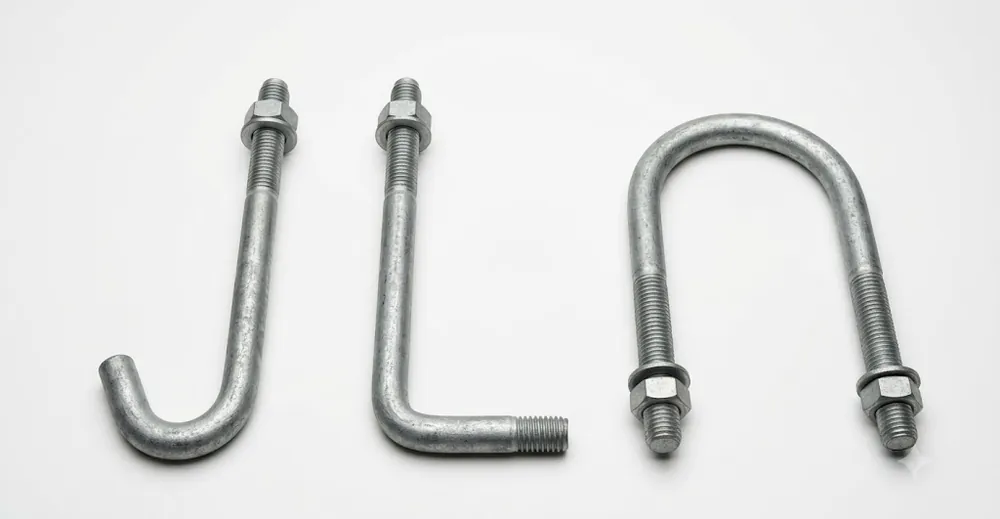
We are Hebei Leeter Import and Export Co., Ltd, a manufacturer and exporter based in Dingzhou, Hebei, China since 2006. We produce wire, mesh, anchor bolts, and support hardware for customers across North America and Europe. This guide walks through each shape, how the buried end builds holding strength, the diameters we run, and how to choose without over-specifying.
How a cast-in anchor develops holding strength
Every cast-in anchor works the same basic way: the concrete grips the embedded end, and the exposed thread carries the connection above. When you pull on the bolt, the load has to travel out of the steel and into a cone of concrete around the buried portion. That cone is what fails first in most tension events, not the steel itself.
The shape of the embedded end matters because it decides how the anchor resists pull-out. A bend or a hook creates mechanical bearing against the concrete. A plate or a nut on the buried end does the same job but spreads the bearing over a larger flat surface. Straight, smooth embedment with no feature relies almost entirely on bond, which is why nobody specifies a plain straight rod for real tension work.
Two numbers drive the design: embedment depth and edge distance. Deeper embedment pulls a bigger concrete cone and raises tension capacity. Generous edge distance stops the cone from breaking sideways out of a slab edge. Design codes such as ACI 318 Appendix D (now Chapter 17) and the ASTM F1554 material standard govern how these are calculated in North America. We build to the print your engineer gives us; we do not substitute geometry on our own.
L bolt vs J bolt: what actually separates them?
The core of the L bolt vs J bolt decision comes down to how much bearing area the embedded end delivers and how much load the connection has to hold. An L-bolt bends 90 degrees, giving a straight leg that presses broadly against the concrete. A J-bolt curls back on itself in a hook, which uses less steel and less space but grips a smaller pocket of concrete. For most structural columns, equipment bases, and heavier anchoring, the L-bolt is the safer default.
When the L-bolt is the right call
Choose an L-bolt when the connection sees meaningful tension or shear and you want predictable, repeatable capacity. The 90-degree leg is easy to fabricate consistently, easy to inspect, and it sits well inside a rebar cage. We make L-bolts across the full ASTM F1554 grade range, so you can match Grade 36 for general work or Grade 55 and 105 where higher yield is needed. Column base plates, structural steel, and machine foundations almost always call for L-bolts.
When the J-bolt makes sense
Reach for a J-bolt on lighter duty: sill plates, light posts, sign bases, guardrail feet, and residential hold-downs. The hook is compact, so it fits thin walls and shallow pours where a long straight leg will not clear the forms. J-bolts cost a little less because they use slightly less material, but do not stretch them into heavy structural roles. In our experience, buyers who try to save money by putting J-bolts under a tall steel column end up back-ordering L-bolts after the engineer rejects the submittal.
One honest trade-off: hook geometry is harder to hold to a tight tolerance than a clean 90-degree bend. If your holes in the base plate are tight, the J-bolt's hook can throw off the projection and thread length. For close-tolerance layouts we usually steer customers toward L-bolts or templated bolt groups.
Where does the U-bolt anchor fit?
A U-bolt anchor is different from the others because it has two threaded legs and a curved bridge, so it clamps around something rather than anchoring a flat plate. The U-bolt straddles a pipe, a round bar, a rail, or a structural member and pins it down to a support. Both legs pass through the fixture or foundation and take nuts, giving two points of restraint from one part.
U-bolts show up on pipe racks, cable trays, pump and compressor piping, road barrier posts, and utility supports. The bend radius must match the outside diameter of whatever it wraps, so U-bolts are made to size rather than pulled from a generic bin. We produce them plain, hot-dip galvanized, or in stainless where corrosion is a concern. Because both legs are threaded, a U-bolt is not really a tension anchor into concrete in the same sense as an L-bolt; it is a clamping restraint, and that difference decides whether it belongs in your design.
What about the double-end stud?
A double-end stud is a straight rod threaded on both ends with no bend, and it develops holding strength through a heavy hex nut or a steel plate on the embedded end. This makes it the most predictable anchor for high-load base plates, because the bearing plate size sets the capacity directly rather than depending on bend geometry. Large turbine bases, heavy columns, and grouted stanchions often use double-end studs.
The trade-off is fabrication and placement. A stud with a nut and plate is a small sub-assembly, and it needs accurate positioning in the cage, usually with a template. It costs more than a bent bolt of the same diameter. But when an engineer wants a clean, calculable pull-out value and room for leveling nuts, the double-end stud earns its price. We supply the stud, the anchor plate, and the nut sets together so nothing goes missing on site.
Comparing the anchor bolt types side by side
The table below sums up the four shapes so you can match them to your connection at a glance. Use it as a starting point, then confirm the details against your structural drawings.
| Anchor type | Embedded end shape | Typical use |
|---|---|---|
| L-bolt | 90-degree bend | Structural columns, base plates, machine bases, general heavy anchoring |
| J-bolt | Hook / J-curve | Sill plates, light poles, sign and guardrail bases, residential hold-downs |
| U-bolt | Round bridge, two threaded legs | Clamping pipe, conduit, rail, and round members to a support |
| Double-end stud | Straight rod with nut or plate | High-load base plates, turbine and heavy equipment foundations |
A quick word on finish, since it interacts with the shape choice. Plain steel suits dry indoor bases. Hot-dip galvanizing is our default for outdoor and marine-adjacent work, and it adds thickness that you must account for in thread fit. Stainless grades handle chemical plants and coastal exposure. We match the coating to the environment, not the bolt shape, so any of these four types ships in the finish your project needs.
What diameters and lengths do we run?
We produce cast-in anchor bolts from M12 to M48 in metric, and from 1/2 inch to 2 inch in imperial, covering the range that most structural and equipment work needs. Smaller than M12 rarely makes structural sense; larger than M48 moves into special forgings that we quote case by case. Length is driven by embedment plus projection plus the concrete cover you need above the thread.
A practical rule we share with buyers: order the projection long enough for a leveling nut, the base plate, a washer, and the top nut, then add a thread or two of margin. Cutting a bolt short in the field is a bad day. We supply matched nuts and washers with the bolts so the thread class, coating, and grade all agree; mismatched hardware is a common cause of galling on galvanized thread. If you are unsure of the sizing, send us the base plate detail and we will work it back with you.
How to choose without over-specifying
Start with the load path, not the catalog. Ask whether the connection is anchoring a flat plate in tension and shear, clamping a round object, or carrying a heavy calculable base. That single question sorts you into L-bolt or double-end stud, U-bolt, or double-end stud respectively. Then set embedment and edge distance from the structural calculation, pick the ASTM F1554 grade that meets the required yield, and choose a finish for the environment.
Avoid two common mistakes. First, do not up-spec a J-bolt job to L-bolts everywhere out of caution; you pay for steel you do not need and you may not clear thin forms. Second, do not down-spec an L-bolt column to a J-bolt to save cents; the concrete cone, not your budget, decides the failure. Match the shape to the mechanics and the numbers take care of themselves. When a drawing is ambiguous, we flag it before cutting steel rather than after. If you want a second set of eyes on a bolt schedule, request a quote and send the detail along.
Frequently asked questions
Is an L-bolt stronger than a J-bolt? Generally yes, for the same diameter and embedment, because the L-bolt's straight 90-degree leg bears against a larger area of concrete than a J-bolt's hook. That said, both fail in the concrete cone before the steel yields in most designs, so embedment depth and edge distance matter more than the bend shape once you are in structural sizes.
Can I use a J-bolt for a structural steel column? We do not recommend it. J-bolts suit sill plates, light poles, and sign bases where loads are modest. For a steel column carrying real tension and shear, use an L-bolt or a double-end stud with an anchor plate, and let your engineer set the grade and embedment. Substituting a J-bolt often gets a submittal rejected.
What is a U-bolt anchor used for? A U-bolt clamps a round object, such as a pipe, conduit, cable tray, or rail, down to a support using its two threaded legs. It is a restraint rather than a flat-plate tension anchor. The bend radius is made to the outside diameter of the item it wraps, so U-bolts are sized to the part, not pulled from a generic bin.
What sizes of anchor bolts do you manufacture? We run cast-in anchor bolts from M12 to M48 metric and 1/2 inch to 2 inch imperial, in the common ASTM F1554 grades, with plain, hot-dip galvanized, or stainless finishes. Length is set by embedment, projection, and cover. We supply matched nuts and washers so the grade, thread class, and coating agree across the whole assembly.
Which anchor type is best for a base plate with leveling nuts? A double-end stud is usually the best choice, because it threads on both ends and gives room for a leveling nut below the plate and a top nut above. Its embedded plate sets a clean, calculable pull-out value. L-bolts also work for many base plates; the double-end stud shines on heavy or precisely leveled equipment.
Still weighing L-bolt against J-bolt, U-bolt, or a double-end stud for your connection? Send us the base plate detail or bolt schedule and we will match the shape, grade, size, and finish to your drawing. Contact Leeter for a quote and we will turn it around quickly.
