Why a vague tie wire RFQ costs you money
A vague enquiry forces the supplier to guess, and guessing goes one of two ways. Either we quote the cheapest interpretation to win the price war, and you receive wire that snaps or won't twist, or we quote our best guess at what a serious buyer wants and price ourselves out of your shortlist. Both outcomes waste a week. When you spell out gauge, temper, finish, format, and packing, we quote the exact product once, and you compare apples to apples across three vendors. That is the whole point of an RFQ: remove ambiguity so the number on the page means something.
Tie wire is a small line item on a big project, which is exactly why people underspecify it. A pallet of the wrong wire, though, can stall a rebar crew, and crew time is never cheap. Spend ten minutes on the five specs below and you avoid the reorder entirely.
What gauge (diameter) should you specify?
Gauge is the single most important number, and it is where most enquiries go wrong. People write "tie wire" and stop. But 16 gauge and 18 gauge behave completely differently in a hand twist. In North America, black annealed tie wire commonly runs 16 gauge and 16.5 gauge; in metric markets, buyers ask for 1.2 mm, 1.24 mm, or 1.6 mm. Always state both the gauge system and, where you can, the target diameter in millimetres, because gauge charts vary slightly between standards.
Here is the trap. "16 gauge" in one supplier's chart may be 1.5 mm and in another's 1.6 mm. If your tolerance matters, name the millimetre value and let the gauge be the label. A ready-to-send line looks like this:
RFQ line: "16 gauge black annealed tie wire, nominal diameter 1.57 mm, please confirm your exact diameter and tolerance."
That last clause does a lot of work. It tells us you know diameters drift, and it forces us to put a real number on paper. If you are still deciding between sizes, our rebar tie wire range covers the common gauges side by side.
How do you specify temper (softness)?
Temper is the second spec, and it decides whether the wire ties easily by hand or fights the worker all day. Tie wire is usually supplied fully annealed, meaning it has been heat-softened so it bends and twists without springing back or snapping. But "annealed" is a range, not a single state. Some buyers want dead-soft wire for fast hand-tying; others want a touch of stiffness for automatic tie guns like the Max RB series (which run their own 0.8–1.0 mm / 19–21GA reels) and need wire that feeds without kinking.
State the intended use, not just the word "soft." That way we can match the anneal to the job.
RFQ line: "Fully annealed, dead-soft temper for hand tying, elongation on the softer end of your range."
Or, for tools:
RFQ line: "Annealed tie wire suitable for automatic rebar tying tools (e.g. Max RB series), 0.8–1.0 mm / 19–21GA reels, please confirm reel compatibility."
If you skip temper, you risk receiving hard-drawn or lightly annealed wire that looks identical in a photo but cannot be twisted by a gloved hand. We have seen crews reject entire pallets over this, so it is worth one sentence.
Which finish (coating) do you need?
Finish is the third spec, and it drives both price and corrosion resistance. Three finishes cover almost every order. Black annealed is the default and cheapest, an uncoated soft steel wire with a dark oxide surface from the annealing furnace. Galvanized (zinc-coated) resists rust and suits humid or coastal work or any tie left exposed before a pour. PVC-coated wire adds a plastic jacket, sometimes required where a clean colour or extra corrosion barrier matters. There is also a lightly oiled black wire that reduces surface rust in transit without the cost of galvanizing.
Name the finish and, for galvanized, name the coating weight if you have a spec, because "galvanized" alone spans a wide zinc range.
RFQ line: "Hot-dip galvanized tie wire, zinc coating approximately 60 g/m2, or please state your standard coating weight."
The table below sums up the trade-offs we walk buyers through.
| Finish | Typical use | Relative cost | Notes |
|---|---|---|---|
| Black annealed | Standard indoor / covered rebar | Lowest | Ties fastest, surface rusts if left wet |
| Lightly oiled black | Short storage before pour | Low | Slows transit rust, not a corrosion barrier |
| Galvanized (zinc) | Exposed, humid, coastal | Medium | State coating weight for real comparison |
| PVC-coated | Colour spec or extra barrier | Highest | Confirm base wire gauge under the coating |
One caution on PVC: quote the base steel diameter separately, because the coating adds thickness and can mislead a gauge check on site.
What coil format works for your crew?
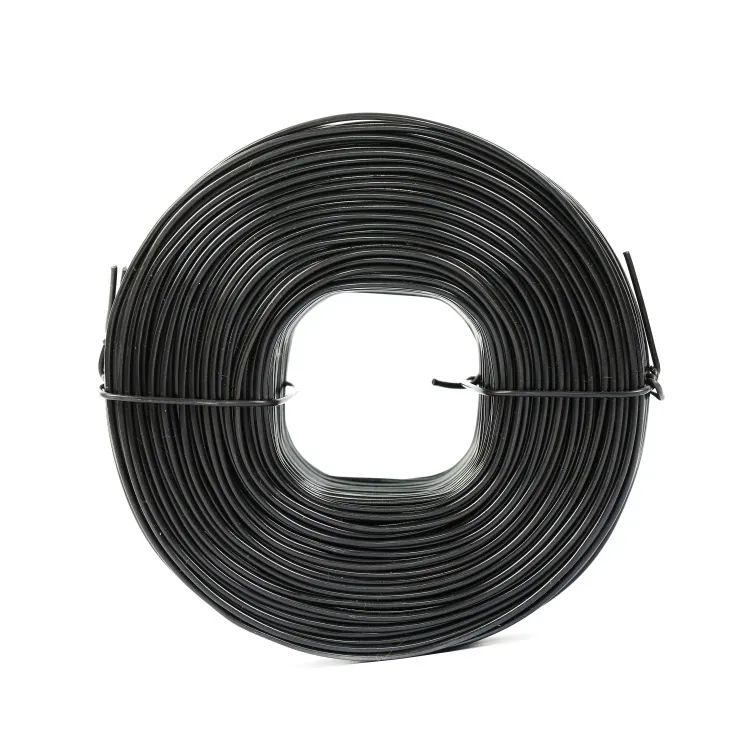
Coil format is the fourth spec, and it is easy to forget until the wrong shape arrives on the truck. Tie wire ships as small hand coils, large coils, spools, or pre-cut loops (bar ties). Hand coils are the classic 1.5 kg to 3.5 kg rings a worker hangs on a belt. Spools suit automatic tie guns. Bag ties or pre-cut, pre-looped wires speed repetitive tying but cost more per kilo. Your choice depends on whether the crew ties by hand, by tool, or wants the labour saving of pre-cut loops.
State the format and the per-unit weight, since "coil" without a weight leaves us guessing between a 1.5 kg ring and a 25 kg roll.
RFQ line: "Small hand coils, 3.5 lb (approx. 1.6 kg) each, inner diameter suitable for belt hooks."
For pre-cut ties, name the wire length and the number of loops, because that is what actually controls your on-site tying speed.
RFQ line: "Pre-cut double-loop bar ties, wire length 6 inches, 16 gauge black annealed, ties per bundle please advise."
If your team is comparing hand coils against spools against loops, weigh the labour math, not just the wire price. A pricier pre-cut loop can still win on a project with tens of thousands of intersections.
How should you spell out packing?
Packing is the fifth spec, and on an export order it is not optional. Packing covers how coils are boxed or bundled, how those units sit on a pallet, total pallet weight, and whether the load is palletized for forklift handling or loose-loaded into a container. Ocean freight, port handling, and your own warehouse racking all care about this. A clean packing spec also protects the wire from moisture and coil crush during a four-week sea transit.
Spell out the packing chain from single coil to full container.
RFQ line: "Coils in cartons, cartons palletized and stretch-wrapped, max pallet weight 1000 kg, palletized for a 20 ft container, please state coils per carton and total loading quantity."
If you have port or truck weight limits, say so now. Rework at the port is expensive, and it is entirely avoidable with one line in the RFQ.
Putting it all together: one clean RFQ paragraph
With all five specs decided, fold them into a single paragraph a supplier can quote in minutes. Here is a complete, copy-ready example:
"Please quote 16 gauge (1.57 mm) black annealed rebar tie wire, fully annealed dead-soft temper for hand tying, black oxide finish with light oil, in small hand coils of 3.5 lb (1.6 kg) each, coils packed in cartons and palletized, max 1000 kg per pallet, loaded in a 20 ft container. Please confirm exact diameter, temper range, coils per carton, and total container quantity. Quantity required: two 20 ft containers, delivery to [port]."
That paragraph answers every question we would otherwise email back to ask, which is how you shorten a quote cycle from ten days to two. When you are ready, you can request a quote and paste your version straight in.
Quick checklist before you hit send
Run these five questions before sending any tie wire RFQ. Did you name the gauge and the millimetre diameter? Did you state the temper and the tying method? Did you pick a finish and, for galvanized, a coating weight? Did you set the coil format and per-unit weight? Did you describe packing from carton to container, with weight limits? Five yes answers means a supplier can quote without a single follow-up. Add your target quantity and delivery port, and the number that comes back is one you can trust and compare.
Frequently asked questions
What is the most common tie wire gauge for rebar?
16 gauge black annealed wire is the most requested size for general rebar work in North America, with 16.5 gauge close behind for slightly lighter ties. Metric buyers most often ask for 1.2 mm to 1.6 mm. Always confirm the exact millimetre diameter, since gauge charts vary between standards and suppliers.
Should I choose black annealed or galvanized tie wire?
Choose black annealed for standard indoor or quickly covered rebar, because it ties fastest and costs least. Choose galvanized when the wire faces humidity, coastal air, or a long delay before the pour. If you pick galvanized, state the zinc coating weight so vendors quote the same corrosion protection, not just the same label.
What temper is best for automatic tie guns?
Automatic rebar tying tools need annealed wire that is soft enough to twist but consistent enough to feed without kinking, so name the specific tool in your RFQ. Fully dead-soft wire meant for hand tying can jam some reels. Ask the supplier to confirm reel compatibility with your tool model before ordering.
How much tie wire do I need per tonne of rebar?
Usage varies with bar spacing, tie pattern, and gauge, so we avoid quoting a fixed figure that could mislead you. The reliable method is to count tie intersections per square metre, multiply by wire length per tie, then add roughly 10 percent for waste. Share your tie pattern and we can help estimate coils needed.
Can I mix gauges and finishes in one order?
Yes. A single order can combine, for example, 16 gauge black annealed hand coils with galvanized spools for tool work, as long as each line is specified separately. List every gauge, temper, finish, format, and packing combination as its own RFQ line so the quote stays clear and the packing plan matches each product.
Ready to specify and order?
Once your five specs are set, send them over and we will quote fast. Our team quotes gauge, temper, finish, coil format, and packing on every enquiry, and we build export packing around your port and container limits. Paste your RFQ paragraph, tell us your quantity and destination, and request a quote today. If you are still comparing options, our tie wire specialists will help you match the wire to the job before you commit.
