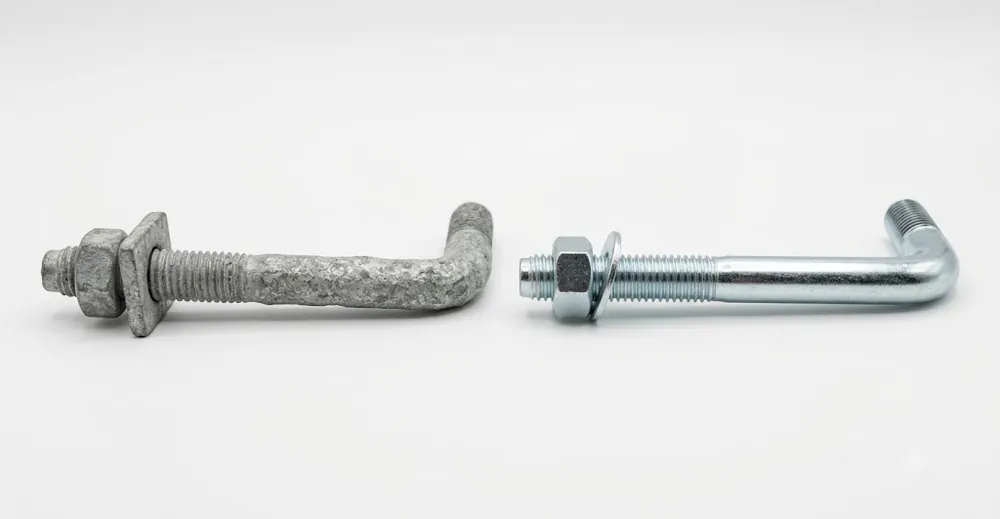
Use plain steel for dry indoor work that stays dry. Use zinc-plated bolts for light, occasional moisture in sheltered spots. Use hot-dip galvanized (HDG) for foundations, structural steel, and anything exposed to outdoor air or water. And remember one detail that trips up first-time buyers: HDG bolts need oversize-tapped nuts to fit over the thick coating. Get that wrong and your threads bind on site.
Why coating choice decides an anchor bolt's service life
Steel corrodes. That is the whole problem, and every finish on the market exists to slow the reaction between iron and oxygen. Zinc solves it two ways. First, it forms a physical barrier over the steel. Second, and more importantly, zinc is sacrificial. When the coating gets scratched or nicked, the surrounding zinc corrodes first and protects the exposed steel underneath. That galvanic behavior is why a small scrape on a galvanized bolt does not immediately turn into a rust bloom.
The variable that matters most is thickness. A thicker zinc layer simply lasts longer before it sacrifices itself away. This single fact explains almost every difference between the three finishes we sell. Plain bolts have no zinc at all. Zinc-plated bolts carry a thin electroplated film. Hot-dip galvanized bolts carry a thick metallurgically bonded layer. Thickness drives life, and life drives cost.
For an anchor bolt specifically, the stakes are higher than for a general fastener. Anchor bolts hold columns, machinery, guardrails, light poles, and equipment skids in place. Many are cast into concrete where you can never inspect or replace them. If the embedded portion corrodes, you cannot swap it out without demolition. That permanence is exactly why we push buyers toward more zinc rather than less when the exposure is uncertain.
What is the difference between plain, zinc-plated, and hot-dip galvanized?
The practical difference is coating thickness and, therefore, corrosion life. Plain bolts have zero coating. Zinc-plated (electroplated) bolts typically carry a zinc film in the single-digit micron range, often around 5 to 12 microns depending on the specified service class. Hot-dip galvanized bolts carry a much heavier layer, commonly in the 50 to 100 micron range for structural fasteners produced to the ASTM A153 family of requirements.
Those numbers are not marketing figures; they come straight from the finishing standards themselves. Electroplating is governed by specifications such as ASTM B633, which defines thin service-condition classes intended for indoor and mildly corrosive environments. Hot-dip galvanizing of threaded fasteners follows ASTM A153 Class C, which sets a minimum average coating weight that lands far higher than any plating class. The gap between roughly ten microns and roughly eighty microns is the entire story of why one bolt rusts in a season outdoors and the other does not.
Here is how the three finishes compare in the terms a buyer actually weighs.
| Finish | Typical zinc thickness | Best environment | Relative outdoor life | Nut fit |
|---|---|---|---|---|
| Plain steel | None | Dry, heated, indoor only | Rusts quickly outdoors | Standard nut |
| Zinc-plated (electroplated) | ~5 to 12 microns | Sheltered, low humidity, occasional moisture | Short in weather | Standard nut |
| Hot-dip galvanized (HDG) | ~50 to 100 microns | Foundations, outdoor, coastal, wet | Longest of the three | Oversize-tapped nut required |
The takeaway is blunt. Zinc-plated bolts look almost identical to galvanized ones on a shelf, but they carry a fraction of the zinc. That visual similarity is the single most common reason a buyer orders the wrong finish and sees rust within a year.
When should you specify hot-dip galvanized anchor bolts?
Specify HDG whenever the bolt sees outdoor air, ground contact, concrete, or any wash-down and humidity cycle. Because HDG coatings run five to ten times thicker than typical electroplating, they carry the reserve of zinc needed to survive decades of weather. For cast-in anchor bolts that can never be replaced, that reserve is not a luxury; it is the difference between a structure that stands for its design life and one that needs costly remediation.
We recommend hot-dip galvanized anchor bolts for the situations that make up most of our export volume. Structural steel baseplates and column anchors belong here. So do light poles, sign structures, highway hardware, and any equipment mounted on an outdoor foundation. Coastal and marine-adjacent projects should treat HDG as the minimum, not the ceiling, because chloride-laden air is brutal on thin coatings. Wastewater plants, chemical bunds, and wash-down food facilities all justify the heavier layer.
The trade-off is honest and worth stating. HDG costs more per bolt, adds lead time for the dipping and centrifuging step, and changes how the threads behave. The coating is not perfectly smooth; it follows the dip, drains, and spins of the process. That is why the nut question below matters so much. In our experience, buyers who understand the thread issue up front never have a fit complaint, and buyers who ignore it call us from the job site.
Why do galvanized anchor bolts need oversize-tapped nuts?
Because hot-dip galvanizing adds real thickness to the threads, a standard nut will not thread onto an HDG bolt. The zinc layer builds up on both the bolt's external threads and, if a nut were dipped as-is, its internal threads. To restore a working fit, the industry galvanizes the bolt, then taps the nut oversize after coating so the internal thread clears the added zinc. This is standard practice, not a defect, and it is baked into the ASTM A563 nut and A153 coating requirements.
This is the single detail we flag on every galvanized anchor bolt order. A properly matched HDG assembly ships with nuts that are tapped oversize and then usually re-coated or lubricated so the threads run smoothly. If you buy galvanized bolts and pair them with off-the-shelf plain nuts, the nut will either refuse to start or seize partway down and strip. That failure is completely avoidable when the bolt and nut are supplied as a matched set.
Zinc-plated bolts do not have this problem. The plating is thin enough that standard nuts thread on without special tapping. That convenience is one of the few genuine advantages plating holds over galvanizing, and it is worth weighing when the exposure is genuinely light.
How do you match anchor bolt finish to corrosion exposure?
Match the finish to the harshest condition the bolt will ever see, not the average one. A survey of the environment beats any rule of thumb: ask whether the bolt gets wet, whether it touches concrete or soil, and whether salt or chemicals are present. If the honest answer to any of those is yes, jump to hot-dip galvanized. The cost delta over the life of a foundation is small; the cost of premature failure is not.
We walk buyers through a simple decision path.
Dry indoor environments
Plain or zinc-plated bolts are fine inside a heated, dry building where humidity stays low and the fastener never contacts water or concrete. Think interior mezzanine framing, machine bases on a dry shop floor, or racking anchored to a sealed slab in a climate-controlled warehouse. Here, plain steel is often adequate, and zinc plating buys a modest safety margin against occasional condensation for very little extra money.
Sheltered outdoor or intermittent moisture
Zinc-plated bolts suit covered exterior areas and spots with brief, occasional wetting: a roofed loading dock, a ventilated equipment shed, or hardware that sees rare condensation. Understand the limit, though. Plating is a short-term shield in weather, and once the thin zinc sacrifices away, the steel underneath rusts fast. If the shelter is imperfect or the project needs to last decades, step up to HDG.
Full outdoor, concrete-embedded, and coastal exposure
Hot-dip galvanized is the answer for anything cast in concrete, buried, splashed, or exposed to open sky and salt air. This covers the majority of anchor bolt work: building foundations, outdoor structural steel, poles, and marine-adjacent hardware. For the most aggressive coastal or chemical settings, some specifiers add a duplex system, painting over the galvanizing for extra life. When in doubt, we default to HDG because it protects the one part of an anchor bolt you can never inspect again.
Frequently asked questions
Are galvanized and zinc-plated anchor bolts the same thing?
No. Both use zinc, but the coating thickness and process differ sharply. Zinc plating is electroplated and thin, often around 5 to 12 microns, suited to indoor or lightly sheltered use. Hot-dip galvanizing dips the bolt in molten zinc for a much thicker 50 to 100 micron layer built for outdoor and concrete-embedded service. They are not interchangeable.
Can I use a standard nut on a hot-dip galvanized bolt?
No. The galvanizing adds thickness to the threads, so a standard nut will not run down cleanly and may seize. HDG bolts require nuts that are tapped oversize after coating to clear the extra zinc. Always order galvanized bolts and their nuts as a matched set so the threads fit and turn freely on site.
How long do galvanized anchor bolts last outdoors?
Coating life scales with zinc thickness and environment. A heavy hot-dip layer can protect steel for decades in typical outdoor and rural conditions before meaningful corrosion begins, though coastal and industrial air shorten that span. A thin zinc-plated film, by contrast, may show rust within a season or two outdoors, which is why we reserve plating for sheltered, low-moisture use.
Do galvanized anchor bolts lose strength from the coating process?
The hot-dip process runs at temperatures below those that would alter the base steel's mechanical properties for standard grades, so strength is generally preserved. The bigger considerations are thread fit, addressed by oversize-tapped nuts, and, for very high-strength fasteners, hydrogen-related concerns that favor hot-dip over some plating methods. For common anchor bolt grades, galvanizing is a well-established, safe finish.
Is zinc-plating ever the better choice over galvanizing?
Yes, in the right setting. For dry indoor work with only occasional condensation, zinc plating gives a clean appearance, threads onto standard nuts without special tapping, and costs less. It is a poor choice outdoors or in concrete, where its thin film sacrifices away quickly. Match the finish to the exposure and plating earns its place indoors.
Get the right finish specified before you order
Choosing between plain, zinc-plated, and hot-dip galvanized anchor bolts is not guesswork once you know the exposure. If the bolt gets wet, touches concrete, or faces the weather, galvanize it and pair it with oversize-tapped nuts. If it stays dry indoors, lighter finishes save money. Tell us your environment, grade, and quantities, and we will match the finish and supply the nuts to fit. Request a quote and we will help you get it right the first time.
