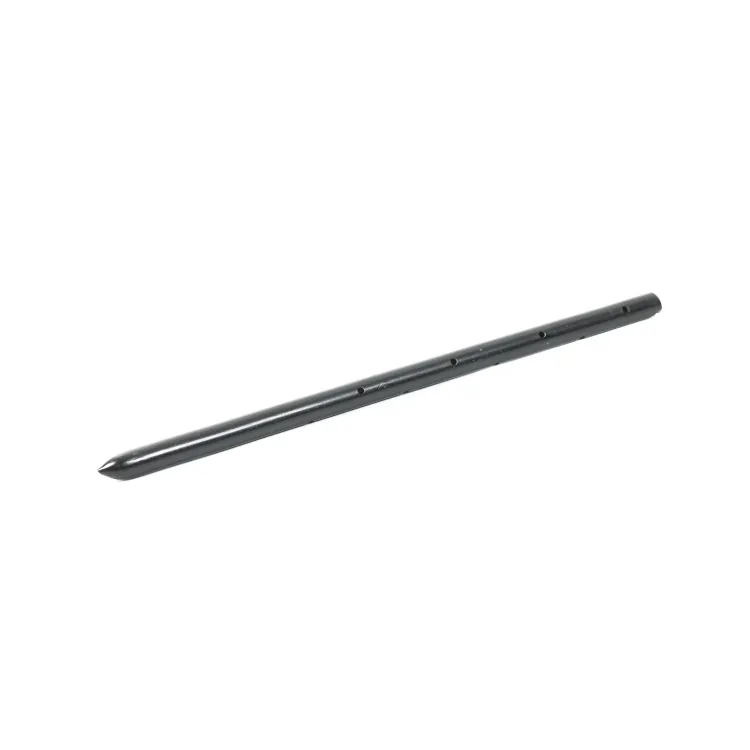
This guide walks through how form stakes work across the three most common flatwork and edge applications: curbs, slab edges and footings. We are Hebei Leeter Import and Export Co., Ltd ("Leeter"), a wire, mesh and stake manufacturer based in Dingzhou, Hebei, exporting to North America and Europe since 2006. Below is the practical knowledge our customers ask about most.
What a form stake actually does
A form stake is a steel rod, usually round or flat bar, with a pointed end for driving into the ground and a row of nail holes running down its length. The nail holes are the key feature. You drive the stake next to your form board, then send a duplex nail through a hole and into the board. That locks the board at the correct elevation and stops it from lifting or sliding when concrete goes in.
Without stakes, form boards float. Fresh concrete is heavy and fluid, and it exerts real lateral pressure against the forms. Even a short curb form will bow outward if the boards are not staked and braced properly. The stake resists that pressure by transferring it into the ground.
Two things matter for that job to work. First, the stake has to be long enough that the driven portion holds firm in the soil. Second, the stakes have to be close enough together that no single board section can bow between them. We cover both below.
Form stakes for curb forming
Curbs are narrow and continuous, so they need frequent, well-braced staking. A standard curb form uses boards or steel forms set on edge to define the curb face and back. Because the pour is tall relative to its width, curbs concentrate a lot of pressure on a small footprint of formwork. That means stakes spaced tighter than you might use on a flat slab edge.
For most residential and light commercial curb and gutter work, crews set stakes every 24 to 36 inches along each form line. On tight radius curves, drop that spacing to keep the form following the arc smoothly. Straight runs can stretch toward the wider end of the range if the boards are stiff and the soil holds well.
Curb forms almost always need bracing in addition to the vertical stake. A kicker, or diagonal brace, runs from the top of the form back to a stake driven into the ground behind the line. This stops the top of the form from kicking out under head pressure. For taller curbs and barrier curbs, add a second row of braces or use dedicated steel curb forms with integral bracing points.
Nailing curb forms
Drive the stake so its top sits at or just below the top of the form board. Then nail through the form into the stake, or through the stake nail holes into the form, depending on your form type. Use duplex, or double-headed, nails so you can pull them cleanly at strip time. Leaving the second head proud makes teardown fast and keeps your stakes reusable.
Form stakes for slab edge forming
Slab edges take lower per-stake pressure than curbs because the form is usually shorter, but the runs are long and the finished edge has to stay dead straight. For a typical 4 to 6 inch residential slab, crews stake edge forms every 3 to 4 feet. Thicker slabs and any form taller than about 8 inches move toward tighter spacing.
The priority on slab edges is a straight, level top edge, because screed crews ride the forms. Any dip or bow shows up in the finished floor. Set your stakes, string a line, and adjust each board to the line before nailing off. Once nailed, check the top of the form with a level or laser across the whole run.
Corners and form joints deserve extra attention. Place a stake within a few inches of every board joint so the two boards cannot shift independently. At outside corners, stake both boards close to the corner and nail them together. This keeps the corner sharp and square through the pour.
For slabs poured against a stiff subgrade, you often need less bracing than a curb, since the form is short. But do not skip the vertical stakes. Long unstaked spans will belly out, and once concrete is in, there is no fixing it.
Form stakes for footing forming
Footings sit at the bottom of the assembly and carry structural load, so their forms must hold exact width and elevation. Footing forms are typically 8 to 12 inches tall, and the wet concrete pushes hard against them. Crews commonly stake footing forms every 2 to 4 feet, with tighter spacing on taller forms and softer ground.
Because footings are wide, you brace both sides. Drive stakes on the outside of each form board and nail off. Then tie the two form walls together at the top with spreaders or cross ties so the forms hold a consistent footing width. Without spreaders, the two walls can spread apart at the top under load, giving you a footing wider than spec and wasting concrete.
Footing trenches are often cut into native soil, which helps support the form on the outside. Even so, drive your stakes to full depth so the form cannot float or tip. Where the footing steps up or down on sloped sites, add stakes at each step and brace the transition carefully.
Keeping footing forms to grade
Footing top elevation controls the starting point for the wall or slab above it. Set your forms to a benchmark, confirm with a level or laser, and stake to hold that grade. Recheck after driving stakes, since heavy hammer blows can nudge a board out of level. Small adjustments now save major headaches later.
Application quick-reference table
The table below gives a practical starting point for stake length and spacing by application. Treat these as typical ranges. Always adjust for your soil, form height and local practice.
| Application | Typical form height | Suggested stake length | Typical stake spacing |
|---|---|---|---|
| Curb and gutter | 6 to 18 in | 18 to 24 in | 24 to 36 in |
| Slab edge (residential) | 4 to 6 in | 12 to 18 in | 36 to 48 in |
| Slab edge (thick / commercial) | 6 to 10 in | 18 to 24 in | 24 to 36 in |
| Footing | 8 to 12 in | 24 to 30 in | 24 to 48 in |
| Deep footing / soft soil | 12 in and up | 30 to 36 in | 18 to 30 in |
A simple rule of thumb: your stake should be roughly three to four times the form height so that enough length drives into the ground to resist pressure. Softer or wetter soil calls for longer stakes and tighter spacing. Firm, compacted subgrade lets you use the shorter end of each range.
Choosing stake length and spacing
Length and spacing work together. A longer stake driven deeper resists more lateral load, so on firm ground you can space stakes farther apart. On soft, sandy or saturated soil, the same stake holds less, so you compensate by adding more stakes and by driving longer ones. When in doubt, add a stake. The cost of one more stake is trivial next to the cost of a blown-out form and a ruined pour.
Form stiffness matters too. Rigid steel forms and thick lumber span farther between stakes than thin or worn boards. If you are reusing older, flexible boards, tighten your spacing to compensate for the flex.
Think about reuse as well. Steel form stakes with clean, round nail holes pull easily and last across many pours. Choose a stake gauge and finish suited to your soil so the stakes drive straight without bending. If you are unsure which length range fits your typical work, request a quote and tell us your applications, and we will recommend a mix.
Bracing basics that apply to every application
Bracing turns a row of vertical stakes into a rigid, self-supporting form wall. The vertical stake resists the form sliding and lifting. The diagonal brace, or kicker, resists the top of the form from tipping outward under head pressure. Together they hold the form square.
For a diagonal brace, drive a stake into the ground behind the form line, then run a board from the top of the form down to that stake and nail both ends. The steeper and taller the form, the more you rely on kickers. Curbs and footings almost always need them. Short slab edges often do not, but check any run longer than a few feet.
Cross ties and spreaders handle the opposite problem on two-sided forms like footings. They hold the correct inside width so the walls cannot spread. Set them near the top of the form at regular intervals, and remove them as the pour comes up if they are the pull-out type.
Common mistakes to avoid
The most common mistake is under-staking a long run to save time. It looks fine until the concrete goes in and the middle of the run bows out. Another is driving stakes too shallow in soft ground, which lets forms float during the pour. A third is forgetting kicker braces on curbs and footings, so the tops kick out even though the bases are staked.
Watch your nailing too. Nails driven at a bad angle can split boards or fail to hold. Use duplex nails, drive them square, and place them through the stake nail holes where possible for a clean, strong connection. Finally, do not reuse badly bent stakes. A bent stake drives crooked and holds poorly.
Talk to us about your stake needs
Getting stake length, spacing and bracing right is the difference between clean, true concrete and a costly redo. Match the stake to the application, drive it deep enough for your soil, keep spacing tight enough that no board can bow, and add kickers and ties where head pressure demands them.
Leeter manufactures form stakes in a range of lengths and gauges for curb, slab and footing work, and we export to contractors and distributors across North America and Europe. If you want help spec'ing a stake package for your projects, request a quote and tell us what you pour. We will point you to the right lengths and quantities.
Frequently asked questions
What length form stakes do I need for curb forming?
For most curb and gutter work with forms 6 to 18 inches tall, an 18 to 24 inch stake driven to firm depth works well. On soft or wet ground, step up to a longer stake and tighten spacing. A good rule is a stake roughly three to four times the form height.
How far apart should form stakes be spaced?
Spacing depends on application, form height and soil. Curbs typically run 24 to 36 inches, residential slab edges 36 to 48 inches, and footings 24 to 48 inches. Tighten spacing on tall forms, curves, joints and soft ground. When unsure, add a stake rather than risk a bowed form.
Why do form stakes have nail holes?
The nail holes let you fasten form boards to the stake at the exact height you need. You drive the stake beside the board, then send a duplex nail through a hole into the board. This locks the board's elevation and stops it lifting or sliding when concrete pushes against the form.
Do I need bracing if I already have stakes?
Often, yes. Vertical stakes stop the form from sliding and lifting, but tall forms also need diagonal kicker braces to stop the top tipping out under concrete pressure. Curbs and footings almost always need kickers. Two-sided footing forms also need cross ties or spreaders to hold the correct width.
Can form stakes be reused across multiple pours?
Yes. Steel form stakes with clean, round nail holes pull easily with duplex nails and reuse across many pours. Keep them straight, avoid driving badly bent stakes, and store them dry. Choosing the right gauge for your soil helps stakes drive true and last longer, improving your cost per pour.
