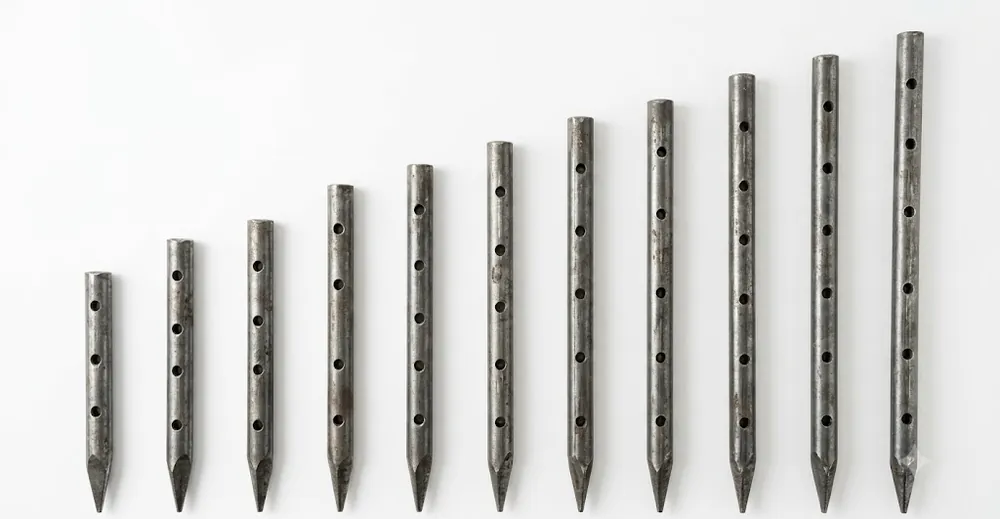
We are Hebei Leeter Import and Export Co., Ltd, a manufacturer in Dingzhou, Hebei, China. Since 2006 we have supplied wire, mesh, anchors, and concrete forming supports to contractors and distributors across North America and Europe. This guide passes along what we have learned from producing millions of stakes and hearing back from the crews who drive them.
The quick rule: double the form height
The fastest way to size a stake is to double your form height and then add a little for soil conditions. If you are forming a 6" slab edge, a 12" stake gives you 6" above grade to back the form board and 6" driven into the ground. That is the bare minimum. In loose or sandy soil, or under heavy wet concrete, you want more bury, so a 12" to 18" stake is safer for that same 6" form.
Bury depth is what actually resists the outward push of fresh concrete. A wet pour can exert real lateral pressure against the form face, and the only thing keeping the board from walking is the friction and bearing of the buried portion of the stake. Short stakes lever out. Long stakes hold. When in doubt, go longer and cut nothing, because you can always drive a stake deeper but you cannot make it taller.
Form stake length by form height
Use the table below as a starting point. It assumes firm to average soil and a standard 3/4" round stake. Step up one size in sand, fill, wet ground, or on tall pours where pressure runs high.
| Form height | Suggested stake length | Notes |
|---|---|---|
| 2" to 4" | 12" | Curbs, thin slab edges, sidewalks |
| 6" | 18" | Standard slab-on-grade, patios |
| 8" | 18" to 24" | Driveways, thicker slabs |
| 10" to 12" | 24" | Grade beams, low walls |
| 12" to 18" | 30" to 36" | Footings, stem walls |
| 18" to 24" | 36" to 48" | Tall footings, heavy pours, poor soil |
These are practical field numbers, not hard limits. Many crews keep three lengths on the truck, usually 18", 24", and 36", and reach for the next size up whenever the ground is soft or the pour is deep. Buying a small range of lengths covers the vast majority of flatwork and footing jobs without carrying a dozen SKUs.
How soil changes the length you need
Soil does more to your stake choice than form height does. Compacted clay and undisturbed native ground grip a stake hard, so you can run closer to the minimum bury. Loose fill, sand, gravel, and saturated ground let stakes wander, so you need extra length below grade and often tighter stake spacing as well.
A few field signals tell you to go longer. If the stake drives too easily by hand, the soil is not holding it. If you can rock a set stake with light pressure, it will not hold a pour. On graded fill that was placed recently, treat the ground as loose no matter how firm the surface feels, because the material below has not consolidated. When the site is wet, add length and add stakes, since water cuts the holding power of almost every soil type.
Why 3/4" diameter is the workhorse size
Diameter controls stiffness, and 3/4" round is the size most North American crews standardize on for good reason. It resists bending when you drive it into firm ground, it shrugs off sledge blows, and it stands up to repeated reuse across many pours. Thinner 5/8" stakes cost less and drive easier, but they bend in rocky or compacted soil and fatigue faster over a season.
For most flatwork, curbs, and residential footings, 3/4" is the sweet spot between weight, cost, and durability. Step up to 1" diameter for tall commercial footings, heavy repeated use, or ground full of rock and old concrete where a smaller stake would mushroom or bow. Step down to 5/8" only for light-duty temporary work where you value easy driving over long life. If you are stocking a yard, 3/4" covers the widest range of jobs with the fewest complaints.
Nail holes: spacing, count, and placement
Staggered nail holes are what let one stake serve many form heights. Holes run down the length of the shaft, offset side to side so you can double-nail through the form board into the stake at whatever height your form sits. That stagger also keeps the steel from splitting or weakening along a single line of holes.
More holes mean more nailing options and better reuse, since a worn or slightly bent hole is not the end of the stake. We punch holes at regular intervals along the full usable length so the same stake backs a 4" curb form or a 12" grade beam without repositioning. Double-nailing, one nail high and one low, stops the form board from pivoting on a single fastener and keeps your top line straight. Duplex nails pull easily at stripping, which saves real time on a big pour.
The chisel point and why it matters
A sharp chisel point is the difference between a stake that drives clean and one that bounces and drifts. The chisel tip cuts into the ground and self-aligns as it goes down, so the stake stays plumb instead of curving off toward a rock. That straight drive keeps your form line accurate and reduces the effort per stake.
We forge and cut points so they hold an edge through many drives rather than folding over on the first hard hit. A blunt or mushroomed point wanders, splits the ground unevenly, and makes the stake harder to pull. On rocky sites the point takes real abuse, which is another reason the 3/4" and 1" sizes earn their keep, since heavier steel behind the tip resists deformation. When a point finally dulls after heavy use, a quick grind restores most of its bite.
Reuse, coatings, and getting your money back
Round steel form stakes are a buy-once tool when you treat them right. A good 3/4" stake survives dozens of pours, and crews routinely run the same stakes for years. The economics only work if you strip carefully, knock off concrete before it cures hard, and store stakes out of standing water so they do not pit.
Plain steel is the standard and the most economical choice, and light surface rust does not hurt holding power. If your stakes sit in a damp yard between jobs, a wipe of form oil slows corrosion and makes concrete release easier at stripping. We supply bright and oiled finishes depending on the market, and we can bundle mixed lengths so a distributor stocks a full range on one pallet. Straightening a slightly bent stake in a vise brings it back into service rather than sending it to scrap.
Matching stakes to your forming application
Not every job wants the same stake. Slab and sidewalk crews lean on 12" and 18" stakes with lumber or steel forms. Footing and stem-wall crews need 24" to 48" stakes to back taller boards and resist deeper pours. Curb and gutter work often uses shorter stakes at tight spacing to hold the profile through screeding.
Round nail stakes pair naturally with dimensional lumber and steel form systems, and they work alongside other forming hardware you already run. When you form walls or deeper sections with plywood, our plywood clips tie panels together while the stakes anchor the base line. Spacing matters as much as length here: closer stakes carry taller forms and wet pressure, so tighten your interval on deep or fast pours rather than trusting length alone. See our full form stakes range for the lengths and diameters that fit your work, and request a quote when you know your mix.
Frequently asked questions
How long should a concrete form stake be?
A good rule is roughly twice the form height, so a 6" form pairs with a 12" to 18" stake. That gives you enough length above grade to back the board and enough bury below grade to resist the outward pressure of fresh concrete. Go longer in soft, sandy, or wet soil.
What diameter of form stake should I use?
Use 3/4" round for most flatwork, curbs, and residential footings, since it balances stiffness, weight, and cost. Step up to 1" for tall commercial footings, rocky ground, or heavy repeated use. Drop to 5/8" only for light temporary work where easy driving matters more than long service life.
Why do form stakes have holes down the shaft?
Staggered nail holes let one stake back many form heights. You nail the form board through whatever hole matches your form position, so the same stake serves a 4" curb or a 12" grade beam. Double-nailing through two holes stops the board from pivoting and keeps your top line straight.
How many times can I reuse steel form stakes?
A quality 3/4" stake handles dozens of pours and often lasts years. Reuse depends on care: strip before concrete cures hard, keep stakes out of standing water, and straighten light bends in a vise. Plain steel with minor surface rust holds fine, so most stakes retire only after a point mushrooms or the shaft bends badly.
What is the chisel point for on a form stake?
The chisel point cuts into the ground and self-aligns as the stake drives, keeping it plumb instead of curving off a rock. A sharp point drives with less effort and holds a straighter form line. When it dulls after heavy use, a quick grind restores most of the bite.
Talk to a manufacturer about your stake mix
Sizing stakes is straightforward once you match length to form height and soil, then set diameter and point to the job. If you want a supplier who produces to spec and ships a full range of lengths and diameters, we are ready to help. Request a quote and tell us your typical form heights, soil, and volumes, and we will recommend the mix that keeps your forms true and your crews moving.
