Why the profile shape matters
Every steel fence post earns its strength from its cross-section, not just its weight. Rolling a flat strip of steel into a T, U, or Y shape adds rigidity the way a folded sheet of paper stands up better than a flat one. The profile decides how much the post resists bending, how well it grips the soil, and how you attach the wire.
That is why you cannot judge a post by weight alone. A heavier post with a poor shape can flex more than a lighter, better-formed one. Studs, ridges, and anchor plates all change the real-world performance. Understanding each profile helps you match the post to the fence line instead of overbuying steel or, worse, underbuilding a boundary that sags in a season.
What is a T-post and when should you use it?
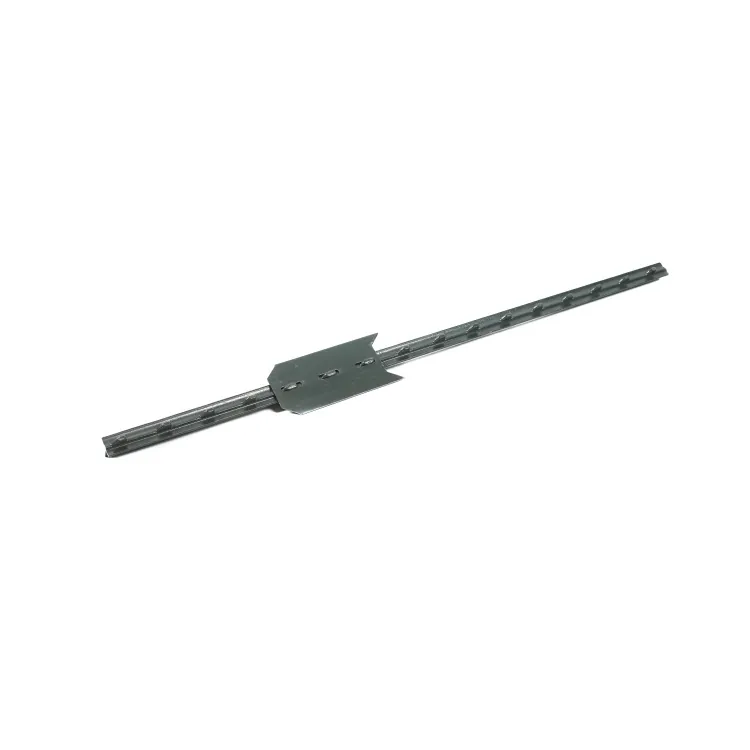
A T-post is a studded steel post with a T-shaped cross-section and a welded anchor plate near the base. The studs run down the spine and lock wire in place, while the anchor plate resists uplift and stops the post from twisting in soft ground. It is the workhorse of agricultural fencing in the United States and Canada.
Reach for a T-post when the fence has to hold tension. Barbed wire, high-tensile smooth wire, welded stock panels, and field fence all pull hard against their posts, and the T profile handles that pull well. Cattle lean, deer push, and wind loads add up, so line posts on a working ranch are almost always T-posts. Common weights run from about 0.95 to 1.33 pounds per foot, and lengths from 5 to 8 feet cover most livestock and boundary work.
Installation is fast. You drive the post with a manual or pneumatic driver, clip the wire to the studs, and move on. Our T-posts ship with a baked enamel or galvanized finish, and the anchor plate is spot-welded rather than clipped, which matters when the ground freezes and heaves. If you want to check load ratings against your span, the numbers depend on soil, spacing, and wire tension more than on the post alone.
What is a U-post and where does it fit?
A U-post is a lighter steel post shaped like a channel or U, usually punched with holes or small barbs along the web so wire and ties can pass through. It carries less steel than a T-post of the same length, which makes it cheaper and easier to hand-drive, but it also bends more under side load.
U-posts suit lighter, lower-stress jobs. Think garden fencing, chicken runs, chain-link mesh on residential lots, road signs, and temporary crowd control. They excel where you need many posts fast and the fence will not face heavy animal pressure or high wire tension. A homeowner fencing a vegetable patch or a contractor mounting dozens of no-trespassing signs will save real money going with U-posts instead of T-posts.
The trade-off is rigidity. Put a U-post on a cattle line and it will lean the first time a steer scratches against it. Match it to the load and it performs for years. Typical U-posts weigh roughly 0.5 to 1.0 pounds per foot depending on gauge, and they are often sold in 3 to 7 foot lengths. The lighter web also makes them simple to pull and reuse, which is why rental and event companies keep them in stock.
What is a star picket and who uses it?
A star picket is a hot-rolled steel post with a Y or star-shaped cross-section, holes punched down the web, and a pointed foot or welded base plate. In Australia, New Zealand, and much of the UK, "star picket" and "Y-post" are the standard terms for what North Americans loosely group with studded posts. The three-arm profile gives strong resistance to bending from any direction.
Star pickets dominate rural and commercial fencing across the Commonwealth markets. Farmers use them for stock fence, builders use them for site hoarding and safety barriers, and councils use them for temporary road works. The multi-directional strength is the selling point: because the load-bearing arms point three ways, the post resists pressure from angles a flat-backed T-post handles less evenly. Common sizes are quoted by weight per meter, often 1.58, 1.86, or 2.04 kilograms per meter, in lengths from 0.45 to 2.4 meters.
Safety caps matter here. Because the top of a driven star picket can injure people or animals if left bare, most markets require a plastic or steel cap. If you are buying for the Australian or UK trade, spec caps and the correct galvanizing standard up front, because those buyers expect them as standard rather than as an add-on.
T-post vs U-post vs star picket: side-by-side comparison
The fastest way to settle the t-post vs u-post vs star picket decision is to line up the specs and typical uses together. The table below reflects what we actually ship and the ranges buyers most often order, though exact figures vary by gauge, coating, and destination standard.
| Feature | T-post | U-post | Star picket (Y-post) |
|---|---|---|---|
| Cross-section | T-shape with studs | U or channel shape | Y or star, three arms |
| Typical weight | 0.95 to 1.33 lb/ft | 0.5 to 1.0 lb/ft | 1.58 to 2.04 kg/m |
| Main market | North America | North America, Europe | Australia, NZ, UK |
| Best for | Livestock, field fence | Garden, signs, temporary | Stock fence, site work |
| Wire attachment | Clip to studs | Thread through holes | Wire ties through holes |
| Relative strength | High | Low to medium | High, multi-directional |
| Relative cost | Medium | Low | Medium to high |
| Anchor | Welded plate | Barbs or none | Foot or plate |
Use the table as a starting filter, then narrow by soil and span. Two posts with the same weight can behave differently once the anchor design and steel grade come into play, so treat these as guide ranges rather than fixed rules.
How much do these fence posts cost?
Cost tracks steel content and forming complexity more than brand. U-posts are the cheapest per unit because they use the least steel and the simplest roll-forming. T-posts sit in the middle, carrying more steel plus a welded anchor plate. Star pickets often cost the most per piece because they weigh more per length and use hot-rolled forming, though price gaps narrow when you buy full container loads.
Coating changes the number too. Plain painted posts cost less up front, while hot-dip galvanized posts cost more but last far longer in wet or coastal ground. For a boundary fence meant to stand twenty years, the galvanizing premium usually pays for itself. For a temporary run you will pull next season, painted steel is the sensible spend. When you request a quote, give us the length, weight, coating, and destination so the price reflects the real duty, not a generic list rate.
How to choose the right steel fence post
Start with the load, then work outward to market and budget. Ask how hard the wire will pull and whether animals will lean on the line. Heavy tension and livestock point to T-posts or star pickets. Light mesh, signage, or a short-term barrier points to U-posts. Your destination market often decides the profile for you, since a buyer in Texas expects studded T-posts and a buyer in Queensland expects star pickets with caps.
Next, factor soil and climate. Soft or sandy ground favors posts with a real anchor plate or a broad foot, because plain-driven posts pull out under uplift. Freezing ground that heaves rewards a welded anchor over a clipped one. Coastal or high-rainfall sites justify hot-dip galvanizing to fight rust. Finally, match length to fence height plus burial depth, usually a third of the post in the ground for driven line posts. Get those three inputs right, load, market, and site, and the correct post almost picks itself.
Frequently asked questions
Is a T-post stronger than a U-post?
Yes, a T-post is generally stronger than a U-post of the same length. The T-shape carries more steel, the studs lock wire firmly, and the welded anchor plate resists twisting and uplift. U-posts trade that strength for lower weight and cost, which makes them better for light garden fencing, signs, and temporary barriers rather than tensioned livestock lines.
Are star pickets the same as T-posts?
No. Star pickets, also called Y-posts, have a three-arm Y or star cross-section that resists bending from multiple directions, and they are the standard in Australia, New Zealand, and the UK. T-posts have a T-shaped profile with studs and a welded anchor plate and dominate North American fencing. The two solve similar jobs with different shapes and different market conventions.
Which fence post is cheapest?
U-posts are usually the cheapest because they use the least steel and the simplest forming process. T-posts cost more due to added steel and a welded anchor plate, and star pickets often cost the most per piece thanks to their heavier hot-rolled profile. Coating choice also shifts price, since galvanized posts cost more up front than painted ones.
Do I need caps on my fence posts?
Caps are strongly recommended on star pickets and any post with an exposed top edge, because the open end can injure people or livestock. Many Australian and UK jobsites treat safety caps as mandatory. T-posts and U-posts are safer to leave bare, but caps still reduce injury risk and improve appearance on residential and public-facing fences.
How deep should I drive a steel fence post?
As a rule of thumb, bury about one third of the post length in the ground for driven line posts, then adjust for soil and load. Softer soil and higher wire tension call for deeper set posts or ones with a strong anchor plate. Corner and end posts always need more depth and often concrete, since they carry the full pull of the fence.
Get the right posts for your project
Choosing between a T-post, U-post, and star picket comes down to load, market, and site conditions, and the right call saves money on both steel and rework. As a manufacturer shipping all three profiles to North America and Europe since 2006, we help buyers match weight, coating, and length to the job rather than guessing from a catalog. Tell us your fence type, destination standard, and volume, and we will spec posts that hold up in the field. Ready to move forward? Request a quote and we will follow up with pricing built around your project.
