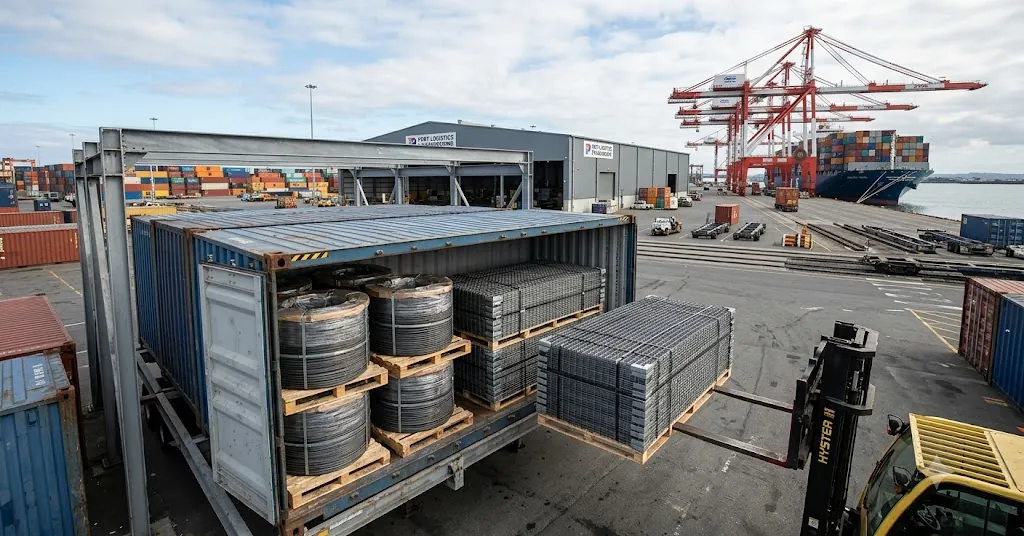
At Leeter, we have loaded thousands of containers of wire, coils, mesh, panels and fasteners out of Dingzhou since 2006. This guide shares how we actually do it, where importers get surprised, and how to check the work through loading photos before the doors close.
Weight comes first, volume comes second
The instinct with any container is to fill it. With steel that instinct will get your shipment rejected at the port. A standard 40ft container has a huge internal volume, but the moment you load dense products like wire coils or fastener cartons, the payload weight ceiling arrives while the box still looks half empty. This is normal and correct.
Think of it this way. A pallet of insulation might "weigh out" a container only after every corner is packed. A pallet of steel nails weighs out the same container with the floor barely covered. So the planning question is never "how do we fill this space." The question is "how do we place this weight so the container is legal, balanced and safe."
Getting this wrong is expensive. An overweight container can be refused for road transport, incur fines, or force a costly re-stuffing at the origin port. Underloading wastes freight budget. The sweet spot is loading to the legal payload while keeping the center of gravity low and centered.
What are the container weight limits for steel?
Weight limits come from two directions, and steel shipments usually run into both. First, the container itself has a maximum payload rated on its CSC plate. Second, the road and rail legs in the destination country impose their own gross weight limits, which are often stricter than the container's rating. For steel you plan against the lower of the two.
Here are the typical reference figures we work with. Always confirm the exact tare and payload on the CSC plate of the actual container assigned, because tare weight varies by build and age.
| Container type | Typical tare weight | Typical max payload | Common road-limited payload |
|---|---|---|---|
| 20ft standard | approx. 2,200 kg | approx. 28,200 kg | often 21,000-25,000 kg |
| 40ft standard | approx. 3,750 kg | approx. 28,750 kg | often 24,000-26,000 kg |
| 40ft high cube | approx. 3,900 kg | approx. 28,600 kg | often 24,000-26,000 kg |
Notice something counterintuitive. A 20ft and a 40ft have almost the same maximum payload. The 40ft gives you double the floor and double the volume, but not double the allowable weight. For heavy steel, this makes the humble 20ft container the workhorse. Dense products like coils, bars and bulk fasteners usually ship in 20ft boxes loaded to weight, while lighter, bulkier items like welded panels or fencing may fill a 40ft by volume first.
The destination road limit is the one importers forget. A container that is legal on the vessel can still be illegal on the truck delivering it to your yard. Tell us your delivery country and axle rules early, and we plan the payload to match. When in doubt, we load lighter and confirm.
Weight distribution: where the steel actually sits
A legal total weight still fails if it sits in the wrong place. Steel is dense enough that a poorly stacked load can concentrate mass over one axle, exceed a floor point rating, or tip the center of gravity to one side. Cranes, ships and trucks all handle a balanced box far better, and so does the container floor.
Our basic rules on the floor:
- Spread the heaviest units across the full floor length, not bunched at one end. A load stacked only in the door half overloads the rear axle of the delivery truck.
- Keep left-right balance even so the container does not lean during lifting.
- Keep the center of gravity low. Heavy coils and dense cartons go on the bottom; lighter cartons go on top.
- Respect point loading. A single coil concentrates enormous weight on a small footprint, so we use dunnage and cradles to spread that force onto the floor.
For mixed loads, we build the plan around the heaviest items first, lock them in, then fit lighter construction hardware around them. You can see the full product range we palletize this way on our construction hardware page.
How do you block and brace steel coils and panels?
Blocking and bracing keep the load from moving, and for steel this is the safety-critical step. A wire coil that breaks loose at sea becomes a several-hundred-kilo battering ram. Ocean transport subjects cargo to constant rolling, pitching and sudden shocks, so we secure steel so that it simply cannot shift, tip or roll, even when the container is handled roughly.
Bracing wire coils and rod
Coils are the trickiest because they want to roll. Loading wire coils safely means killing every axis of movement. We place coils eye-to-the-side or eye-up depending on the product, then chock them with timber cradles or wedges so they cannot rotate. Rows are tied together and to the floor lashing points. Between rows we add timber blocking so there is no gap for a coil to gather momentum. Where coils stack, we use interlayer dunnage to spread weight and stop nesting damage.
Blocking panels, mesh and bundles
Flat products like welded mesh, fence panels and rebar bundles are strapped into tight, rigid units on the ground before loading. Once inside, we fill voids with airbags or timber so the bundles cannot slide toward the doors. Banding is checked for sharp edges that could cut a strap, and edge protectors go on where needed. The goal is one solid block from wall to wall, with no loose space.
Fasteners and small hardware
Cartons of nails, screws, bolts and anchors are palletized and stretch-wrapped, then loaded in an interlocking brick pattern. Because these boxes are dense and heavy, we keep stacks low and tie the top layer down so vibration cannot walk the cartons apart over a five-week voyage.
How do you stop steel from rusting in the container?
Moisture is the silent damage in steel exports, and it comes from inside the box, not the sea outside. Warm, humid air packed into a sealed container hits cooler steel at night and condenses. This "container rain" drips onto the cargo and leaves rust spots on bright wire, zinc-flashed fasteners and untreated bar. Controlling humidity matters as much as any strap.
Our export packing steel routine layers several defenses:
- Desiccant. We hang container-grade desiccant bags or poles that absorb kilograms of water vapor over the voyage. Quantity is matched to container size and route humidity.
- VCI protection. Vapor corrosion inhibitor film or paper around sensitive items releases a protective vapor that guards the surface even inside sealed bundles.
- Barrier wrap. Coils and finished hardware get poly or woven wrap to shield against drips and handling scuffs.
- Dry dunnage. We use kiln-dried or properly dry timber, because wet pallets release moisture straight into the box.
- Floor and wall check. We inspect for leaks, holes and prior cargo residue before anything goes in.
For long transits through the tropics, these steps are not optional. A single condensation cycle can turn a bright shipment into a claim. Honest word of caution: no packing eliminates every risk on a badly delayed voyage, so we match protection to the actual route and season rather than using one recipe for everything.
Why loading photos matter before the doors close
Loading photos are your evidence and your quality gate, and they cost nothing to insist on. Because you cannot inspect the container yourself, a documented photo set is the practical way to verify that the plan we described was the plan executed. We photograph the empty clean container, the floor dunnage, each stage of stacking, the bracing and desiccant, and the final wall before sealing.
A good photo set shows:
- The empty container interior and its CSC plate.
- Product labels and quantities as layers build up.
- Blocking, bracing, strapping and airbags in place.
- Desiccant and moisture protection installed.
- The full load before the doors close, plus the sealed doors with the seal number visible.
These images resolve disputes fast. If a claim ever arises, the sequence proves how the goods left our factory. We send them as standard, and we encourage every buyer to review them against the packing list. If something looks off, we would rather reopen the container than ship a problem. Ready to plan a shipment? request a quote and we will map the load before we build it.
Frequently asked questions
How much steel fits in a 20ft container?
A 20ft container is limited by weight, not volume, for steel. Payload usually caps around 21,000 to 28,000 kg depending on the container plate and destination road limits. Dense products like coils and fasteners reach that ceiling while the box still looks partly empty, which is completely normal.
Should I ship steel in a 20ft or 40ft container?
Ship dense steel in a 20ft container, because both sizes share a similar maximum payload while the 20ft is cheaper to move and easier to balance. Use a 40ft only for lighter, bulkier items like panels or fencing that "volume out" before they hit the weight limit.
Why does steel rust inside a sealed container?
Rust comes from condensation inside the box, not seawater. Humid air trapped at loading condenses on cooler steel during temperature swings, then drips onto the cargo. Desiccant, VCI film, barrier wrap and dry dunnage control this, which is why we specify moisture protection for every steel shipment.
How do you secure wire coils so they do not roll?
We chock each coil with timber cradles or wedges, tie rows together and lash them to the container floor points, then fill gaps with blocking so no coil can gather momentum. Interlayer dunnage spreads weight when coils stack. The aim is zero movement on every axis, even under rough handling.
Can I get photos of my container being loaded?
Yes. We photograph the empty container, floor dunnage, each stacking stage, bracing, desiccant and the sealed doors with the seal number. This is standard on our shipments. Review the set against your packing list, and if anything looks wrong we will reopen and correct it before the goods leave.
Loading steel well is quiet, unglamorous work, and it is where shipments are won or lost. Get the weight legal, keep it balanced, brace it so nothing moves, and beat the moisture. Tell us your product, quantity and destination, and we will build the load plan around your road limits and your route. To start, request a quote and ask for the loading photos as standard.
