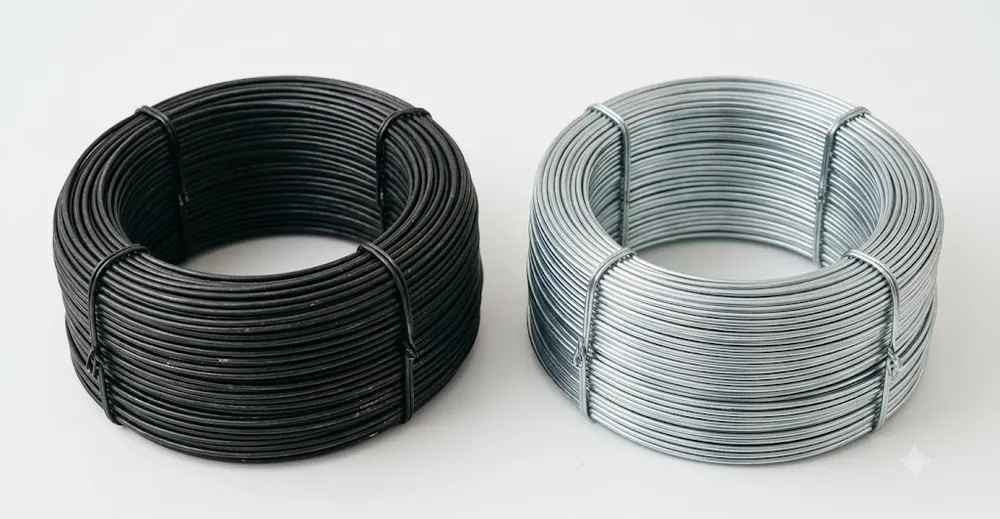
That said, the details matter. The coating type, the coating weight, and how long the tie stays visible all change the calculation. Below we break down each finish, compare electro-galvanized against hot-dip galvanized, and give you a decision guide you can hand to a foreman.
What is black annealed tie wire?
Black annealed tie wire is low-carbon steel drawn to gauge, then heat-treated in a controlled furnace to make it soft and highly ductile. The annealing process relieves stress in the metal so the wire bends tight around a bar intersection and holds without springing back. The dark surface, that classic dull black or blue-grey color, comes from a thin oxide film and a light oil coating that reduces friction and slows surface rust in storage.
We supply black annealed rebar tie wire most often in 16 and 16.5 gauge for hand tying, and in fine gauges spooled for battery-powered tie guns. Its biggest strength is workability. A soft temper wire wraps faster, snaps cleaner, and tires the hand less over a full shift. Crews doing thousands of ties a day feel that difference by mid-morning.
The trade-off is corrosion. The oil film is a shipping protectant, not a service coating. Left in the rain, black annealed wire develops surface rust within days. That rust is cosmetic and harmless once the tie is locked inside concrete, because the alkaline environment of cured concrete passivates the steel and stops further corrosion. But on exposed work, or where staining and long weather exposure are a concern, black wire is the wrong tool.
Where black annealed wire wins
Use black annealed wire for embedded structural work: footings, foundations, slabs on grade, columns, and beams that get poured over promptly. If the tie disappears into the pour within a normal construction window, the extra cost of a zinc coating buys you nothing. You are paying to protect a wire that concrete already protects. For high-volume interior and below-grade rebar, black annealed is the economical default, and it is what most contractors reach for first.
What is galvanized tie wire?
Galvanized tie wire is the same low-carbon steel base coated in zinc, which shields the steel through both a physical barrier and sacrificial protection. When the coating is scratched, the surrounding zinc corrodes first and spares the steel underneath. That sacrificial behavior is why a nicked galvanized tie still resists rust where a nicked bare wire would not. The result is a wire that holds a clean silver appearance and survives rain, humidity, and salt air far longer than black wire.
Our galvanized tie wire ships in the same common gauges as black annealed, so crews swap finishes without changing their tie technique. The temper is set slightly softer to keep good workability, because heavier zinc coatings can stiffen a wire if the base is left too hard. In practice, a well-made galvanized tie feels nearly as pliable as black in the hand.
The two variables that define a galvanized tie are the process used to apply the zinc and the amount of zinc laid down, measured as coating weight in grams per square meter. Those two factors separate a wire that lasts a season from one that lasts years.
Electro-galvanized vs hot-dip galvanized: what is the difference?
Electro-galvanized and hot-dip galvanized differ mainly in coating thickness, which drives both corrosion life and price. Electro-galvanized wire is plated with zinc through an electric current in a bath. That deposits a thin, bright, very uniform layer, typically in the range of about 8 to 25 grams per square meter for tie wire. It looks clean and holds well indoors or under moderate outdoor exposure, but the film is light and wears through faster in aggressive conditions.
Hot-dip galvanized wire is pulled through molten zinc at around 450 degrees Celsius, building a thicker, metallurgically bonded coating that commonly runs from roughly 40 up to 150 grams per square meter, depending on spec. That heavier layer, and the iron-zinc alloy bond formed at the interface, gives hot-dip wire markedly longer service life outdoors and near salt. The surface is a touch rougher and the coating slightly less uniform than electro, but for durability it is the clear winner.
Here is how the two galvanizing methods compare in practice.
| Factor | Electro-galvanized (EG) | Hot-dip galvanized (HDG) |
|---|---|---|
| Typical zinc coating | ~8 to 25 g/m2 | ~40 to 150 g/m2 |
| Coating appearance | Bright, very uniform | Duller, slightly rougher |
| Corrosion resistance | Moderate | High |
| Relative cost | Lower | Higher |
| Workability | Excellent | Very good |
| Best fit | Indoor, short exposure | Outdoor, coastal, long exposure |
Our short rule: choose electro-galvanized when you want rust resistance on a budget and the exposure is mild or brief. Choose hot-dip when the wire will face weeks or months of weather, marine air, or wet-dry cycling. Do not overspec, but do not under-protect a coastal deck either.
Black annealed vs galvanized tie wire: the head-to-head
For the same gauge and temper, black annealed and galvanized tie wire deliver similar tensile strength and similar tying speed, so corrosion exposure and cost decide the winner. Black annealed is cheaper per kilogram because it skips the zinc bath entirely, and its soft temper gives a slight edge in raw tying comfort. Galvanized costs more, with hot-dip the priciest of the group, and repays that premium only when rust would otherwise be a real problem.
The table below puts the everyday trade-offs side by side.
| Factor | Black annealed | Galvanized (EG / HDG) |
|---|---|---|
| Corrosion resistance | Low (relies on concrete) | Moderate to high |
| Relative cost | Lowest | Higher |
| Tensile (same gauge) | Comparable | Comparable |
| Workability | Excellent | Very good |
| Appearance | Dark, rusts if exposed | Bright silver, stays clean |
| Best environment | Embedded, poured promptly | Exposed, delayed, outdoor, coastal |
A point crews sometimes miss: the finish does not add meaningful strength. If a spec calls for a stronger tie, you change the gauge or move to a higher-tensile wire, not to galvanized. Zinc protects; it does not reinforce. Keep those two decisions separate and you will spec more accurately.
When should you pick each finish?
Pick the finish by exposure time and environment, because those two factors drive more than 90 percent of real-world tie wire failures we hear about from the field. If the rebar gets covered by concrete within a normal schedule and stays dry until then, black annealed is the right, economical call. Once the wire faces weather, delay, or salt, step up to zinc.
Use this quick decision guide:
- Interior slabs, footings, foundations, prompt pours: black annealed
- Precast yards and short outdoor storage before pouring: electro-galvanized
- Exposed rebar left standing for weeks, or highway and bridge decks: hot-dip galvanized
- Coastal, marine, or de-icing salt environments: hot-dip galvanized, higher coating weight
- Architectural or visible ties where staining matters: galvanized
One field note from our own shipments: crews in wet coastal regions who tried to save money with black annealed on delayed pours often ended up with rust bleed staining the concrete face. The wire itself was fine structurally, but the cosmetic complaint cost them more than galvanized would have. When in doubt on an exposed or delayed job, the zinc premium is cheap insurance.
If you are unsure which coating weight matches your climate and schedule, send us the site conditions and we will match the spec. You can request a quote with your gauge, finish, and volume, and we will confirm coating weight and packaging.
Frequently asked questions
Is galvanized tie wire stronger than black annealed?
No. For the same gauge and temper, tensile strength is essentially the same. Zinc adds corrosion resistance, not mechanical strength. If you need a stronger tie, change the gauge or the wire temper rather than the finish. Galvanizing protects the steel from rust; it does not reinforce the tie itself.
Does black annealed tie wire rust inside concrete?
Black annealed wire may show light surface rust before the pour, but cured concrete is highly alkaline and passivates the steel, halting further corrosion. Once embedded and covered promptly, that cosmetic rust is harmless. The risk appears only when the wire stays exposed to weather for a long period before or after pouring.
What gauge of tie wire do most contractors use?
16 gauge and 16.5 gauge are the most common for hand tying rebar, balancing holding strength with easy bending. Fine-gauge spooled wire is used in battery-powered tie guns for speed. We supply both black annealed and galvanized in these gauges, so crews keep the same technique when they switch finishes.
Electro-galvanized or hot-dip galvanized for outdoor work?
For real outdoor exposure, choose hot-dip galvanized. Its coating commonly runs from about 40 to 150 grams per square meter, far heavier than the roughly 8 to 25 grams of electro-galvanized. That thicker, alloy-bonded zinc layer resists rust much longer in rain, humidity, and coastal salt air. Reserve electro-galvanized for indoor or short-exposure jobs.
Can I mix black annealed and galvanized on one project?
Yes, and many crews do. Use black annealed for embedded, promptly poured sections to control cost, and galvanized for exposed, delayed, or coastal areas. Matching the finish to each zone of the same project is smart budgeting. Just label the coils clearly on site so crews grab the correct finish for each pour.
Talk to us about your spec
Choosing between black annealed and galvanized tie wire is easier when someone knows the coatings inside out. As a wire and mesh manufacturer serving contractors across North America and Europe, we help buyers match finish, gauge, and coating weight to real site conditions every week. Tell us your environment, schedule, and volume, and we will recommend the most cost-effective spec. Request a quote and we will follow up with pricing and packaging options.
