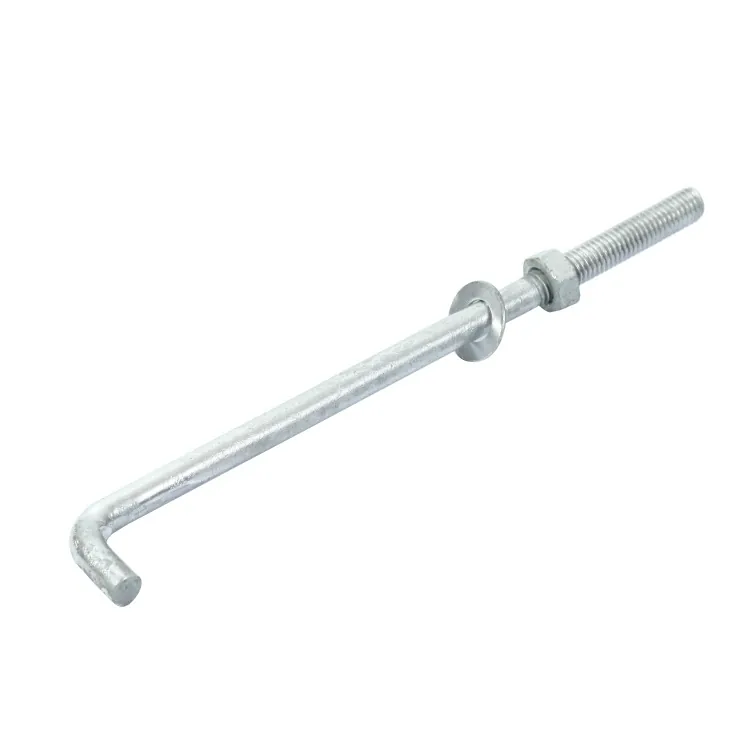
What is a bent anchor bolt?
A bent anchor bolt is a straight rod with a hook formed on one end. The hook is bent to 90 degrees for an L-bolt, to roughly 180 degrees for a J-bolt, or into a wide U shape for a U-bolt. The threaded end projects above the concrete to receive the base plate, washer, and nut. The bend sits inside the pour, and the concrete gripping that bend is what resists pull-out.
These bolts are the workhorses of light and moderate construction. They anchor sill plates, light poles, sign posts, equipment skids, and countless small structural connections. Because a bent bolt is made from a single length of round bar with one forming operation, it is cheap to produce, easy to bulk-order, and fast to install in wet concrete or in a template before the pour.
The catch is how the hook actually carries load. When you pull on the projecting thread, the bend tries to straighten. Concrete bears against the inside of the hook and stops it, up to a point. Under high tension the hook can slip, straighten slightly, and lose grip. That behavior is well documented in anchorage research and is the reason design codes treat hooked capacity with caution.
What is a headed anchor bolt?
A headed anchor bolt carries an enlarged bearing surface at the embedded end. That surface is either a hot-forged head shaped like a standard bolt head, or a heavy hex nut threaded and often tack-welded onto a threaded rod, sometimes combined with a plate washer for extra bearing area. This head presses directly against the surrounding concrete when the bolt is loaded in tension.
The mechanism is simple and dependable. Tension in the rod transfers to the head, and the head bears on a cone of concrete above it. There is no bend trying to straighten and no slip mechanism waiting to activate. The result is a load path that engineers can calculate with confidence using established concrete breakout and pull-out equations.
Headed bolts dominate heavy structural work. Think steel building columns, bridge components, crane rails, tall light standards, and any base plate that must resist large uplift, overturning, or seismic demand. The common structural anchor specification in North America, ASTM F1554, is written around straight anchor rods finished with a nut and, where needed, a plate. Our ASTM F1554 grades explained guide walks through the strength grades that pair with these assemblies.
How does each type develop tension capacity?
The core difference is the load-transfer mechanism, and it drives everything else. A bent bolt resists pull-out through bearing on the inside radius of the hook plus a little friction and bond along the shaft. A headed bolt resists pull-out through direct bearing of the head on the concrete, which mobilizes a much larger and more predictable failure cone.
Hooked anchors have a known weakness. The concrete just inside the bend is highly stressed and can crush locally, letting the hook straighten and pull through. Because of this, many design provisions do not allow the full theoretical bond of a hook to be counted, and they cap the reliable capacity of hooked anchors well below that of an equivalent headed anchor. Where tension governs the connection, a hook is often the limiting detail.
Headed anchors avoid that failure mode. The bearing area of a nut or plate is large and stable, so the anchor fails, when it does, by breaking out a full cone of concrete or by yielding the steel rod itself. Both of those are calculable and repeatable. That predictability is exactly what a structural engineer wants when signing off on a connection that resists wind, seismic, or heavy machine loads.
One practical note from our own shipments: for pure shear connections, such as a sill plate resisting sliding, the end detail matters far less because shear transfers near the concrete surface. In those cases a bent bolt is often perfectly adequate and the cost savings are real.
Which is more reliable and consistent?
Headed anchor bolts are the more reliable and consistent choice, and the gap widens as load increases. A nut or forged head gives a fixed, repeatable bearing area, so the same bolt embedded to the same depth performs the same way every time. Hooked bolts vary more because hook radius, bend angle, and concrete quality around the bend all influence the result.
Reliability also covers installation. A headed rod is symmetric and easy to set square in a template. A bent bolt must be oriented so the hook clears rebar and sits at the right depth, and a hook bent too tight can develop micro-cracks that reduce capacity. Quality forming and correct bend radius matter, which is why we control bend tooling closely on our production line rather than field-bending bar.
There is also the matter of code acceptance. Modern anchoring design methods, including the appendix provisions used across the United States, provide clean, qualified design equations for headed anchors. Hooked anchors are permitted but restricted, and cast-in hooked bolts cannot be used interchangeably where higher ductility or seismic performance is required. For a structure that must be inspected and certified, that acceptance path alone often decides the question.
How do cost and lead time compare?
Bent anchor bolts are cheaper per piece and simpler to produce, which makes them attractive for high-volume, low-load work. A single cut and a single bend turn plain round bar into a finished anchor. There is no nut to thread on, no head to forge, and often no secondary machining. For a contractor buying thousands of small L-bolts for framing or fencing, that difference adds up fast.
Headed bolts cost more because they carry more processing. A forged head requires heading equipment and heat, while a nutted assembly needs threading on both ends, a heavy hex nut, and frequently a tack weld or a plate washer. Longer embedment and larger diameters, common in heavy work, push material cost up too. You pay for capacity and predictability.
The table below summarizes the trade-offs we walk customers through when they request a quote.
| Factor | Bent (L, J, hooked) | Headed (nut or forged) |
|---|---|---|
| Capacity mechanism | Bearing on the bend | Bearing on head or nut |
| Tension reliability | Moderate, can slip | High, predictable |
| Typical load range | Light to moderate | Moderate to heavy |
| Cost per piece | Lower | Higher |
| Fabrication | One bend, fast | Threading plus head or nut |
| Code treatment | Permitted, restricted | Fully qualified methods |
| Best for | Sill plates, poles, fencing | Columns, bridges, seismic |
Lead time usually tracks complexity. Simple bent bolts move through the shop quickly and ship in large batches. Headed assemblies with plates, special coatings, or tight tolerances take longer, so it pays to confirm schedule early on structural jobs.
When should you specify each type?
Specify a bent anchor bolt when loads are light to moderate, when the connection is governed by shear rather than tension, and when budget and volume matter more than maximum capacity. Sill plate hold-downs, timber framing, light fixtures, guardrails, and small equipment bases are classic bent-bolt applications. The hooked end does the job and keeps cost low.
Specify a headed anchor bolt when tension or uplift governs, when the connection must resist seismic or dynamic loads, or when a certifying engineer needs a calculable, code-qualified load path. Steel column base plates, bridge bearings, crane systems, tall poles, and heavy machinery foundations all fall here. The extra cost buys predictability that you cannot safely skip on these structures.
A few decision cues we share with buyers:
- If the drawings call out ASTM F1554 with a nut and plate, that is a headed assembly. Do not substitute a hook.
- If the detail is a simple 90 degree L-bolt for a wood sill, a bent bolt is correct and economical.
- If seismic design categories apply, hooked cast-in bolts are usually off the table for primary tension.
- When unsure, share the base plate detail and load type with your supplier and let the engineer confirm.
Choosing the right end type is less about brand and more about matching the mechanism to the demand. Get that right and both families deliver decades of service.
Frequently asked questions
Are bent anchor bolts weaker than headed anchor bolts?
In tension, generally yes. A bent bolt resists pull-out through bearing on its hook, which can slip and straighten under high load. A headed bolt bears on a nut or forged head that gives larger, more predictable capacity. In pure shear near the surface, the difference is much smaller.
Can I replace a hooked anchor bolt with a headed one?
Often you can upgrade to a headed bolt if embedment, diameter, and edge distances still work, and many engineers prefer it. You cannot go the other way and swap a specified headed bolt for a hook without engineering approval, because the capacity and code qualification change.
What is the difference between an L-bolt and a J-bolt?
Both are bent anchor bolts. An L-bolt has a 90 degree bend at the embedded end, while a J-bolt has a longer, roughly 180 degree hook shaped like the letter J. The J shape adds a little more bearing on the hook, but both share the same slip limitations under high tension.
Which anchor bolt type is required for seismic connections?
Structural tension connections in seismic zones typically require headed cast-in anchors or qualified alternatives, because they offer predictable, calculable capacity and ductility. Hooked cast-in bolts are generally restricted for these uses. Always follow the project engineer and the governing anchoring code provisions.
Does the end type affect corrosion or coating choice?
No. Both bent and headed bolts accept the same finishes, including plain, hot-dip galvanized, zinc-plated, or epoxy coating. Coating choice depends on the exposure environment, not the end geometry. Galvanizing does require slightly larger thread tolerances, which we account for during production.
Talk to a manufacturer before you order
Matching anchor bolt end type to your load case protects both budget and safety. Leeter produces bent and headed anchor bolts in common grades, diameters, and finishes, and we can advise on the right configuration for your base plate detail. Send your drawings or load requirements and request a quote, or browse the full anchor bolts range to see standard options ready to ship.
