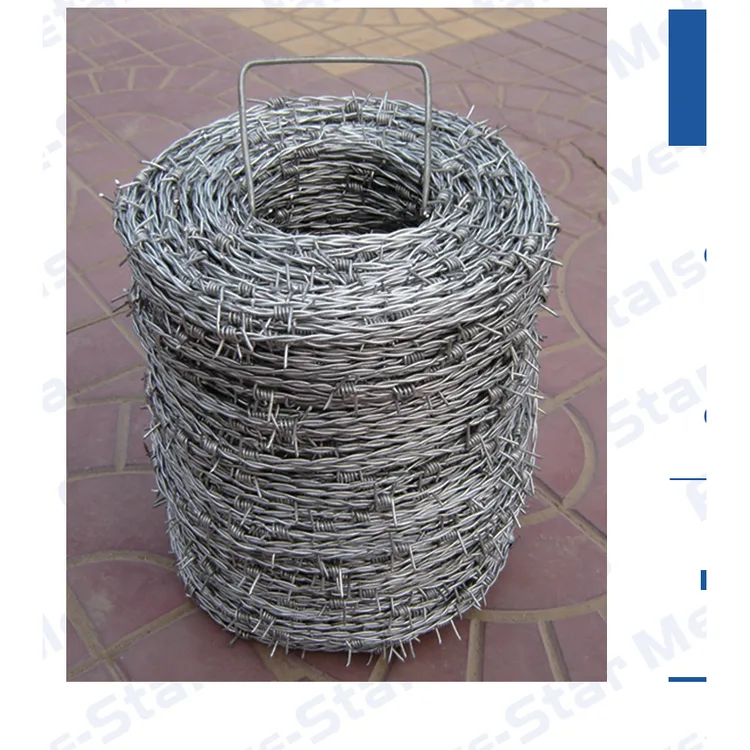
We are Hebei Leeter Import and Export Co., Ltd ("Leeter"), a wire and fencing manufacturer in Dingzhou, Hebei, China, exporting since 2006 to importers and fence wholesalers across North America and Europe. Barbed wire is one of our core permanent-fencing lines, and the specifications below are exactly how we quote it.
How barbed wire is specified: strand gauge x barb gauge
A barbed wire spec has two gauge numbers. The first is the line wire (strand) that carries the tension; the second is the thinner wire the barbs are formed from. Both are quoted in SWG (Standard Wire Gauge) in the export trade, so "12#x14#" means 12 SWG strands with 14 SWG barbs. A heavier strand gauge gives the fence its strength; the barb gauge mostly affects how sharp and rigid the points feel and how much steel per meter you pay for.
These are the strand x barb combinations we manufacture:
| Strand x barb (SWG) | Approx. strand dia | Approx. barb dia | Typical use |
|---|---|---|---|
| 10#x12# | 3.25mm (0.128 in) | 2.64mm (0.104 in) | Heavy security lines, harsh climates |
| 12#x12# | 2.64mm (0.104 in) | 2.64mm (0.104 in) | Security fencing, top-of-fence runs |
| 12#x14# | 2.64mm (0.104 in) | 2.03mm (0.080 in) | The volume export spec; cattle and boundary fence |
| 14#x14# | 2.03mm (0.080 in) | 2.03mm (0.080 in) | General agricultural fencing |
| 14#x16# | 2.03mm (0.080 in) | 1.63mm (0.064 in) | Light farm fence, budget lines |
| 16#x16# | 1.63mm (0.064 in) | 1.63mm (0.064 in) | Light-duty and temporary demarcation |
| 16#x18# | 1.63mm (0.064 in) | 1.22mm (0.048 in) | Lightest spec, price-driven markets |
For US buyers: American ranch wire is traditionally quoted in US steel wire gauge, where 12-1/2 ga is the classic cattle-fence strand. When a customer asks us to match "12-1/2 gauge barbed wire", we quote our 12# SWG strand combinations and confirm the actual millimeter diameter on the proforma so there is no gauge-system confusion. Always confirm mm, not just gauge numbers, when comparing quotes from different countries.
Normal twist vs reverse twist
Both twist types use the same double-strand construction; the difference is how the two line wires are wrapped.
- Normal (conventional) twist: the two strands are twisted continuously in one direction along the whole length. This is the traditional pattern and the default in most tenders.
- Reverse twist: the direction of the twist alternates between barb groups. Each change of direction locks the barbs in place, so barbs resist sliding along the strands, and the wire lies flatter and kinks less when paid out from the coil. Crews generally find reverse twist easier to tension without the barbs migrating.
Functionally both give the same security performance at the same gauge. If your market has no stated preference, we recommend reverse twist for fence-line work because installers complain less about barb slip; normal twist remains common where buyers reorder a legacy spec.
Barb spacing and barb length
Barbs are 4-point, formed from the barb-gauge wire and wrapped around both strands. We manufacture barb spacing anywhere from 75mm to 150mm — in trade terms, 3 in, 4 in, 5 in or 6 in centers — and barb lengths from 15mm to 30mm. Closer spacing and longer barbs raise the deterrent value and the steel weight per meter, which is why security specs sit at 75–100mm spacing while agricultural wire is normally 125–150mm (5–6 in).
| Barb spacing | Imperial | Typical application |
|---|---|---|
| 75mm | 3 in | Security topping on walls and chain link fence |
| 100mm | 4 in | Security and boundary fencing |
| 125mm | 5 in | Cattle and mixed-use fence lines |
| 150mm | 6 in | Standard agricultural spacing, lowest cost per meter |
When you specify, state spacing as a center-to-center dimension and give a tolerance you can accept. Barb length matters less for livestock control than spacing does, but longer 25–30mm barbs are visibly more aggressive and are usually chosen for security work.
Coatings: electro-galvanized, hot-dip galvanized and PVC-coated
We supply three finishes, and the right one depends on climate and how long the fence must last relative to its price point.
Electro-galvanized (EG) gives a thin, bright, uniform zinc layer. It is the cheapest finish and fine for dry climates or shorter-life fencing, but the zinc is consumed faster outdoors.
Hot-dip galvanized (HDG) deposits a much thicker zinc coating by dipping the wire in molten zinc. It is the standard for permanent fence lines in North America and Europe and what we recommend for coastal or wet climates and any fence expected to stand for decades.
PVC-coated barbed wire starts with a galvanized core wire of 1.0–3.5mm and extrudes a plastic jacket over it to a coated outside diameter of 1.4–4.0mm, with the PVC layer itself 0.4–0.6mm thick. The plastic seals the steel completely and adds color — dark green and black are the volume choices, and other colors are available. PVC is the pick for visible locations, coastal corrosion, and markets that pay for appearance. The same logic applies to our PVC-coated chain link fence: quote both the core and the overall diameter so suppliers cannot pad a quote with plastic instead of steel.
| Finish | Construction | Corrosion resistance | Relative price |
|---|---|---|---|
| Electro-galvanized | Thin electroplated zinc | Basic | Lowest |
| Hot-dip galvanized | Thick molten-zinc coating | High; export standard | Mid |
| PVC-coated | 1.0–3.5mm galvanized core, 1.4–4.0mm OD, 0.4–0.6mm PVC wall | Highest; adds color | Highest |
Coil weights and export packing
Standard export coils are 25–50kg (55–110 lb); we also run custom coil weights when a market has a fixed retail convention. Coils are wound on a former, compressed, and strapped, with options for individual plastic wrap, woven-bag or carton packing, and palletizing for retail distribution. When you request a quote, tell us the coil weight your customers expect and whether you need a printed label or private-label wrap — coil weight determines pieces per pallet and therefore your landed cost per coil.
A practical note for mixed containers: barbed wire is dense and loads heavy, so importers often top up a container with lighter items such as studded T-posts — the post that pairs with barbed wire on ranch fencing — or field fence rolls to hit the weight limit and the cube together.
RFQ checklist for barbed wire
To get an accurate quote in one pass, specify:
- Strand x barb gauge (SWG or mm) — e.g. 12#x14#
- Twist type — normal or reverse
- Barb spacing (75–150mm / 3–6 in) and barb length (15–30mm)
- Finish — EG, HDG, or PVC-coated (state core diameter, coated OD and color)
- Coil weight (25–50kg or custom) and packing/labeling requirements
- Quantity, destination port and incoterm
Frequently asked questions
What gauge is standard barbed wire?
The volume export specification is 12#x14# SWG — a 12 SWG (about 2.64mm / 0.104 in) double strand with 14 SWG (about 2.03mm / 0.080 in) barbs. Heavier 10#x12# and 12#x12# specs serve security work, while 14#x16# and 16#x16# cover light agricultural and budget lines. Always confirm the millimeter diameter, because SWG and US steel wire gauge numbers do not match.
What is the difference between normal twist and reverse twist barbed wire?
Normal twist wraps the two line wires continuously in one direction; reverse twist alternates the twist direction between barb groups. Reverse twist locks the barbs so they cannot slide along the strands and the wire pays out of the coil with less kinking. Security performance is the same at equal gauge — the difference is handling and barb stability.
How far apart are the barbs on barbed wire?
Barb spacing runs from 75mm to 150mm (3 to 6 in) center to center. Agricultural fence is typically 125–150mm (5–6 in), while security applications use 75–100mm (3–4 in) for a denser barb pattern. Barb length is 15–30mm (0.6–1.2 in), with longer barbs specified for security work.
Is PVC-coated barbed wire worth the extra cost?
For coastal climates, wet regions and visible locations, yes. PVC-coated wire uses a 1.0–3.5mm galvanized core inside a 0.4–0.6mm plastic wall (coated OD 1.4–4.0mm), which seals the steel from moisture entirely and adds color. For inland agricultural fencing, hot-dip galvanized is usually the better value; electro-galvanized suits only dry climates or short-life fencing.
How much does a coil of barbed wire weigh?
Standard export coils are 25–50kg (55–110 lb), and we produce custom coil weights where a market has a fixed retail size. Coil weight, gauge and barb spacing together set the length per coil, so state the coil weight your customers expect when requesting a quote and we confirm meters per coil on the proforma.
What is double strand barbed wire?
Double strand (2-ply) barbed wire is the export standard: two line wires twisted together, with the four-point barbs wrapped around both strands so they cannot be pulled off. It holds tension and shape better than single-strand, which is why almost all agricultural and security barbed wire is double strand. The two line wires and the barb wire can be different gauges — that is what the strand gauge × barb gauge notation means, e.g. 12# × 12# (heavy) or 12# × 14# (lighter barb).
