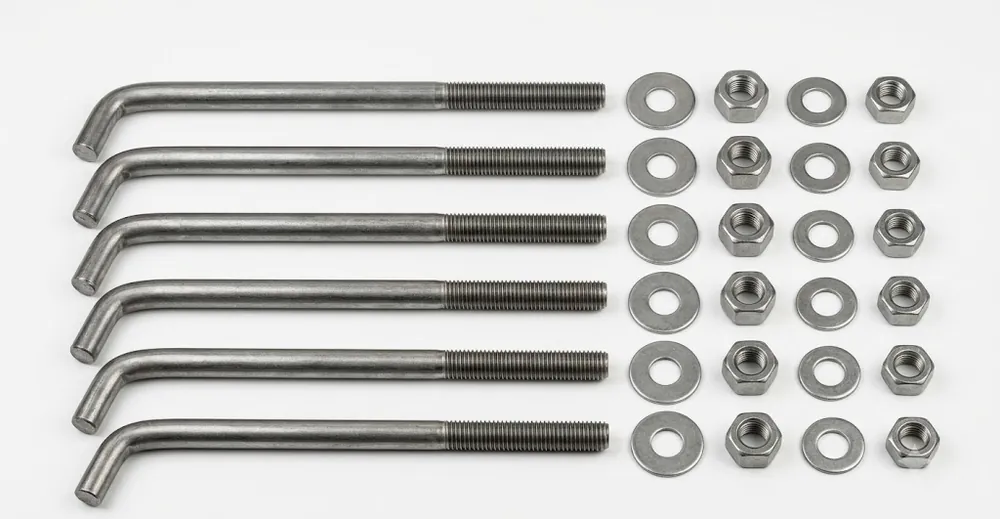
At Leeter, we have manufactured and exported anchor bolts and their hardware since 2006 from Dingzhou, Hebei. Most of the mistakes we see on incoming orders trace back to hardware, not the bolt body. This guide walks a buyer through nuts, washers, sets, and the details that keep a shipment from stalling at inspection.
What ships in a complete anchor bolt set?
A complete anchor bolt set is the bolt plus everything needed to make the connection: at minimum one hex nut and one washer, matched to the bolt's grade and diameter. On leveling and structural jobs, the set expands to two nuts and often a heavy plate washer. The idea is simple. When the bolt lands on site, the crew should not be hunting through bins for compatible hardware.
Here is how the common components break down and why each one is on the parts list.
| Component | Purpose |
|---|---|
| Anchor bolt body | Embeds in concrete; carries tension and shear into the foundation |
| Hex nut (matched grade) | Clamps the base plate; develops the bolt's full tensile capacity |
| Second hex nut | Acts as the leveling nut below the plate, or as a jam/lock nut |
| Plain (round) washer | Spreads bearing load, protects the plate surface under the nut |
| Plate washer (square) | Covers oversized or slotted holes, distributes load over a wider area |
| Heavy hex nut | Used with higher-grade bolts where standard nuts lack proving load |
A short definition helps here. The "set" is a commercial term, not a fixed standard. One buyer's set is a bolt with a single nut and washer; another's is a bolt with two nuts and two washers for double-nut leveling. Because there is no universal default, we always confirm the count in writing before we cut steel. That one habit prevents the most common shortage claim we see.
Which nut grade matches your anchor bolt?
The nut grade must be strong enough to develop the bolt's full strength, so it is matched to the bolt grade rather than chosen at random. For an ASTM F1554 Grade 36 bolt, an ASTM A563 Grade A hex nut is the common match. Step up to F1554 Grade 55 or Grade 105 and you move to heavy hex nuts in higher A563 grades or A194 nuts. The governing rule is that the nut should not strip before the bolt yields.
The logic behind matching is worth understanding. A nut is engineered to a proof load, the tension it can hold without permanent deformation. If you pair a low-grade nut with a high-strength bolt, the nut threads deform and the joint loses clamp long before the bolt reaches its design capacity. That is a silent failure mode, easy to miss during a quick torque check.
Grade pairings we ship most often
For F1554 Grade 36, we supply A563 Grade A or DH nuts. For Grade 55, A563 Grade DH or A194 Grade 2H is typical. For Grade 105, A194 2H is the workhorse. When a project specifies galvanizing, the nut grade usually shifts to DH or 2H because those grades tolerate the process better and are the ones fabricators expect to see on the mill certs.
If a specification is silent on nut grade, ask. We would rather send a short email than guess and ship the wrong hardware across an ocean.
Plain washers or plate washers: which do you need?
Both washer types spread load, but they solve different problems, so the choice depends on the hole. A plain round washer sits under the nut and protects the plate face while distributing bearing pressure. A square plate washer, often 3 to 6 mm thick or heavier, covers oversized and slotted holes that anchor bolts frequently pass through. Structural steel details commonly call for plate washers precisely because anchor holes are drilled larger than the bolt for field tolerance.
Think about why the hole is oversized in the first place. Base plates are set with some slack so the erector can shift the column into plumb. That slack means a small round washer might not fully cover the hole, leaving the nut to bear partly on air. A plate washer bridges that gap and puts the clamping force back over solid steel.
When a plate washer is not optional
On slotted holes, on holes drilled more than a couple of millimeters oversize, and on connections where the engineer calls out a bearing area, the plate washer is structural, not cosmetic. We keep square plate washers in stock in the sizes that pair with common anchor diameters, and we can supply drawings so your engineer signs off before production. Round washers still have their place for tight-tolerance holes and for the top washer under a leveling nut.
How does double-nut leveling work?
Double-nut leveling uses two nuts on the anchor: a leveling nut below the base plate and a top nut above it, with the plate suspended between them. The lower nut is threaded up to the correct elevation, the plate drops onto it, and the top nut is tightened down to clamp the assembly. This lets a crew set a column dead level without shims or grout doing the leveling work, then grout fills the gap afterward.
The method is standard on tall columns, light poles, and equipment skids where precise elevation matters. It also allows fine adjustment: turning the leveling nut a fraction raises or lowers one corner of the plate. Because both nuts carry load in this arrangement, both must be the matched structural grade. We have seen crews reach for a spare low-grade nut as the leveling nut, and that is exactly the shortcut that leads to a loose connection under service load.
One practical caution from the shop floor. Double-nut joints need enough thread projection above the top nut, and enough length below the plate for the leveling nut plus a washer. If you tell us the plate thickness and the standoff you want, we thread the bolt long enough. Guessing the length is how bolts arrive too short to accept both nuts.
Why do galvanized anchor bolts need special nuts?
Galvanizing adds zinc thickness to the threads, so a galvanized nut has to be tapped oversize to spin onto a galvanized bolt without binding. Hot-dip galvanizing deposits a zinc layer that can measurably build up in the thread valleys. If the nut were cut to standard dimensions, it would seize partway down the bolt. The fix is an overtapped nut, sometimes with the female threads chased after coating so the fit stays smooth.
There is a second detail buyers miss. The nut is often galvanized first, then overtapped, which can leave the tapped threads with thinner zinc than the bolt. To restore corrosion protection, good practice is a zinc-rich touch-up or a lubricant that also protects, and the two mating parts should come from a supplier who controls both. When we ship a galvanized set, we match the bolt, nut, and washer as a system so the threads run freely on the first try. Mixing a galvanized bolt from one source with a standard nut from another is a reliable way to jam threads on site.
A note on stainless and mechanical galvanizing
Stainless sets have their own concern, galling, where the threads cold-weld under friction. A dab of anti-seize solves it. Mechanically galvanized hardware behaves more like plain hardware on thread fit but still benefits from a confirmed match. Whatever the coating, the principle holds: buy the bolt and its nuts and washers together.
What should you put in an anchor bolt RFQ?
A clear RFQ prevents almost every hardware error, so specify the bolt grade, diameter, length, thread length, coating, and the exact nut and washer count per bolt. Add the standards you are working to, ASTM F1554 for the bolt and A563 or A194 for nuts, plus any plate washer size and thickness. If double-nut leveling is planned, say so, because that changes the thread length and the nut quantity.
The details that most often go missing are the ones that stop a job. Thread projection, plate thickness for leveling standoff, and whether the washer is round or square all shape how we cut and thread the steel. Tell us the destination too. North American and European jobs sometimes carry different documentation and marking expectations, and we would rather build that in from the start than rework a shipment.
When you are ready, send the drawing or a simple line list and request a quote. We will come back with a per-set breakdown so you can see exactly which nut and washer pairs with each bolt, and confirm the galvanized fit before anything hits the production line.
Frequently asked questions
Does an anchor bolt come with nuts and washers included?
Not automatically. Anchor bolts are frequently priced as the bolt body alone, with nuts and washers quoted separately or as a bundled set. Always state the nut and washer count you need per bolt on the purchase order. We confirm the set contents in writing on every order so nothing is assumed and nothing arrives short.
How many nuts do I need per anchor bolt?
One nut is enough for a simple bolted connection. Double-nut leveling needs two matched nuts per bolt, a leveling nut below the plate and a top nut above it. Some details add a third jam nut for extra security on vibrating equipment. Confirm the count during design, because it also affects the thread length you order.
What washer goes with an anchor bolt?
For standard holes, a plain round washer under the nut distributes load and protects the plate. For oversized or slotted holes, which are common on base plates, a square plate washer is the correct choice because it fully covers the hole and spreads bearing over more steel. Many structural details specify the plate washer thickness directly.
Can I use a standard nut on a galvanized anchor bolt?
No. A standard nut will bind on the added zinc thickness of galvanized threads and can seize partway down. Galvanized bolts need oversize-tapped nuts sized to run freely over the coating. We match the bolt, nut, and washer as a galvanized system so the threads engage smoothly the first time on site.
What nut grade should I use with an F1554 anchor bolt?
Match the nut to the bolt grade. F1554 Grade 36 typically pairs with A563 Grade A or DH; Grade 55 with A563 DH or A194 2H; Grade 105 with A194 2H. The nut must develop the bolt's full strength without stripping. If your spec does not name a nut grade, ask before ordering rather than guessing.
Order sets, not surprises
The difference between a clean install and a stalled one usually comes down to hardware that was assumed rather than specified. Match the nut grade to the bolt, pick the right washer for the hole, plan the nut count for leveling, and confirm the galvanized fit up front. That is the whole game. Send us your drawing or line list and request a quote, and we will return a per-set breakdown so every bolt ships with the nuts and washers it actually needs.
