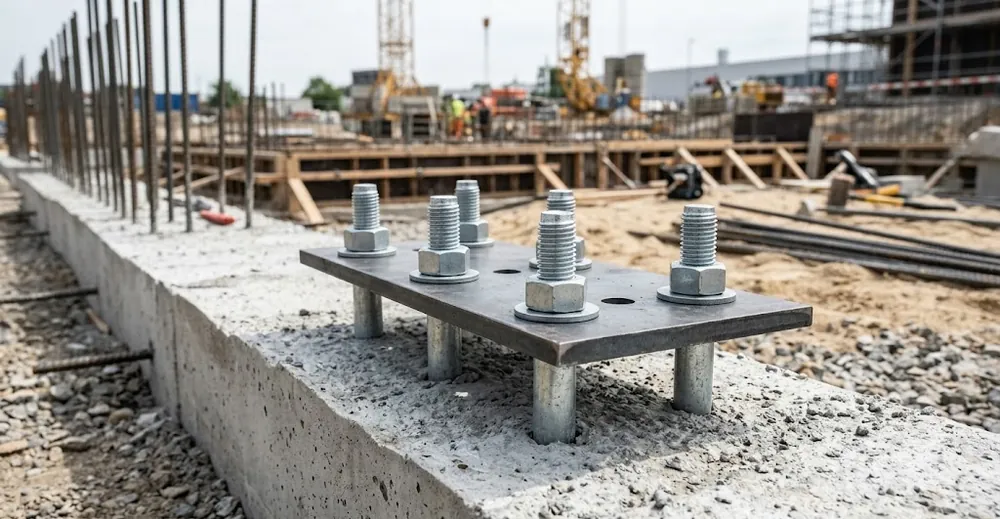
Before we go further, one rule sits above everything else. Every dimension you order should come from the structural drawing and the anchorage design stamped by your engineer. We manufacture to that design. We do not replace it. Where we mention typical relationships below, treat them as background for a conversation with your engineer, not as a substitute for the numbers on your plan.
What do embedment, projection and edge distance actually mean?
These three terms describe where the bolt lives in relation to the concrete. Get them clear and the rest of the job falls into place.
Embedment depth is the vertical distance from the top surface of the concrete down to the bottom of the bolt, or more precisely to the load-bearing feature such as the hook, the bend, or the plate and nut on a headed anchor. This is the working length. It transfers tension out of the steel and into the concrete mass. When people talk about "how deep the anchor is," this is the number they mean.
Projection is the opposite end. It is the length of threaded bolt that stands proud above the finished concrete. Projection has to be long enough to pass through whatever sits on top, the base plate, the leveling nut, the washer, the top nut, plus a little thread showing for inspection. Too short and the nut will not engage full threads. Too long and you waste steel and invite bent bolts on a busy site.
Edge distance is the horizontal measurement from the center of the bolt to the nearest free edge of the concrete. Concrete is strong in compression but weak in tension near a corner or an edge. A bolt set too close to the edge can blow out a cone of concrete long before the steel ever yields.
Add these up along the bolt and a pattern emerges: total bolt length roughly equals embedment plus the concrete cover you lose at the top plus projection. That simple sum is where most ordering mistakes begin.
Why does embedment depth matter so much?
Embedment matters because it controls the two failure modes that engineers worry about most: pull-out and concrete breakout. A shallow bolt fails by dragging its hook or head straight up through the concrete. A bolt with proper embedment forces any failure to spread across a much larger cone of concrete, which takes far more force to break.
Think of it as leverage against the concrete's own weight and internal strength. The deeper the embedment, the bigger the imaginary cone of concrete that a tension load has to lift or crack. That is why a deeper anchor in the same slab resists more uplift. It is also why simply choosing a longer bolt without changing its embedment does nothing for capacity. The steel above the concrete is not what holds the structure down.
In our own production experience, the most common field problem is not a weak bolt. It is a correctly made bolt set at the wrong depth. A template that floats up during the pour, or a bolt cage tied a few centimeters high, quietly steals embedment. The part passes inspection on paper, but the anchorage the engineer designed no longer exists in the concrete. This is why we stamp lengths clearly and why we push customers to control depth at the setting stage, not the ordering stage alone.
How does bolt diameter relate to embedment and projection?
Diameter, embedment and projection move together, and engineers usually express embedment as a multiple of bolt diameter. Larger diameter bolts generally need proportionally deeper embedment to develop their higher strength, though the exact multiple always comes from the anchorage calculation, never from a rule of thumb.
Here is a practical way to picture the relationships. The table below shows typical planning ranges we see across common structural jobs. These are for orientation only. Your engineer's stamped drawing governs the real figures.
| Bolt diameter | Typical embedment planning range | Typical projection to plan for |
|---|---|---|
| 1/2 in (M12) | 8 to 12 x diameter | Plate + nut + washer + ~1 thread |
| 5/8 in (M16) | 8 to 12 x diameter | Plate + nut + washer + ~1 thread |
| 3/4 in (M20) | 10 to 12 x diameter | Plate + nut + washer + ~1 thread |
| 1 in (M24) | 12 x diameter or more | Plate + nut + washer + ~1 thread |
Notice that embedment scales with diameter while projection scales with what sits on top of the concrete. A one inch bolt carrying a thick base plate and a leveling nut needs more projection than a half inch bolt under a thin bracket, even though both might follow a similar embedment multiple. When you send us a request, give us both the anchorage design depth and the stack of hardware above the pour. We cut the total length from those two facts.
How much projection should you leave above the concrete?
Projection should cover every layer of hardware plus enough thread for the nut to fully engage and for an inspector to see thread past the nut. In practice you add up the base plate thickness, any grout or leveling nut, the top washer, the height of the top nut, and a small margin, then round to a sensible length.
The margin matters more than people expect. A leveling nut setup, where the plate sits on a lower nut and is locked by an upper nut, needs extra thread on both sides of the plate. Skip that allowance and the crew arrives to find the plate will not seat, or the top nut runs out of thread before it is tight. Because we cut and thread to order, we would rather have the full hardware stack from you up front than ship a batch that is a few threads short.
There is a quiet cost to too much projection as well. Long exposed threads on a jobsite get bent by scaffolding, knocked by material handling, and rusted before the plate ever lands. On galvanized bolts, damaged thread also means damaged coating right where corrosion loves to start. We generally advise ordering the projection your design needs plus a modest allowance, not the longest bolt that will fit.
How close to the edge can an anchor bolt sit?
Edge distance limits how near a bolt can be to a free concrete edge before the concrete, not the steel, becomes the weak link. A bolt set too close can shear out a wedge of concrete under load, so anchorage designs always specify a minimum edge distance and often a minimum spacing between bolts as well.
Two factors drive the requirement. First, tension near an edge can crack a cone of concrete sideways instead of pulling a full cone from the mass. Second, shear loads pushing toward the edge are especially unforgiving, because there is little concrete left to resist the push. This is why bolts near slab edges, pier tops and pedestal corners get so much attention on the drawing.
From a manufacturing standpoint, edge distance rarely changes the bolt we make. It changes the template and the layout. When a pattern crowds a pedestal, the fix is usually a tighter, more rigid template and careful placement, not a different bolt. Still, tell us if you are working near edges. It affects how we recommend you jig and brace the assembly, and sometimes it nudges the whole bolt group toward a smaller diameter at deeper embedment to keep clearances legal.
How do you set anchor bolts to hold these dimensions?
You hold embedment, projection and edge distance with a template, a rigid bolt cage or fixture, and a check before, during and after the pour. A template is a plate or timber jig, drilled to the exact bolt pattern, that fixes the bolts in plan and holds them at the right height while the concrete is placed and vibrated.
A reliable setting routine looks like this:
- Confirm the bolt pattern, embedment and projection against the stamped drawing before anything is tied.
- Assemble the bolts into a template so the pattern and projection are locked together as one unit.
- Set the template to the correct top-of-concrete elevation and brace it so it cannot float up when concrete is placed.
- Verify edge distances and diagonals with a tape before the pour, because it is nearly free to fix now and very expensive to fix later.
- Recheck projection and pattern right after the pour, while the concrete is still workable enough to make small corrections.
The template is where good bolts earn their keep. We supply bolts with clean, consistent thread and accurate overall lengths precisely so that a template built to your drawing gives repeatable results across every base plate. If you need matched sets, we mark and bundle bolts by pattern so the crew is not sorting loose parts at the edge of a fresh pour.
Frequently asked questions
Does a longer anchor bolt automatically hold more load? No. Capacity comes from embedment depth and the concrete around the buried portion, not from total length. Extra length above the concrete becomes projection, which only serves the hardware stack. If you need more holding power, you change the embedment and diameter in the anchorage design, then order to that. A longer bolt with the same embedment holds the same load.
Can you tell me the exact embedment my job needs? We cannot, and no honest manufacturer should. Embedment comes from the anchorage design your engineer stamps, using the concrete strength, load and edge conditions specific to your project. We build precisely to that depth and projection. Send us the drawing numbers and the hardware stack above the pour, and we will cut, thread and mark the bolts to match.
What happens if the projection ends up too short? Too little projection means the top nut cannot fully engage, and inspectors flag the missing thread. On a leveling nut detail it can stop the base plate seating at all. The fix in the field is ugly: couplers, welded extensions or re-drilling. Far cheaper to give us the full plate, grout, washer and nut dimensions so we set projection right before cutting.
Why is edge distance on my drawing larger than I expected? Edge distance protects against concrete breakout near a free edge, where the concrete can fail before the steel. Piers, pedestals and slab corners leave less concrete to resist the load, so designs push the bolt inward or demand a bigger pedestal. It is a concrete limit, not a steel limit, which is why a stronger bolt does not shorten it.
Do galvanized and plated anchor bolts change these dimensions? The coating does not change embedment, projection or edge distance, which are set by the anchorage design. It does affect thread fit and long-term durability, so we account for coating thickness when threading. If you are weighing finishes, match the coating to the exposure and the nut fit rather than to the dimensions, since those come straight from the drawing.
Set it right, order it once
Embedment holds the load, projection serves the hardware, and edge distance keeps the concrete honest. Order from your stamped drawing, control depth with a braced template, and you will set anchor bolts that pass inspection the first time. Send us your pattern, embedment, projection and hardware stack, and we will manufacture matched, marked bolts to suit. Request a quote and we will turn your anchorage design into parts ready for the pour.
