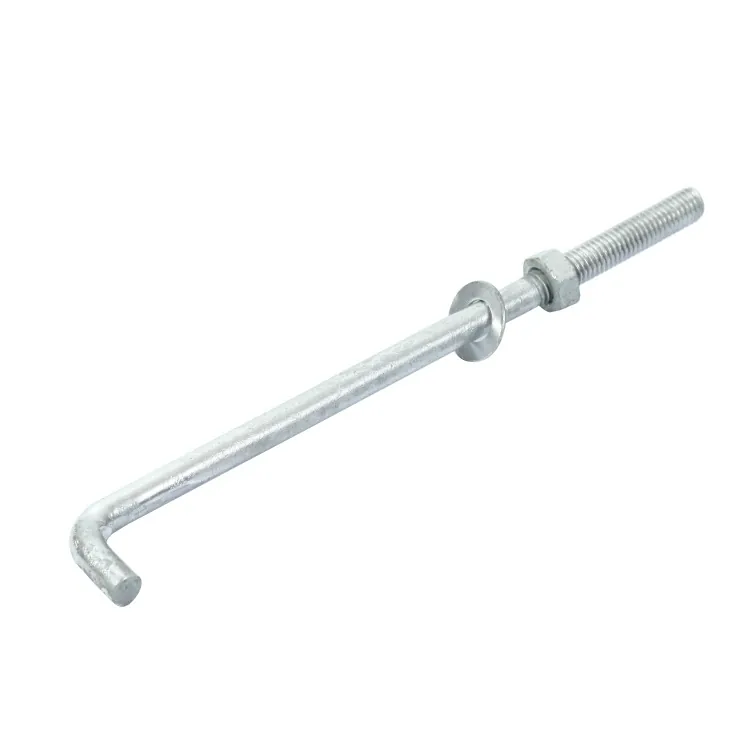
At Hebei Leeter Import and Export Co., Ltd ("Leeter"), a Dingzhou-based anchor manufacturer supplying North American and European projects since 2006, we get this question weekly from steel fabricators and contractors. This guide explains where corrosion actually attacks anchor bolts, how to select a finish, and how to detail the connection so the protection lasts.
Why the embedded portion is usually protected
Concrete does two useful things for buried steel. It surrounds the bar with a physical barrier, and it creates a highly alkaline environment, typically around pH 12 to 13, that passivates the steel surface and stops rust from forming. As long as the cover is sound, uncracked and thick enough, the embedded shaft and hook of a cast-in anchor can last for decades with no coating at all.
Problems start when that protection breaks down. Chlorides from de-icing salt or seawater can migrate through the cover and destroy the passive layer. Carbonation slowly lowers the concrete pH near the surface. Cracks give water a direct path to the steel. Insufficient cover leaves the bar close to the exposed face. In each case the failure is a concrete detailing problem first, and a coating problem second.
For most dry interior slabs and well-detailed foundations, the embedded steel is not where you should spend your protection budget. Spend it above the concrete.
Where does anchor bolt corrosion actually start?
Corrosion concentrates at the transition zone: the projecting thread, the leveling nut, the base-plate washer and the top nut. This is the region that stays wet longest and dries slowest, and it is fully exposed to air. Water ponds on the base plate, wicks into thread gaps, and sits under washers where oxygen access varies. That differential creates the ideal setup for pitting and crevice corrosion.
A few specific hot spots deserve attention.
The grout line and cold joint
The line where the projection meets the top of the concrete or grout pad is the classic first-rust location. If grout shrinks or cracks, a thin gap forms and traps water against the shaft just below the nut. That trapped moisture, with limited drying, drives localized attack right at the most highly stressed section of many connections.
Threads under the nut
Threads are hard to coat evenly and easy to damage during installation. A scratched galvanized thread, or a cut thread on a plain bolt, exposes bare steel exactly where the clamping load concentrates. Field cutting of anchor projections after concrete placement is a common cause of premature rust because it removes the coating from the new cut face.
Splash and coastal zones
Anything within reach of wheel spray, wash-down water, or salt fog corrodes far faster than the general environment suggests. A bolt 300 mm above a de-iced parking deck, or on a structure within a kilometer of surf, sees repeated wet-dry chloride cycling. Those conditions demand a heavier finish than a sheltered indoor column would ever need.
How do you choose the right anchor bolt finish?
Match the finish to the exposure category, then verify it against the project specification and any galvanic pairing with the base plate and connected steel. The three common options for foundation bolt protection are plain (black) steel, electro zinc plating, and hot-dip galvanizing, and they sit on a clear ladder of durability and cost.
The table below summarizes how we guide customers when they ask which finish to order.
| Finish | Typical zinc thickness | Best exposure | Notes |
|---|---|---|---|
| Plain / black steel | None | Dry interior, fully embedded, temporary works | Cheapest; rusts once exposed to moisture |
| Zinc electroplated | Roughly 5 to 12 microns | Dry to mildly humid interior | Bright finish, thin layer, limited outdoor life |
| Hot-dip galvanized | Roughly 45 to 85 microns | Exterior, splash, coastal, high-humidity | Thick, abrasion-resistant, sacrificial protection |
| Galvanized + extra measures | HDG plus sealer or isolation | Severe marine, chloride-heavy | Pair with detailing, not coating alone |
A short way to read that table: if the projection will ever get wet outdoors, default to hot-dip galvanized. Zinc plating is a finish for dry indoor use and appearance, not for weather. Plain steel is fine fully buried or for temporary anchors that come out again.
Why hot-dip galvanizing works outdoors
Hot-dip galvanizing gives two layers of defense. First, the thick zinc coating is a physical barrier. Second, zinc is anodic to steel, so even at a scratch or cut edge the surrounding zinc corrodes preferentially and keeps the underlying steel protected. That sacrificial behavior is why a galvanized anchor bolt tolerates minor handling damage far better than a plated one. The coating also bonds metallurgically to the steel, so it resists the knocks of transport and installation.
Galvanizing is not free of trade-offs. The coating adds thickness, it needs a higher-strength grade check for very high-strength bolts to avoid hydrogen embrittlement risk, and it changes how the nut fits. That last point trips up a lot of first-time buyers.
How does galvanizing affect nut fit?
Hot-dip galvanizing adds real thickness to threads, so the nut and bolt threads cannot both be coated at full dimension and still assemble. The standard solution is to galvanize the bolt thread and then tap the nut oversize after galvanizing, so the coated bolt runs freely into the nut. Order galvanized bolts and galvanized, over-tapped nuts together as a matched set.
If you buy a galvanized bolt and try to run a standard, uncoated nut onto it, the nut will bind or gall on the thicker thread. If you force it, you strip zinc off the thread and reintroduce the bare steel you were trying to protect. Two practical rules follow.
First, always source the nuts, washers and bolt from the same finish batch, specified as an assembly. Second, do not chase or re-tap a galvanized bolt thread in the field to make a standard nut fit. That defeats the whole coating.
Washers matter too. A galvanized flat washer under the nut spreads load and keeps the sacrificial zinc present at the highest-stress bearing surface. Mixing a bright zinc-plated washer against a galvanized bolt in a wet location invites galvanic mismatch and uneven wear.
What detailing keeps the protection working?
Good detailing does more for long-term durability than upgrading the coating one step. Concrete cover, drainage and sealing control how much water ever reaches the steel. The finish is your backup, not your only line of defense. Aim to keep the transition zone dry, keep grout sound, and avoid trapping water against the projection.
Here are the details that make the biggest difference in the field.
- Provide adequate, uncracked concrete cover over the embedded portion so the passive layer stays intact.
- Slope the grout pad and base plate area so water drains away from the bolt rather than ponding around it.
- Use non-shrink grout and cure it properly to avoid the shrinkage gap at the grout line.
- Seal the joint between base plate, grout and concrete where standing water or wash-down is expected.
- Avoid field-cutting projections; if you must cut, re-coat the cut end with a zinc-rich repair compound.
- Keep dissimilar metals from bridging wet gaps, since galvanic pairs accelerate attack.
Handle and store anchors correctly
Protection can be lost before the bolt ever reaches the pour. Store anchors off the ground, under cover, and out of standing water. Do not drag galvanized threads across concrete or steel decking. Cap or wrap projecting threads until the nut goes on. Small habits on site keep the coating intact where it counts.
Match the coating to the whole connection
Think about the anchor as one part of a system that includes the base plate, the connected column and the fasteners. If the plate is galvanized and the bolt is plain, the plain bolt becomes the sacrificial anode and corrodes faster. Consistency across the connection avoids these unintended galvanic cells and gives a predictable service life.
Putting it together for a purchase decision
For a typical exterior structural column base in a temperate climate, a hot-dip galvanized bolt with matched over-tapped galvanized nuts and galvanized washers is a sound default. For a heated, dry interior mezzanine, zinc plating or even plain steel can be acceptable and cheaper. For coastal or heavily de-iced sites, keep the galvanized finish but add detailing, sealing and drainage so the coating is not fighting standing chloride water on its own.
When you specify, state the finish for the bolt, the nut and the washer explicitly, confirm the grade, and confirm that galvanized nuts are tapped for a galvanized bolt. Those three lines on a purchase order prevent most of the fit and corrosion complaints we see after delivery. If you want a second opinion on a finish for a specific exposure, request a quote and send the exposure conditions along with the bolt schedule.
Frequently asked questions
Do fully embedded anchor bolts need a coating?
Usually not for corrosion resistance alone. Sound, alkaline concrete with adequate cover passivates the embedded steel and keeps it from rusting. Coatings on the embedded portion are more about matching the finish of the exposed thread and covering the splash zone near the grout line. Cracked or low-cover concrete changes this and may justify galvanizing the full length.
Is zinc plating enough for outdoor anchor bolts?
Generally no. Electroplated zinc is a thin layer, often around 5 to 12 microns, and it wears through quickly under outdoor wet-dry cycling and chlorides. It suits dry interior use and appearance. For any exterior, splash or coastal exposure, hot-dip galvanizing gives a much thicker, sacrificial coating and a far longer service life on foundation bolts.
Why won't a standard nut fit my galvanized bolt?
Hot-dip galvanizing adds thickness to the threads, so a standard nut binds or galls on the coated bolt. Galvanized nuts are tapped oversize after coating to clear the thicker bolt thread. Always order galvanized nuts and washers matched to the galvanized bolt, and never re-cut the bolt thread in the field to force a standard nut on.
Where does anchor bolt corrosion usually start first?
At the transition zone above the concrete: the projecting thread, the nut and washer, and especially the grout line where water can be trapped in a shrinkage gap. This region stays wet, dries slowly, and is fully exposed to air and airborne chlorides. Field-cut projections are another frequent starting point because cutting removes the coating.
Can I cut galvanized anchor bolt projections on site?
You can, but you should avoid it where possible because cutting exposes bare steel at the new end. If a cut is unavoidable, clean the cut face and apply a zinc-rich repair coating to restore the sacrificial protection. Better practice is to order bolts at the correct projection length so no field cutting is needed.
Next step
The right anchor bolt finish is a short conversation, not a guess. Tell us the exposure, the grade and the connection detail, and we will recommend a matched bolt, nut and washer set that holds up for the life of the structure. To discuss a specific project or get pricing on galvanized anchors, request a quote and our team will follow up with a tailored recommendation.
